


With revenues from traditional circuit-switched voice lines steadily decreasing, service providers recognise that Ethernet access and related services represent the core of their future offerings. As a result they are shifting investment away from legacy data-services such as ATM towards flexible Ethernet access solutions. However, until recently Ethernet deployment and maintenance were an expensive endeavour compared to traditional alternatives - lack of sufficient remote network management solutions meant frequent on-location troubleshooting and maintenance.
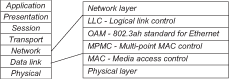
The recent ratification of the IEEE 802.3ah Ethernet in the First Mile (ETFM) testing standard offers significant opportunities for service provider OpEx reduction and quicker deployment of Ethernet services. This new standard created the OAM (operation and maintenance) sub-layer within the Ethernet/data link layer of the OSI protocol stack.
Test solutions based on the 802.3ah guidelines address all of the key challenges commonly encountered with Ethernet service deployment: reliability, performance, QoS, SLA assurance and network troubleshooting.
Key to the standard are specifications for remote loop-back testing to customer premises. This single-ended test technique permits proactive network management and speeds restoration of failed services. In addition to loop-back testing, 802.3ah also provides guidelines for remote failure and event notification, link monitoring statistics, diagnostics, and the ability to collect historical performance parameters from 802.3ah compliant elements. Because this standard emulates common DS1/3 access maintenance practices, ETFM management solutions are easily integrated into existing operations. As the 802.3ah standard is increasingly adopted by system, switch and broadband equipment suppliers, remote testing and monitoring is becoming straightforward and cost effective to deploy.
Access line management using the 802.3ah standard
Remote testing with 802.3ah involves three key elements:
1. A demarcation device located between the provider and customer networks;
2. A remote test-head capable of advanced performance evaluation and commissioning functions;
3. Management software capable of identifying and cataloguing demarcation devices and their location in the network to simplify test access.
Demarcation devices
The most common demarcation device is a network interface unit (NIU), which marks the hand-off between client and provider (see Figure 1). Ethernet layer-2 switches with 802.3ah compatibility may also be used as a demarcation device in some installations, but this is impractical if a single switch serves multiple clients (as in an office tower) or is owned by the customer. As low-cost devices, NIUs are most often the service providers' best choice for demarcation. A typical NIU installation is shown in Figure 1.

Several NIUs can be connected to a single carrier-provided switch to provide separate demarcations when there are multiple customers connected to a single access link as in Figure 2.
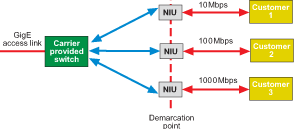
NIUs are often combined with media converters, providing optical to electrical conversion between the fibre access line and the copper-based 10/100 Mbps or Gigabit Ethernet commonly-used in enterprise environments. Advanced NIUs also provide rate conversion with bandwidth provisioning, allowing providers to remotely alter customer bandwidth on demand. 802.3ah compliant units can be remotely queried for usage information, link performance statistics, and will broadcast link failures and events to network management systems.
Ethernet test-heads
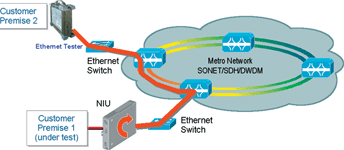
An Ethernet tester is required for remote 802.3ah link-testing. Compliant test-sets can activate loop-back mode in the NIU, allowing advanced performance and troubleshooting tests to be conducted from a central office or other relevant location. Two common examples are illustrated in Figures 3 and 4. Tests commonly performed include RFC-2544-compliant performance analysis (throughput, latency, frame lost, burst tolerance), BER testing, or application-specific tests such as packet-jitter for VoIP and other delay-sensitive applications.
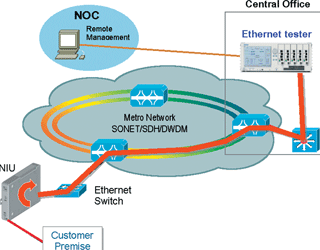
When customers report a problem with an Ethernet service, the cause is often related to events or constraints within the customer's network. Remote testing with an NIU allows service providers to quickly segment the network up to the customer premises, and subsequently determine if a network issue is within the access line (service provider's responsibility) or related to customer-side problems (no further support required). This technique significantly reduces truck-rolls to customer premises, decreases troubleshooting time, and results in faster service restoration. In recent studies with North American multiservice operators, maintenance costs associated with Ethernet services were reduced by up to 50% when 802.3ah remote test solutions were implemented.
Remote testing can also be used for commissioning, monitoring, and service level agreement (SLA) management, adding further value to the deployment of these solutions. Remote bandwidth provisioning is a typical example of the advantages of having an 802.3ah-based Ethernet access network. When a customer requests additional bandwidth on their access link, the related NIU is remotely accessed by the provider, and a message is sent to immediately increase the throughput available to the customer. The NIU is then put into loop-back mode, and remote Ethernet performance tests are conducted to ensure that the expected bandwidth is available. A series of tests are then conducted to ensure that revised SLA parameters will be met under various network conditions. With the new bandwidth assured and commissioned, the NIU is returned to pass-through mode and the customer's traffic passes over the upgraded link.
Management software
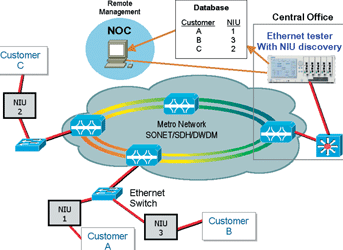
If a large number of NIUs are deployed in a provider's network, management software that can actively catalogue their location and status can greatly facilitate remote testing operations. Automated discovery schemes identify active NIUs in realtime and retrieve customer-related information stored in the units. Interoperability between this database and the Ethernet test set allows quick loop-back activation to any client on the network (see Figure 5).
Remote testing, commissioning, and SLA management with 802.3ah compliant solutions are the most cost effective Ethernet deployment tools available for multiservice providers. By leveraging the operational and maintenance extensions available through this new standard, operational expenditures can be greatly reduced, while increasing network availability, and reliability. Mean time to repair (MTTR), often a cornerstone of SLAs, can be substantially reduced when remote test solutions are deployed. The 802.3ah standard was designed as a scaleable standard to ensure Ethernet networks can reach their full potential as the future of providers' revenue-driving service offerings.
For more information contact Chris Nel, Lambda Test Equipment, +27 (0)12 349 1341, [email protected]
| Tel: | +27 12 349 1341 |
| Email: | [email protected], [email protected] |
| www: | www.lambdatest.co.za |
| Articles: | More information and articles about Lambda Test |






© Technews Publishing (Pty) Ltd | All Rights Reserved
 printer friendly version