


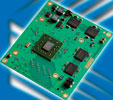
Kontron recently released the world’s first UGM (universal graphics module) based on AMD’s flagship GPU ATI R600.
The Kontron UGM-M72 is equipped with the 450-700 MHz version of the R600 core and delivers outstanding visualisation and multitasking features beyond integrated chipset graphics, combined with power saving features and long-term availability. It is designed for embedded and rugged mobile applications that call for short time to market.
High-end PEG features of the Kontron UGM-M72 include support of DirectX 10 and Shader Model to accelerate even the latest high-end 3D graphics for Windows Vista Aero, and beyond. The Kontron UGM-M72 presents spectacular full HD visualisation, with smooth surfaces, sharp images and high colour fidelity to provide realistic graphics.
Fully hardware-decoded streams, up to full HD 1920 x 1080 pixel resolution, will be supported by up to 512 MB/128 bit/500-800 MHz GDDR3, while the first available Kontron UGM-M72 variants are equipped with 256 MB/64 bit GDDR3. The module consumes no more than 25 W and is equipped with hardware-managed dynamic power modes and integrated Powerplay 7.0 power management technology, which offer outstanding performance-per-watt ratios for embedded applications and exceptional battery life for mobile rugged applications.
The key industries that demand high-end embedded modular graphics are medical and industrial imaging, gaming and entertainment machines, POS/POI terminals, commercial outdoor broadcasting, public facilities and high-end residential gateways.
The Kontron UGM-M72 is based on the new UGM standard that was first unveiled by Kontron and XGI in February at the Embedded World trade show in Germany. UGM is an open standard for embedded graphic modules and defines an 84 x 95 mm PCB, supplying monitors with the most up-to-date range of high-end graphics card signals.
Unlike conventional graphics cards that are plugged in at 90° to the baseboard, UGMs are connected parallel to the baseboard. This saves space and thereby allows for extremely flat and scalable designs. Even more importantly for users, UGMs offer availability of at least three to five years and the graphics functions, including drivers, are claimed to be particularly quick and easy to implement in custom designs.
UGM cards receive PCI Express signals and video signals via the 220 pins of the connector, which is also used for COM Express/ETXexpress Computer-On-Modules, over 1, 4, 8 or 16 lanes (PEG), and process them - including video capture functions and up to 1 GB of video memory - and then deliver the converted signals back to the baseboard, also via the connector. The UGM 1.0 specification currently supports Dual LVDS, Dual DVI, and Dual VGA as playback sources.
On the baseboard itself, the developer can decide which signal combinations will ultimately be made available to the external connection. For example, a combination of sound, USB, and DVI can be implemented via the HDMI interface. In terms of the graphics layout and driver development, all the developer has to do is to allocate the appropriate circuits, plugs, and any peripheral components needed for additional features, such as HDCP copy protection for the display of high-resolution, protected video material. The graphics processing core is already finished and all necessary drivers are already implemented.
This design also does away with cables completely. Thus, UGM stands out from current standard graphics cards where interfaces are led out via breakout cables because the narrow expansion card slot bracket does not offer enough room for external interfaces. Furthermore, with a 12-22 V d.c. power supply, the UGM specification allows for up to 72 W thermal design power. As a result, UGM can effectively support even the most high-end graphics applications with high frame rates and all graphics optimisation algorithms.
For more information contact Osiris Technical Systems, 0861 OSIRIS.
| Tel: | 087 093 2700 |
| Email: | info@osiris.co.za |
| www: | www.osiris.co.za |
| Articles: | More information and articles about Osiris Technical Systems |






© Technews Publishing (Pty) Ltd | All Rights Reserved
 printer friendly version