Epcos has announced it will start shipping niobium capacitors from volume production in late 2001 as a supplement to tantalum capacitors: it will be the first company in the world to manufacture this product.
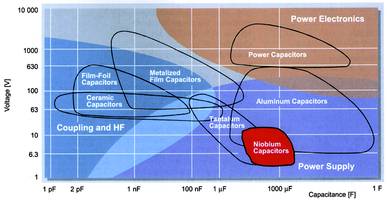
Two factors were decisive for the development of this type of capacitor, says Epcos, for which patents are pending: first, niobium oxide permits three times higher dielectric constants, so that capacitors can either be built significantly smaller or else three times the capacitance can be implemented in the same chip package. This makes 1500 µF at 10 V feasible in case size E it says.
The other reason lies in the continuing scarcity and dramatic rise in the price of tantalum powder, which is expected to top 200% in January 2001 alone. As around half the cost of the tantalum chips is determined by this rare raw material, a price increase is unavoidable. In contrast, niobium is currently estimated to be some thirty times more common than its close relative tantalum, according to the company, so that capacitors made of this can offer significant cost benefits.
Niobium technology represents an economical alternative for a number of applications in the sector of high-capacitance low-voltage capacitors
Niobium technology will gain a particularly strong foothold sectors such as mobile communications, telecom, data and consumer electronics as an economical alternative to tantalum - and in some cases also to low-voltage aluminium electrolytic capacitors. Current estimates suggest that around 10% of tantalum chips can be replaced by niobium. But Dr Werner Lohwasser, Head of Development of Tantalum Electrolytic Capacitors at Epcos, is certain that a separate market will develop for this product in view of its attractions.
Because niobium capacitors are still specified only to a temperature of 105°C, Epcos says that for now the important automotive market remains closed to them. However Lohwasser is confident: "It is quite likely that we will clear the important hurdle of 125°C in the next development stage of niobium technology so that we will be able to tap the enormous application potential of automotive electronics."
Space saving SMD common-mode chokes Electrocomp
Passive Components
TDK Corporation presents the EP21 series of flat-wire double chokes designed for common-mode EMI filtering and available in an SMD format with dimensions of only 23,8 x 17,7 mm and heights ranging from 21,6 to 22,3 mm
Read more...From the editor's desk: Inspiring the next generation Technews Publishing
News
Welcome to the August issue of Dataweek. Peter Howells is still on leave, so I am back for this issue. I hope you enjoy the content and find value in it.
August is Women’s Month in South Africa, ...
Read more...Procurement is becoming a competitive advantage RS South Africa
News
As mining, manufacturing and industrial businesses continue to navigate rising costs, supply chain disruption and increasing pressure to improve operational performance, procurement and inventory management have become strategic business priorities rather than simply administrative functions.
Read more...Omniflex delivers ICCP systems across London Omniflex Remote Monitoring Specialists
News
Omniflex has supplied impressed current cathodic protection (ICCP) systems for a range of prominent buildings across London, helping to protect reinforced concrete structures from corrosion and extending their service life.
Read more...MTN celebrates 80 Western Cape digital graduates
News
Eighty unemployed young people from across the Western Cape have successfully completed MTN South Africa’s Digital Skills for Digital Jobs (DS4DJ) programme, earning accredited qualifications in Data Analytics, Systems Development and Cybersecurity.
Read more...Rooibos heads to space
News
A South African scientific initiative linking agriculture and space research has officially launched today with the Rooibos in Space programme at Parklands College’s Innovation Centre in Cape Town.
Read more...From the editor's desk: Local can be international Technews Publishing
Editor's Choice News
Welcome to the July 2026 issue of Dataweek. As you can see from this introduction, Dataweek’s regular editor, Peter Howells, is on extended leave and I am filling the void in his editor’s column – hopefully without being too boring.
While every effort has been made to ensure the accuracy of the information contained herein, the publisher and its agents cannot be held responsible for any errors contained, or any loss incurred as a result. Articles published do not necessarily reflect the views of the publishers. The editor reserves the right to alter or cut copy. Articles submitted are deemed to have been cleared for publication. Advertisements and company contact details are published as provided by the advertiser. Technews Publishing (Pty) Ltd cannot be held responsible for the accuracy or veracity of supplied material.









 printer friendly version