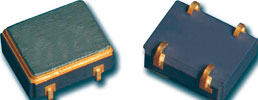
Precision Devices (PDI) has announced the introduction of a newly designed and developed ceramic J-lead crystal clock oscillator. The new J-lead package has been introduced to enable compliance with stringent type approvals.
Development and implementation of an enclosed quartz crystal design has enabled PDI to introduce a new design that compares favourably with existing hybrid IC technology which employs an open crystal blank construction. The new enclosed design provides good crystal ageing characteristics and enhances hermetic performance.
Supporting a frequency range of 750 kHz to 200 MHz, the compact 7,4 x 8,9 mm JL4 J-lead package, available with an operating voltage of 2,5 V or 3,3 V and an operating temperature range up to -55°C to 125°C, makes this clock oscillator suited to high end commercial, aviation, space flight and military applications.
The new oscillator has successfully met the environmental and screening test requirements for Class type S as required for space flight. The test requirements for Class S approval include rigorous random vibration, high frequency sine-vibration, mechanical shock and temperature cycling test profiles. The J-lead package termination method also allows the oscillator to comply with the NASA-STD-8739.3 technical standard which ensures the physical integrity and continuity of solder connections used in flight hardware and mission critical ground support equipment. The J-lead design also exceeds the 5000 G-force acceleration requirement described in many missile and rocket propulsion applications.
More room to scale Altron Arrow
Power Electronics / Power Management
With the latest STM32H5 lines from STMicroelectronics, you can now scale within the same platform, from a compact 1 Mbyte device to higher-memory MCUs for graphics-rich and feature-heavy designs.
Read more...Quick and easy shielding Würth Electronics South Africa
Electronics Technology Manufacturing / Production Technology, Hardware & Services
Würth Elektronik expands its EMC product portfolio with nanocrystalline WE-FNCS sheets.
Read more...Multi-constellation GNSS module in a legacy-compatible footprint Altron Arrow
Telecoms, Datacoms, Wireless, IoT
Telit Cinterion has announced the SE869eK2L, a single-frequency L1 GNSS module designed to help device manufacturers upgrade legacy positioning designs with improved performance and cost efficiency, while preserving design continuity.
Read more...Compact SSI family for industrial automation Altron Arrow
Passive Components
Infineon Technologies has introduced the ISSI20BxxF Solid State Isolator (SSI) family, bringing solid-state isolation technology into high-volume applications traditionally served by photovoltaic isolators (PVIs), photovoltaic relays (PVRs), and electromechanical relays (EMRs).
Read more...Rev 2.0 PolarFire FPGA ethernet sensor bridge Altron Arrow
Computer/Embedded Technology
Smaller, multi-camera platform enables scalable Ethernet architectures for NVIDIA Edge AI systems, while lowering power, cost and integration complexity.
Read more...Universal IR receiver module Altron Arrow
Telecoms, Datacoms, Wireless, IoT
Vishay Intertechnology has introduced a new series of infrared (IR) receiver modules for IR remote control applications, which feature a wide modulation frequency acceptance from 30 kHz to 68 kHz.
Read more...Low profile SMD antenna Altron Arrow
Telecoms, Datacoms, Wireless, IoT
The Havok PCS.06.A antenna, from Taoglas, is a low profile SMD LTE/cellular 4G/3G/2G embedded antenna designed for direct SMD mount on a device PCB.
Read more...Accelerate development of physical AI deployments Altron Arrow
DSP, Micros & Memory
With Avocado OS now available on the HummingBoard RZ-V2N-
AIoT and SolidSense AIoT V2N from SolidRun, teams can move from prototype to deployed fleet in weeks.
Read more...Universal NFC device Altron Arrow
DSP, Micros & Memory
Delivering high-end performance in a compact 4 x 4 mm package, the multipurpose NFC reader from ST Microelectronics, enables the convenience of contactless interaction and features for various end applications.
Read more...Compact direct Time-of-Flight 3D LiDAR module Altron Arrow
AI & ML DSP, Micros & Memory
The VL53L9 from STMicroelectronics is the first direct Time-of-Flight (dToF) 3D LiDAR all-in-one module in ST’s portfolio, offering a resolution of 2,3K zones, wide field of view, on-chip processing, 100 frames per second, and sensing range from 5 centimeters to 9 meters.
While every effort has been made to ensure the accuracy of the information contained herein, the publisher and its agents cannot be held responsible for any errors contained, or any loss incurred as a result. Articles published do not necessarily reflect the views of the publishers. The editor reserves the right to alter or cut copy. Articles submitted are deemed to have been cleared for publication. Advertisements and company contact details are published as provided by the advertiser. Technews Publishing (Pty) Ltd cannot be held responsible for the accuracy or veracity of supplied material.









 printer friendly version