The new DS3102 from Maxim is said to be the industry's first timing-card IC to provide full carrier-class, Stratum 3 clock synchronisation for G.8262-compliant synchronous Ethernet (Sync-E) equipment.
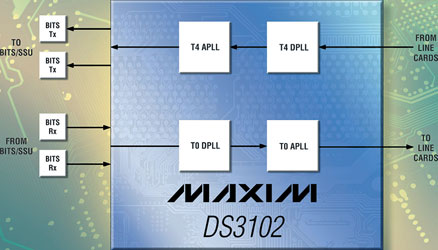
The device features two independent DPLLs (digital phase-locked loops), one for creating the main system clock and one for generating derived DS1/E1 clocks to send to an external BITS/SSU through DS1/E1 transceivers. The device provides impressive frequency agility, while supporting all common system clock rates for SONET/SDH, PDH, synchronous Ethernet, and wireless base stations. It is suitable for use in timing cards in a wide variety of wireline and wireless systems, including ADMs, digital cross-connects, carrier-class switches and routers, wireless base stations, DSLAMs, and multiservice access nodes.
The DS3102 continually monitors up to eight input clocks, each of which can be assigned to either of the two internal DPLLs. Inputs are continuously monitored for activity and frequency and can be automatically qualified and disqualified by the device according to configurable criteria. The eight clock inputs accept all common telecom clock rates, as well as all multiples of 2 kHz up to 131,072 MHz, and all multiples of 8 kHz up through 155,52 MHz (differential) or 125 MHz (single-ended).
The chip can simultaneously produce a total of seven output-clock frequencies plus 2 kHz and 8 kHz frame pulses. Each output clock can be frequency-locked to either of the two DPLLs. The output clocks have the same frequency options as the input clocks, plus differential-signal rates as high as 312,5 MHz. In addition, programmable synthesis engines can produce any multiple of 2 kHz up to 77,76 MHz, any multiple of 8 kHz up to 311,04 MHz, any multiple of 10 kHz up to 388,79 MHz, and many other frequencies as needed.
The DS3102 has an SPI-compatible serial interface and is packaged in an 81-lead, 10 x 10 mm BGA. It is fully specified over the -40°C to +85°C temperature range, and an RoHS-compliant package option is available.
Macom targets broadband radar with time delay MMIC RFiber Solutions
Telecoms, Datacoms, Wireless, IoT
Macom’s MADU FR1012 is a GaAs MMIC 1-bit true time delay device covering 4 GHz to 12 GHz, designed for broadband microwave systems where beam accuracy and signal integrity are critical.
Read more...Compact analogue phase shifter RF Design
Telecoms, Datacoms, Wireless, IoT
The Mini-Circuits JSPHS-150+ is a compact analogue voltage-controlled phase shifter designed for narrowband RF applications between 100 and 150 MHz.
Read more...Wireless connectivity expanded iCorp Technologies
Telecoms, Datacoms, Wireless, IoT
Espressif Systems has introduced two new members of its ESP32 wireless SoC family: the ESP32-E22, the company’s first Wi-Fi 6E connectivity chip, and the ESP32-H21, an ultra-low-power Bluetooth LE microcontroller aimed at coin-cell and battery-powered devices.
Read more...Integrated X-band radar front-end module RF Design
Telecoms, Datacoms, Wireless, IoT
Qorvo has introduced an X-band radar front-end solution that enables defence system designers to achieve higher performance without increasing size, weight or prime power.
Read more...Introducing Aurata CST Electronics
Telecoms, Datacoms, Wireless, IoT
Antenova has launched Aurata SR4L112: a compact, high efficiency embedded 4G/LTE antenna engineered for long, narrow PCB designs.
Read more...Multi-constellation GNSS module in a legacy-compatible footprint Altron Arrow
Telecoms, Datacoms, Wireless, IoT
Telit Cinterion has announced the SE869eK2L, a single-frequency L1 GNSS module designed to help device manufacturers upgrade legacy positioning designs with improved performance and cost efficiency, while preserving design continuity.
Read more...Quectel expands 5G portfolio iCorp Technologies
Telecoms, Datacoms, Wireless, IoT
Quectel expands 5G portfolio with new Qualcomm- and UNISOC-based modules.
Read more...Compact RTK design: More than just the receiver iCorp Technologies
Editor's Choice Telecoms, Datacoms, Wireless, IoT
In practice, engineers building compact RTK products keep discovering the same thing: the hardest component in the system is no longer the receiver. It is the antenna.
Read more...Microchip advances Space-Grade timing performance ASIC Design Services
Telecoms, Datacoms, Wireless, IoT
Microchip Technology has expanded its atomic clock portfolio with the radiation-tolerant Space CSAC-SA65, a Chip Scale Atomic Clock designed to deliver precise timing for space systems.
Read more...Channel emulator for 6 G and Wi-Fi 7/8 Concilium Technologies
Telecoms, Datacoms, Wireless, IoT
With 400 MHz instantaneous bandwidth and support for carrier frequencies up to 23,6 GHz, Vertex 6.0 is the industry’s first channel emulator designed for next generation 6 G and Wi-Fi 7/8 testing.
While every effort has been made to ensure the accuracy of the information contained herein, the publisher and its agents cannot be held responsible for any errors contained, or any loss incurred as a result. Articles published do not necessarily reflect the views of the publishers. The editor reserves the right to alter or cut copy. Articles submitted are deemed to have been cleared for publication. Advertisements and company contact details are published as provided by the advertiser. Technews Publishing (Pty) Ltd cannot be held responsible for the accuracy or veracity of supplied material.









 printer friendly version