Thermally-conductive phase-change interface materials nad heatsink effectiveness
29 June 2005
Manufacturing / Production Technology, Hardware & Services
Semiconductors can generate significant amounts of heat during operation which leads to an increase in junction temperature. If appropriate measures are not taken to dissipate this heat, the component's performance is critically affected, and can ultimately lead to its destruction.
In order to dissipate heat, power semiconductors are mounted on heatsinks. However, the surfaces of semiconductors and heatsinks are not generally flat and smooth, and a good heat contact cannot be obtained without taking special measures such as grinding the contact surfaces. In many applications, the component must also be electrically-insulated from the cooling surface. This requires an electrically-insulating material having a low thermal resistance.
Kunze, located in Munich, Germany, is a recognised leader in customised heat management solutions. The company manufactures a range of phase change interface materials that conduct a change of phase from a solid state to a soft state from a certain temperature - the so-called phase-change-temperature. Because phase-change materials expand after having passed the phase-change-temperature, if inserted between the heatsink and the component, they fill all air voids and expel the air pockets from the contact surfaces' micro-pores, wetting out the complete surfaces.
Through pressure and expansion of the material, this layer becomes very thin, resulting in minimal thermal contact resistance. Both the thermal contact and total thermal resistances remain then, forever very low - at all temperature cycles, even when the temperature drops under the phase-change-temperature point.
Kunze phase-change interface materials have no electrical insulation properties. They are made either of pure phase-change material or used in combination with highly thermally-conductive metals.
Aluminium with phase-change coating
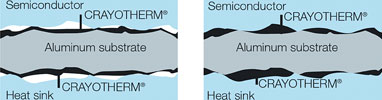
One of the Kunze lines is the 'Heatpad KU-ALC and KU-ALF' products, which are both very thin aluminium foils, coated on both sides with the silicone-free, thermally-conductive polymer called 'Crayotherm'. This coating changes its state at about 60°C for KU-ALC and 51°C for KU-ALF, and becomes soft. Crayotherm expands in volume by about 15% to 20% once past the phase-change-temperature and complete wet-out of the contact surfaces takes place without outflow.
Figure 1. Picture on the left shows before first operation, unheated; picture on right shows the voids filled after first phase change
After the first phase-change has taken place and the material has expanded, it irreversibly remains in that condition throughout all following temperature cycles. Thus, a minimum thermal resistance and therefore a minimum total thermal resistance is permanently assured. The fact that Crayotherm is mixed with highly thermally-conductive graphite in the KU-ALF version, enhances this thermal result even more.
Types KU-ALC/S and KU-ALF/S have narrow acrylic adhesive stripes on the sides, to make mounting easier, and does not impair either the very good thermal flow effected by the Crayotherm, or the total thermal resistance.
Properties
This KU-ALC/ALF product demonstrates minimum thermal resistance through active wet-out of the interfaces by volumetric expansion of about 15-20% without outflow. It is silicone-free, with guaranteed coating thicknesses. Because of the aluminium substrate it is mechanically-stable, and can be replaced without special surface treatment. Cleaning is with isopropyl alcohol.
The product comes in all standard configurations, with or without adhesive strips on the edges. It can be stamped or cut according to customer specifications, or delivered in roll form.
Further reading:
High precision in-line conformal coating inspection system
MyKay Tronics
Manufacturing / Production Technology, Hardware & Services
Conformal coating is widely used to protect electronics from moisture or other environmental hazards. It is critical to know if coatings are properly applied; covering what is meant to be covered and not covering what should be exposed.
Read more...
Soldering day highlights
Manufacturing / Production Technology, Hardware & Services
JAPAN UNIX has published a new event report and highlight video from their UNIX SOLDERING DAY 2026 in Hungary. This event reflects on their commitment to supporting manufacturers not only through soldering automation systems, but also through technical education, live demonstrations, hands-on training, and practical engineering know-how.
Read more...
Clearing the Static: Electrostatic Discharge
Actum
Manufacturing / Production Technology, Hardware & Services
A cordless ESD (Electrostatic Discharge) wrist strap does not work by grounding the person in the same way as a traditional wired wrist strap. Instead, it works by reducing or balancing the static charge on your body so that you are less likely to discharge electricity into sensitive electronic components.
Read more...
Engineering trust in South Africa’s SMT sector
ZETECH ONE
Manufacturing / Production Technology, Hardware & Services
From a small Johannesburg start-up to a trusted SMT technology partner, Zetech One has spent four decades helping South African electronics manufacturers improve production quality, efficiency and reliability.
Read more...
The new reality of PCB material supply
Jemstech
Editor's Choice Manufacturing / Production Technology, Hardware & Services
How resilient manufacturing strategies are helping OEMs navigate a changing global supply chain.
Read more...
Streamlining Device Programming with the AutoBee-D1
Vepac Electronics
Manufacturing / Production Technology, Hardware & Services
The AutoBee-D1 desktop automated programmer is designed to simplify the programming of devices, while delivering consistent accuracy, high throughput and reduced manual intervention.
Read more...
Zero PFAS die attach paste
Testerion
Manufacturing / Production Technology, Hardware & Services
With silver price volatility increasing and sustainability requirements accelerating across semiconductor assembly, MacDermid Alpha Electronics Solutions introduces ATROX CD 560-1, a zero per- and polyfluoroalkyl substance (PFAS) alternate silver filler die attach paste.
Read more...
Precision jet printing for advanced PCB designs
MyKay Tronics
Manufacturing / Production Technology, Hardware & Services
Mycronic’s BA 01 small dot ejector delivers unmatched precision in solder paste jet printing for advanced PCB designs.
Read more...
Strengthening local electronics manufacturing through investment and innovation
Microtronix Manufacturing
Editor's Choice Manufacturing / Production Technology, Hardware & Services
Microtronix South Africa cements its commitment to local manufacturing with ongoing investments in production capacity, skills development, and job creation.
Read more...
Polypropylene pole-top boxes support smarter, more secure electricity networks
Manufacturing / Production Technology, Hardware & Services Enclosures, Racks, Cabinets & Panel Products
As South Africa accelerates the rollout of smart prepaid electricity metering, innovative enclosure technology from Power Process Systems (PPS) is helping utilities improve network security, reduce electricity theft and protect critical electrical infrastructure.
Read more...









 printer friendly version