RFICs for 4G and LTE cellular base stations
14 October 2009
Telecoms, Datacoms, Wireless, IoT
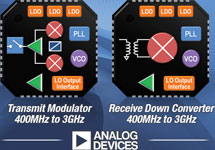
Analog Devices has introduced a series of highly integrated RFICs (radio frequency integrated circuits) designed for LTE lLong term evolution) and 4G cellular base stations.
LTE is a set of enhancements to the UMTS (universal mobile telecommunications system) standard and is considered to be the last step toward the fourth generation of radio technologies in cellular networks. As worldwide mobile carriers evolve toward 4G technologies, small higher-density radio card form factors are needed to support the delivery of continuous voice and high-data-rate services. AD’s new ADRF660x series of mixers and ADRF670x series of modulators enable these high-density radio cards by combining multiple discrete functional blocks into a single device, while meeting the demanding performance required by higher-capacity base stations.
The ADRF660x and ADRF670x series each début with four pin-compatible devices that cover the commonly used cellular 2G, 3G and LTE frequency bands and ease system design through integration, allowing for a common footprint PCB design for all cellular frequency bands and air interface standards.
The four ADRF670x products integrate a high dynamic range analog I/Q modulator, RF output switch and PLL (phase locked loop) with integrated VCO (voltage controlled oscillator) in one compact RFIC. The modulator input bandwidth of 500 MHz is capable of supporting either a specified band or complex IF up-conversion transmit signal paths. In addition, the modulator output supports a linear high output power level for wideband multicarrier LTE applications.
The four ADRF660x products integrate a high-linearity active RF mixer, RF input balun for single-ended 50 input and a PLL synthesiser with integrated VCO. The active mixer provides a voltage conversion gain of 6 dB, alleviating the need for additional IF amplification. The differential IF output is capable of supporting high IF frequencies up to 500 MHz. The ADRF660x series can be used for receiver path down-conversion and transmit path observation receiver applications.
All eight devices share a common SPI control interface and are software compatible. The integrated PLL is a multimodulus Fractional-N synthesiser designed to support LTE’s 100 kHz channel raster and offers low in-band phase noise. For added flexibility, all devices provide a buffered local oscillator (LO) output and allow the use of an external VCO.
Further reading:
Simplifying system design
iCorp Technologies
Telecoms, Datacoms, Wireless, IoT
The FGMC63N tri-band MCU Wi-Fi 6E module from Quectel addresses offers integrated connectivity across 2,4 GHz, 5 GHz, and 6 GHz bands in a compact, highly optimised design.
Read more...
Dragino’s connectivity catalogue
Otto Wireless Solutions
Telecoms, Datacoms, Wireless, IoT
Where Wi-Fi demands frequent charging and covers tens of meters, and traditional cellular consumes too much power for battery-operated nodes, LoRaWAN threads the needle.
Read more...
RF filters explained
RFiber Solutions
Telecoms, Datacoms, Wireless, IoT
As RF environments become increasingly crowded, RF filters play a critical role in maintaining signal quality, improving system performance, and ensuring reliable operation.
Read more...
Practical design strategies for 5G
RF Design
Telecoms, Datacoms, Wireless, IoT
The Cavli CQM211 aims to provide a platform that combines strong 5G connectivity with onboard compute capability, as well as interface flexibility that suits both new designs and rapid migrations from earlier products.
Read more...
GigaDevice expands optical communication portfolio
NuVision Electronics
Telecoms, Datacoms, Wireless, IoT
GigaDevice has introduced the new GD32E512 and GD32E252 series MCUs specifically designed for optical module applications.
Read more...
An industry-first Android 16 smart module solution
RF Design
Computer/Embedded Technology Telecoms, Datacoms, Wireless, IoT
The MeiG Smart SLM580 4G Smart Module features native support for Android 16 and covers core frequency bands in major countries and regions worldwide.
Read more...
High performance RF signal conditioning
RFiber Solutions
Telecoms, Datacoms, Wireless, IoT
The AM3269 from Mercury Systems is a high-performance RF preselector module designed to improve receiver sensitivity and signal integrity in demanding electronic warfare, signals intelligence, test, and communications applications.
Read more...
RF filters explained
RFiber Solutions
Telecoms, Datacoms, Wireless, IoT
As RF environments become increasingly crowded, RF filters play a critical role in maintaining signal quality, improving system performance, and ensuring reliable operation.
Read more...
GigaDevice expands optical communication portfolio
NuVision Electronics
Telecoms, Datacoms, Wireless, IoT
GigaDevice has introduced the new GD32E512 and GD32E252 series MCUs specifically designed for optical module applications.
Read more...
Industrial connectivity without compromise
Telecoms, Datacoms, Wireless, IoT
The IR315 combines 4G LTE, Wi-Fi, Ethernet, and VPN technologies into a rugged, industrial-grade platform that enables seamless connectivity across a wide range of applications.
Read more...









 printer friendly version