

Computer/Embedded Technology


Low-power LCDs

15 September 2010 Computer/Embedded Technology

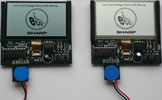
Through an integrated image memory, Sharp’s ‘Memory LCDs’ purportedly only require around 1% of the power of conventional TFT LCDs and are therefore particularly suited for low-power use. The lineup of 1,35 to 6,02-inch variants covers a broad range of applications.

In addition to the 1,35-inch model (LS013B4DN02) introduced last year, Sharp is introducing further Memory LCDs in new sizes: two 2,7-inch (LS027B4DN01, LS027B4DH01) displays with a resolution of 400 x 240 and a 2,94-inch (LS029B4DN01) model with a resolution of 456 x 240 pixels. Also new is a 6,02-inch model specifically addressing the e-books market and other portable reading devices. For this particular market segment, Sharp is supplementing the range with transflective and touch screen models. Unlike the usual reflective Memory LCDs, transflective memory LCDs offer the option of adding backlighting so that e-books or other applications can also be used in the dark.

These LCDs are based on Sharp’s Continuous Grain Silicon (CGS) technology which enables it to equip each pixel with a 1-bit memory that stores the image information uploaded onto the screen. Image information therefore only needs to be rewritten in those pixels in which the content has changed compared to the previous picture frame. As reflective displays, Memory LCDs do not require any backlighting. The combined effect means that memory LCDs only have 0,8% of the power consumption of conventional displays of the same size. A 1,35-inch Memory LCD uses 15 μW in operation, whereas a standard LCD of comparable size requires around 2 mW to display an image.

The LCDs offer a unique image representation. Unlike other reflective displays, this new type of LCD does not require any polarisers. Thanks to a special polymer network liquid crystal (PNLC) material, the image is generated by the status of the pixel changing from transparent to white with a reflectivity of 50%. This gives the display a silver-metallic appearance that is particularly suited to fashionable applications. With a slightly more conventional version of the Memory LCDs, polarisers and high-reflective (HR) liquid crystals are used. They supply a pure black-and-white image with excellent legibility and a broad viewing angle.

Thanks to their minimal consumption of power, small solar cells can supply sufficient electricity to run the new Memory LCDs. The new type of display is thus a suitable solution for small portable applications such as e-books, wristwatches, shelf labelling, heart rate monitors and other fitness devices. In order to simplify design-in, Sharp also offers memory LCDs as 3 V models so that when operated with conventional lithium ion re­chargeable batteries, no charge pump is required.

For more information contact Glen Nilsen, Arrow Altech Distribution, +27 (0)11 923 9600, [email protected], www.arrow.altech.co.za


Credit(s)


Share this article:
Share via emailShare via LinkedInPrint this page

Further reading:

What happens when trust can no longer live only in software?
Computer/Embedded Technology Electronics Technology
[Sponsored] For years, many enterprise security architectures treated hardware primarily as the execution layer, while software handled authentication, access control and trust decisions.

Read more...
EMC limits and levels
Altron Arrow Editor's Choice Circuit & System Protection
As soon as electronics and electrical systems started interfering with each other, the world had to come to some consensus. Considering physics is universal and does not care about what country electrical/electronic products are used in, it should be the same everywhere, right? It is nearly there, but not quite.

Read more...
Introducing STM32CubeMX2
Altron Arrow Design Automation
STMicroelectronics has launched STM32CubeMX2, a new evolution of its popular configuration and code generation tool for STM32 microcontrollers.

Read more...
Plug-in timing module
Comtest Computer/Embedded Technology
Microchip’s MD-990-0011-B timing module redefines the role of timing, making it possible for customers to seamlessly integrate advanced synchronisation at any stage of development.

Read more...
Next-gen SPE
Altron Arrow Telecoms, Datacoms, Wireless, IoT
Next-generation 100/1000BASE-T1 Single Pair Ethernet PHYs integrate MACsec security, time sensitive networking, and functional safety.

Read more...
Advanced Layer 2 industrial switches
Vepac Electronics Computer/Embedded Technology
The Raptor EP4200 and EP5200 series switches provide advanced Layer 2 switching capabilities with high performance and availability tailored for demanding critical infrastructure and energy applications.

Read more...
Industrial vibration sensing simplified
Altron Arrow Analogue, Mixed Signal, LSI
The IIS3DWBG1 from STMicroelectronics is a high performance, three-axis digital vibration sensor engineered for demanding industrial applications where accurate motion monitoring is essential.

Read more...
Cost-effective microcontroller series
Altron Arrow DSP, Micros & Memory
The STM32C5 series from STMicroelectronics delivers an excellent balance of performance, efficiency, and affordability for embedded designs that require more capability without increasing bill of materials cost.

Read more...
Understanding two key tools for cleaner serial data
Altron Arrow Editor's Choice Analogue, Mixed Signal, LSI
Understanding how pre-emphasis and equalisation works, and when to use one over the other, is critical when designing reliable high-speed systems.

Read more...
Connected without limits: An engineering perspective on Altron Arrow’s wireless ecosystem
Altron Arrow Editor's Choice Design Automation
Wireless connectivity is no longer a supporting technology, but rather, a core design consideration that underpins modern electronic systems across industries.

Read more...


While every effort has been made to ensure the accuracy of the information contained herein, the publisher and its agents cannot be held responsible for any errors contained, or any loss incurred as a result. Articles published do not necessarily reflect the views of the publishers. The editor reserves the right to alter or cut copy. Articles submitted are deemed to have been cleared for publication. Advertisements and company contact details are published as provided by the advertiser. Technews Publishing (Pty) Ltd cannot be held responsible for the accuracy or veracity of supplied material.


© Technews Publishing (Pty) Ltd | All Rights Reserved

