POL converters
10 November 2010
Power Electronics / Power Management
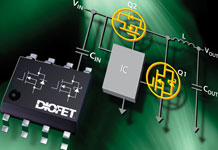
Diodes Incorporated has expanded its DIOFET product portfolio with the introduction of two dual-channel devices. The DMS3017SSD and DMS3019SSD integrate an optimised control MOSFET with a proprietary DIOFET into a single SO8 package to provide a high efficiency solution for point-of-load (POL) converters in consumer and industrial applications.
The low-side DIOFET device integrates a power MOSFET and anti-parallel Schottky diode into a single die. The typical low RDS(ON) of the DIOFET ensures that conduction losses are kept to a minimum, while its forward voltage (VSD) is 25% lower than comparable MOSFET/Schottky solutions, thereby further lowering conduction losses through the body diode during PWM dead time. The high-side MOSFET included in the DMS3017SSD and DMS3019SSD features low gate charge and fast switching, enabling high-side switching losses to be minimised.
The device characteristics enable them to deliver a point-of-load conversion efficiency of 94% under full load conditions, while at the same time reducing the parasitic inductance associated with co-packaged or externally mounted Schottky diodes.
Further reading:
Quality batteries are critical for IIoT
Uniross Batteries
Power Electronics / Power Management
Batteries intended for use in industrial operations must indeed offer complete reliability under extreme environmental conditions, resistance to vibration and harsh environments.
Read more...
12 kW hybrid inverter
Power Electronics / Power Management
Sungrow recently unveiled its next-generation residential energy storage solution, expanding its power range from 5 kW to 12 kW with the introduction of the new MG12RL hybrid inverter.
Read more...
40 W and 75 W railway DC/DC converter
Brabek
Power Electronics / Power Management
RECOM has announced two new cost-efficient DC/DC converters for the rail market with an ultra-wide 11:1 input range to cover all nominal input voltages from 24 to 110 V DC.
Read more...
Power modules for solid-state transformers
RS South Africa
Power Electronics / Power Management
Microchip’s new 3,3 kV silicon carbide modules deliver the required thermal performance and efficiency for SSTs to increase power available for token generation.
Read more...
Solving South African power problems with locally built intelligence
Editor's Choice Power Electronics / Power Management
Smart metering infrastructure in South Africa remains patchy. The rollout has been slow, coverage is inconsistent, and for the most part, granular per-unit measurement simply does not exist.
Read more...
Wide range power module
Power Electronics / Power Management
The latest DC-DC modules from Würth Elektronik are characterised by high resilience to voltage transients on the 24 V bus and an extremely wide input-voltage range from 3,5 V to 38 V.
Read more...
Selecting primary batteries for maximum service life
Uniross Batteries
Power Electronics / Power Management
Primary batteries play an important role in IoT applications. Designed for longevity, they have a high-energy capacity and are often used in standalone applications where charging is impractical or impossible.
Read more...
4 kW e-mobility DC-DC converter
Brabek
Power Electronics / Power Management
The RECOM RMOD4000 series of compact, plug-and-play DC-DC converters is a cost-effective solution to provide isolated 14 V, 28 V, or 56 V DC network rails from a high input voltage between 180 and 950 V DC.
Read more...
Aluminium case upgrade boosts performance
Vepac Electronics
Power Electronics / Power Management
The SQBF Quarter Brick 300 W DC to DC Converter is now available in a newly upgraded metal case designed to deliver improved durability and superior electrical performance across demanding applications.
Read more...
Extending the range of power converters
RS South Africa
Power Electronics / Power Management
Power Integrations recently announced a breakthrough in flyback topology extending the power range of flyback converters to 440 W - well beyond the limits that traditionally required more complex resonant and LLC topologies.
Read more...









 printer friendly version