

Passive Components


Voltage dividers and resistor networks

20 July 2011 Passive Components

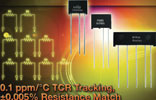
Vishay has released new 2-, 3- and 4-resistor voltage dividers and resistor networks in both Bulk Metal Foil and Z-Foil versions. The resistor arrays come in standard configurations, but with custom values and tolerances for all 13 possible schematic variations of two, three and four resistors.

For applications requiring maximum precision, the Z-Foil devices feature low absolute TCR of ±0,05 ppm/°C from 0°C to +60°C and ±0,2 ppm/°C from 55°C to +125°C, +25°C ref., TCR tracking to ±0,1 ppm/°C, matching tolerance to 50 ppm and PCR (R due to self heating) of 5 ppm at rated power. For a low thermal EMF of 0,05 μV/°C, the leads that emerge from the arrays’ packages connect directly to the resistance elements or an internal PC board. In addition, each element offers a wide resistance range from 1 Ω to 100 kΩ, and can be combined for even higher values. Finally, the elements retain all the advantages of discrete Bulk Metal Z-Foil resistors, plus the ability to be further sorted for TCR track and absolute matching before encapsulation.

The Z-Foil resistor arrays feature power ratings of 0,3 W per element at +125°C and resistance ratio stability to 0,001% at 0,05 W. The resistor networks offer a rise time of 1 ns, with effectively no ringing, a thermal stabilisation time of <1 s (nominal value achieved within 10 ppm of steady state value), current noise of 0,010 μVrms/V of applied voltage (<-40 dB), a voltage coefficient of <0,1 ppm/V and a non-inductive (<0,08 μH), non-capacitive design.

The networks are optimised as voltage dividers, bridges and attenuators in a wide range of military and aerospace, medical and high-temperature down-hole applications where performance and stability are important, including differential amplifiers, gain-defining resistors in digital voltmeters, ratio arms in bridge circuits, fuel metering and fire control instrumentation, binary ladders, and linear and linear-summing networks.

For applications that require only near-maximum stability, the standard foil resistor arrays feature a TCR of ±2 ppm/°C from -55°C to +125°C, +25°C ref., TCR tracking to ±0,5 ppm/°C and matching tolerance to 50 ppm. The devices offer a low thermal EMF of 0,05 μV/°C and a resistance range from 1 Ω to 150 kΩ. The standard foil resistor arrays feature power ratings of 0,3 W at


+125°C for resistance values to 100 kΩ, and 0,2 W for resistance values above 100 kΩ.

For more information contact Marian Ledgerwood, Future Electronics, +27 (0)21 421 8292, [email protected], www.futureelectronics.com


Credit(s)


Share this article:
Share via emailShare via LinkedInPrint this page

Further reading:

Advanced industrial connectivity at the edge
Future Electronics Computer/Embedded Technology
Dual 4K display capabilities, ultra-efficient processing, and versatile mounting options make the Intelli TWL01 Edge the ultimate embedded platform for multimedia solution building.

Read more...
Tiny power inductor for low noise applications
iCorp Technologies Passive Components
With the evolution of Bluetooth, chips, sensors and other technologies, the design of TWS earphones is becoming smaller and thinner, and the performance and size requirements of integrated inductors need to follow suit.

Read more...
Compact high precision magnetometer
Future Electronics Test & Measurement
Bosch Sensortec has introduced the BMM350, a compact 16-bit, 3-axis magnetometer engineered to deliver high accuracy, low noise, and exceptional energy efficiency in space constrained designs.

Read more...
Standalone USB PD controller
Future Electronics Power Electronics / Power Management
The STUSB4531 from STMicroelectronics is a standalone USB Power Delivery sink controller designed to streamline the implementation of USB-C power negotiation in sink devices without requiring a full software stack on a host microcontroller.

Read more...
Compact power MOSFET for high current switching
Future Electronics Power Electronics / Power Management
onsemi’s NTMFSC2D6N08X is a high-performance 80 V N-channel power MOSFET engineered for demanding switching and power conversion applications.

Read more...
Wide input step-down DC-DC converter
Future Electronics Power Electronics / Power Management
The DCP3601 from STMicroelectronics is a wide-input, synchronous step-down DC-DC converter designed for compact and efficient power conversion in industrial and embedded systems.

Read more...
Connector range for demanding environments
Future Electronics Interconnection
TE Connectivity’s DEUTSCH connector range offers high-performance interconnect solutions engineered for demanding environments where reliability and durability are essential.

Read more...
Future Electronics and SnapMagic announce CAD model integration to support faster design cycles
Future Electronics Design Automation
Engineers can now download verified symbols, footprints, and 3D models directly from supported product pages, enabling a smoother transition from component selection to PCB layout.

Read more...
High-endurance polymer tantalum capacitors
Passive Components
Panasonic Industry TDC Series POSCAP polymer tantalum capacitors deliver high endurance and reliable performance in demanding, high-temperature environments.

Read more...
Power MOSFET in a PowerFLAT package
Future Electronics Power Electronics / Power Management
The ST8L60N065DM9 from STMicroelectronics is a 600 V N-channel Super-Junction power MOSFET that offers excellent performance in a compact surface-mount package.

Read more...


While every effort has been made to ensure the accuracy of the information contained herein, the publisher and its agents cannot be held responsible for any errors contained, or any loss incurred as a result. Articles published do not necessarily reflect the views of the publishers. The editor reserves the right to alter or cut copy. Articles submitted are deemed to have been cleared for publication. Advertisements and company contact details are published as provided by the advertiser. Technews Publishing (Pty) Ltd cannot be held responsible for the accuracy or veracity of supplied material.


© Technews Publishing (Pty) Ltd | All Rights Reserved

