GUI development board
14 September 2011
Design Automation
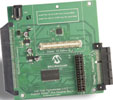
Microchip has developed the ‘low-cost controller-less (LCC) Graphics’ PICtail Plus daughterboard (AC164144), which enables the development of graphics applications without an external graphics controller.
The cost of integrating an external graphics controller to support touch-screen user interfaces can be prohibitive for highly competitive markets such as home appliances, consumer, automotive and industrial products. Based on a 32-bit PIC32 microcontroller (MCU), the new daughterboard enables developers to directly drive 256-colour (8 bits per pixel) graphical user interfaces using the PIC32’s on-chip memory, direct memory access controller and parallel master port. The board also enables developers to ‘jumper’ in the onboard 256 KB of SRAM to support 65K-colour (16 bits per pixel) WQVGA interfaces.
The new daughterboard can be used with an Explorer 16 development board or PIC32 starter kit, and can be connected to any of the LCD panels available from Microchip, including the Truly 3,2” QVGA and Powertip 4,3” WQVGA display panels. It is supported by Microchip’s free graphics library, making it easy to incorporate graphical user interfaces into industrial products such as control panels; home appliances such as coffee machines, washing machines and dryers; consumer thermostats, security-alarm panels and educational toys; and into driver information displays in the automotive market.
Further reading:
Advanced STM32 debugging in VS Code
Design Automation
Once an STM32 project is running in VS Code, the IAR C-SPY Debug extension adds a professional-grade analysis layer that scales with project complexity.
Read more...
Accelerate development of AI-enabled embedded systems
Design Automation
ADI’s CodeFusion Studio (CFS) is a modern embedded software development platform aimed at accelerating the creation of AI-enabled embedded systems.
Read more...
Introducing STM32CubeMX2
Altron Arrow
Design Automation
STMicroelectronics has launched STM32CubeMX2, a new evolution of its popular configuration and code generation tool for STM32 microcontrollers.
Read more...
AI assistant for STM32 developers
Design Automation
The STMicroelectronics STM32 Sidekick is an AI-driven assistant fully integrated into the STM32 ecosystem designed to streamline embedded development using STM32 microcontrollers.
Read more...
Connected without limits: An engineering perspective on Altron Arrow’s wireless ecosystem
Altron Arrow
Editor's Choice Design Automation
Wireless connectivity is no longer a supporting technology, but rather, a core design consideration that underpins modern electronic systems across industries.
Read more...
Next-gen robotic systems initiative
EBV Electrolink
Design Automation
EBV Elektronik recently introduced MOVE – Driving Robotics Forward, a new initiative designed by EBV Elektronik‘s Embedded Solutions team to support the development of next-generation robotic systems.
Read more...
Reference design for NB-IoT plus GNSS
Altron Arrow
Design Automation
ST Microelectronics’ STDES-ST87M01IGN is a reference design for the ST87M01 NB-IoT + GNSS module, implemented on a 2-layer FR4 PCB (90 x 60 x 1,6 mm).
Read more...
ST welcomes STM32Cube AI Studio
Design Automation
STMicroelectronics has introduced STM32Cube AI Studio, a new desktop software environment designed to simplify the deployment of artificial intelligence on STM32 microcontrollers.
Read more...
NeoCortec introduces new NeoGW software
Design Automation
This is a powerful multiplatform open-source solution designed to streamline integration between the NeoMesh network and upper-level systems, whether deployed in the cloud or on-premise environments.
Read more...
Keil Studio now in VSCode
Design Automation
Keil Studio, Arm’s latest IDE, now integrates embedded development tools directly into Visual Studio Code providing features like seamless industry tool integration, version control, and a CLI for CI workflows.
Read more...









 printer friendly version