

Power Electronics / Power Management


Uninterruptible power supplies

2 May 2012 Power Electronics / Power Management

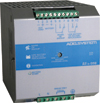
New from Adelsystem is the ‘all in one’ family of uninterruptible DC power supplies. The product offers reliable, consistent backup of the DC supply, and can be incorporated where frequent power outages or dips occur. These products are particularly useful where there is a PLC or other digital communication.

The DC UPS prevents the system from falling over due to power failures and negates the need to continuously reboot the system.

The system consists of three devices – the power supply, battery charger and backup module. The power supply section is a switched mode device. The battery charger circuit is microprocessor-based, and uses smart battery management to ensure the cells are in prime condition. Visual and relay outputs warn of battery problems or failure.

The backup module ensures that the available power is automatically allocated between the load and the battery. Supplying power to the load is the first priority of the unit, after that the power is used to charge the batteries. In power boost mode, power is available simultaneously from both the power supply and the batteries, making the maximum current available two times the rated current of the unit. This is used for short time periods of high current demand.
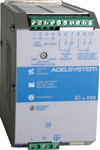
Wide input voltage (115–230 V a.c. or 400–500 V a.c ) coupled with a selection of output voltages (12, 24 and 48 V d.c.) reduces the spares holding requirements. Different versions offer from 3 to 20 A of current. Designed to offer safe operation, protection features such as short circuit and overload on the output, high insulation between primary and secondary, protection against deep battery discharge, protection against reverse polarity connection and detection of batteries with incorrect voltage are standard.

The battery charging circuit is microprocessor-based and contains charge curves for various types of batteries. Open lead acid cells, sealed lead acid cells, Gel and Ni/Cd types are all catered for. These curves are user selectable by means of jumpers. Multi-stage charging (with boost, trickle and recovery modes) ensures a fast recharge and also the recovery of deeply discharged batteries.

The maximum charging current to the battery is user adjustable by means of a potentiometer on the front of the unit. To protect the battery, the unit will shut down when the cell voltage reaches 1,5 V, avoiding deep discharge and battery damage. The unit also performs a battery life test and guarantees battery reliability by continually testing the internal impedance of the cells. The system, through a battery stimulation circuit, is able to detect sulphated batteries and those with short circuited cells.

LEDs and relays contacts are used to signal system conditions such as main or backup supply, battery flat, no mains supply, battery fault, low battery, battery charge mode and help. The devices are completely automatic and can be customised to meet the needs of the user and the requirements of the application. After installation it is possible to carry out functional software updates using a laptop computer.



Credit(s)


Share this article:
Share via emailShare via LinkedInPrint this page

Further reading:

Quality batteries are critical for IIoT
Uniross Batteries Power Electronics / Power Management
Batteries intended for use in industrial operations must indeed offer complete reliability under extreme environmental conditions, resistance to vibration and harsh environments.

Read more...
12 kW hybrid inverter
Power Electronics / Power Management
Sungrow recently unveiled its next-generation residential energy storage solution, expanding its power range from 5 kW to 12 kW with the introduction of the new MG12RL hybrid inverter.

Read more...
40 W and 75 W railway DC/DC converter
Brabek Power Electronics / Power Management
RECOM has announced two new cost-efficient DC/DC converters for the rail market with an ultra-wide 11:1 input range to cover all nominal input voltages from 24 to 110 V DC.

Read more...
Power modules for solid-state transformers
RS South Africa Power Electronics / Power Management
Microchip’s new 3,3 kV silicon carbide modules deliver the required thermal performance and efficiency for SSTs to increase power available for token generation.

Read more...
Solving South African power problems with locally built intelligence
Editor's Choice Power Electronics / Power Management
Smart metering infrastructure in South Africa remains patchy. The rollout has been slow, coverage is inconsistent, and for the most part, granular per-unit measurement simply does not exist.

Read more...
Wide range power module
Power Electronics / Power Management
The latest DC-DC modules from Würth Elektronik are characterised by high resilience to voltage transients on the 24 V bus and an extremely wide input-voltage range from 3,5 V to 38 V.

Read more...
Selecting primary batteries for maximum service life
Uniross Batteries Power Electronics / Power Management
Primary batteries play an important role in IoT applications. Designed for longevity, they have a high-energy capacity and are often used in standalone applications where charging is impractical or impossible.

Read more...
4 kW e-mobility DC-DC converter
Brabek Power Electronics / Power Management
The RECOM RMOD4000 series of compact, plug-and-play DC-DC converters is a cost-effective solution to provide isolated 14 V, 28 V, or 56 V DC network rails from a high input voltage between 180 and 950 V DC.

Read more...
Aluminium case upgrade boosts performance
Vepac Electronics Power Electronics / Power Management
The SQBF Quarter Brick 300 W DC to DC Converter is now available in a newly upgraded metal case designed to deliver improved durability and superior electrical performance across demanding applications.

Read more...
Extending the range of power converters
RS South Africa Power Electronics / Power Management
Power Integrations recently announced a breakthrough in flyback topology extending the power range of flyback converters to 440 W - well beyond the limits that traditionally required more complex resonant and LLC topologies.

Read more...


While every effort has been made to ensure the accuracy of the information contained herein, the publisher and its agents cannot be held responsible for any errors contained, or any loss incurred as a result. Articles published do not necessarily reflect the views of the publishers. The editor reserves the right to alter or cut copy. Articles submitted are deemed to have been cleared for publication. Advertisements and company contact details are published as provided by the advertiser. Technews Publishing (Pty) Ltd cannot be held responsible for the accuracy or veracity of supplied material.


© Technews Publishing (Pty) Ltd | All Rights Reserved
