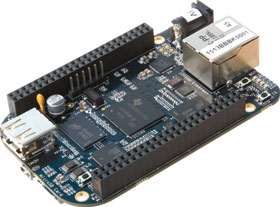
The new BeagleBone Black announced by Texas Instruments is a credit-card-sized Linux computer aimed at developers, makers, hobbyists and students, and is selling for just $45 – half the price of the original BeagleBone.
The pricing and specifications of the new board clearly position it as a competitor to the more established Raspberry Pi. Although the marketing material does not come out and say as much, it does include snippets like 'Everything you need to go from box to developing in less than 3,14 minutes' – 3,14 being equal to pi, of course.
It also points out that the Texas Instruments Sitara AM335x processor onboard the BeagleBone Black boasts double the performance of ARM11-based solutions, and indeed, the Raspberry Pi is based on an ARM11 processor core.
BeagleBone Black is based on the 1 GHz Sitara AM335x ARM Cortex-A8 processor and includes 2 GB of onboard storage to run pre-loaded Linux software, as well as a USB cable to power the board. Featuring USB, Ethernet and HDMI interfaces, the board has the interfaces to connect to a wide variety of devices such as a mouse, keyboard or LCD display. It offers designers flexibility with expansion headers, including 65 digital I/Os, seven analog inputs and access to a variety of analog and digital peripherals.
The system comes pre-loaded with a Linux operating system and Cloud9 IDE to kickstart development and keep the microSD slot available for additional storage. The software is optimised to help new users explore embedded Linux and become proficient quickly. The ecosystem includes free access to documentation, example code and mainline kernel support for other software distributions like Ubuntu, Android and Fedora. BeagleBone Black’s kernel and driver flexibility allows users to easily integrate new hardware and software.
More than 30 plug-in boards, called ‘capes’ by the community, are compatible with BeagleBone Black, with more capes to come. Integrating BeagleBone Black with these capes – such as 3D printers, a DMX lighting controller, a Geiger counter, a telerobotic submarine, LCD touch screens and more – extends the functionality of the board and accelerates the development process.
UFS 5.0 flash for on-device AI EBV Electrolink
DSP, Micros & Memory
UFS 5.0 embedded flash memory solutions, designed to deliver the performance, efficiency and capacity required for the next generation of AI-enabled mobile and edge devices.
Read more...From the editor's desk: Inspiring the next generation Technews Publishing
News
Welcome to the August issue of Dataweek. Peter Howells is still on leave, so I am back for this issue. I hope you enjoy the content and find value in it.
August is Women’s Month in South Africa, ...
Read more...Procurement is becoming a competitive advantage RS South Africa
News
As mining, manufacturing and industrial businesses continue to navigate rising costs, supply chain disruption and increasing pressure to improve operational performance, procurement and inventory management have become strategic business priorities rather than simply administrative functions.
Read more...Omniflex delivers ICCP systems across London Omniflex Remote Monitoring Specialists
News
Omniflex has supplied impressed current cathodic protection (ICCP) systems for a range of prominent buildings across London, helping to protect reinforced concrete structures from corrosion and extending their service life.
Read more...MTN celebrates 80 Western Cape digital graduates
News
Eighty unemployed young people from across the Western Cape have successfully completed MTN South Africa’s Digital Skills for Digital Jobs (DS4DJ) programme, earning accredited qualifications in Data Analytics, Systems Development and Cybersecurity.
Read more...Compact low-power 32-bit platform EBV Electrolink
DSP, Micros & Memory
Microchip’s PIC32CM PL10 microcontroller family expands the company’s Arm Cortex-M0+ portfolio, delivering a compact, low-power 32-bit platform designed for cost-sensitive embedded applications.
Read more...Rooibos heads to space
News
A South African scientific initiative linking agriculture and space research has officially launched today with the Rooibos in Space programme at Parklands College’s Innovation Centre in Cape Town.
While every effort has been made to ensure the accuracy of the information contained herein, the publisher and its agents cannot be held responsible for any errors contained, or any loss incurred as a result. Articles published do not necessarily reflect the views of the publishers. The editor reserves the right to alter or cut copy. Articles submitted are deemed to have been cleared for publication. Advertisements and company contact details are published as provided by the advertiser. Technews Publishing (Pty) Ltd cannot be held responsible for the accuracy or veracity of supplied material.









 printer friendly version