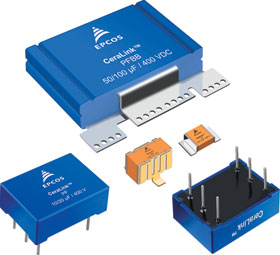
TDK has revealed EPCOS CeraLink, an innovative DC link capacitor for frequency converters. It is based on a PLZT ceramic material (lead lanthanum zirconate titanate) and covers a capacitance range from 1 μF to 100 μF at a rated voltage of 400 V d.c. Another type has a rated voltage of 800 V d.c. and a capacitance of 5 μF.
CeraLink technology offers many benefits in the stabilisation and filtering of DC link circuits of power converters, especially compared to conventional capacitor technologies. Thanks to a low ESL value of less than 4 nH as well as a low ESR of less than 4 mΩ, the new capacitors are ideally suited for applications with high switching frequencies and rapid rise times. This includes converters for industrial and automotive electronics that operate with new fast-switching MOSFETs or IGBTs.
The capacitors can be produced with several commonly available terminal configurations, including low-profile, SMD, solder pin and press-fit busbar types. Designs that can be integrated in semiconductor power modules are also possible.
CeraLink is designed for temperatures between -40°C and +125°C (or up to +150°C for short periods) thus making it suitable for SiC-based power modules as well. Compared to conventional MLCCs, CeraLink features a positive DC bias. Another benefit of the new capacitor is the very compact dimensions: depending on the type, they range between 6,84 x 7,85 x 2,65 mm and 52,5 x 30,5 x 10,5 mm³.
As production of these new components is still ramping up, please contact a distributor to confirm availability.
Harnessing Leakage Inductance Würth Electronics South Africa
Passive Components
Würth Electronics has expanded its WE-MCRI product series with the new 1090HL variant (HL = High Leakage), a coupled inductor specifically designed to improve the performance of SEPIC, ZETA and Cuk converters.
Read more...Space saving SMD common-mode chokes Electrocomp
Passive Components
TDK Corporation presents the EP21 series of flat-wire double chokes designed for common-mode EMI filtering and available in an SMD format with dimensions of only 23,8 x 17,7 mm and heights ranging from 21,6 to 22,3 mm
Read more...Highly rugged GAPS and HAPS proximity sensors IOT Electronics
Passive Components
Now available through Powell Electronics are the GAPS (General Aerospace Proximity Sensors) and HAPS (Harsh Application Proximity Sensors) proximity sensors from Honeywell.
Read more...Understanding EMI Filters and their applications Vepac Electronics
Passive Components
Electromagnetic Interference (EMI) Filters are essential for maintaining electromagnetic compatibility (EMC), allowing multiple devices to function together without interference.
Read more...SMT flat-wire inductor
Passive Components
Würth Elektronik introduces its new WE-SFIA series of flat-wire inductors in 2010, 2013, and 2016 packages.
Read more...Compact SSI family for industrial automation Altron Arrow
Passive Components
Infineon Technologies has introduced the ISSI20BxxF Solid State Isolator (SSI) family, bringing solid-state isolation technology into high-volume applications traditionally served by photovoltaic isolators (PVIs), photovoltaic relays (PVRs), and electromechanical relays (EMRs).
Read more...SGMICRO expands analogue IC portfolio iCorp Technologies
Passive Components Telecoms, Datacoms, Wireless, IoT
SGMICRO continues to add to its analogue IC portfolio at a steady pace, with new devices released across power protection, power conversion, current sensing and RF signal-chain categories.
While every effort has been made to ensure the accuracy of the information contained herein, the publisher and its agents cannot be held responsible for any errors contained, or any loss incurred as a result. Articles published do not necessarily reflect the views of the publishers. The editor reserves the right to alter or cut copy. Articles submitted are deemed to have been cleared for publication. Advertisements and company contact details are published as provided by the advertiser. Technews Publishing (Pty) Ltd cannot be held responsible for the accuracy or veracity of supplied material.









 printer friendly version