Reference library for precision analog designs
24 July 2013
Design Automation
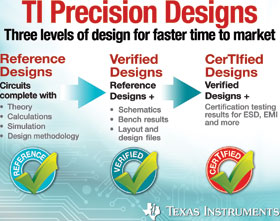
Texas Instruments introduced a precision analog design library that provides comprehensive board-level precision designs to help engineers quickly evaluate and customise their systems while expanding their analog knowledge base.
Accessible at www.ti.com/precisiondesigns-pr-eu, the TI Precision Designs library includes categories of Reference, Verified and CerTIfied Designs that provide all of the methodology and results, and design and simulation files necessary.
The reference designs provide circuits complete with theory, simulation, calculation and design methodology. Verified designs are reference designs that are built and characterised with everything needed to take a concept to copper, including bench results, Gerber files and schematics. CerTIfied designs are verified designs that are characterised for real-world environmental testing such as EMC, ESD and EMIRR.
Board- and system-level designers can search for precision analog designs by design and analog product type (e.g. amplifier, ADC or DAC), plus end equipment (e.g. functional block or electrocardiograph) and application function (e.g. current source, data acquisition, thermocouple, temperature sensing or pulse-width modulation (PWM) generator).
For more information visit www.ti.com/precisiondesigns-pr-eu
Further reading:
AMD Vivado Design Suite 2026.1
Design Automation
AMD Vivado Design Suite 2026.1 is here and features a new tiered licensing model for greater flexibility, new device support, major NoC and QoR improvements, and ease-of-use enhancements for designing with AMD Versal adaptive SoCs.
Read more...
Advanced STM32 debugging in VS Code
Design Automation
Once an STM32 project is running in VS Code, the IAR C-SPY Debug extension adds a professional-grade analysis layer that scales with project complexity.
Read more...
Accelerate development of AI-enabled embedded systems
Design Automation
ADI’s CodeFusion Studio (CFS) is a modern embedded software development platform aimed at accelerating the creation of AI-enabled embedded systems.
Read more...
Introducing STM32CubeMX2
Altron Arrow
Design Automation
STMicroelectronics has launched STM32CubeMX2, a new evolution of its popular configuration and code generation tool for STM32 microcontrollers.
Read more...
AI assistant for STM32 developers
Design Automation
The STMicroelectronics STM32 Sidekick is an AI-driven assistant fully integrated into the STM32 ecosystem designed to streamline embedded development using STM32 microcontrollers.
Read more...
Connected without limits: An engineering perspective on Altron Arrow’s wireless ecosystem
Altron Arrow
Editor's Choice Design Automation
Wireless connectivity is no longer a supporting technology, but rather, a core design consideration that underpins modern electronic systems across industries.
Read more...
Next-gen robotic systems initiative
EBV Electrolink
Design Automation
EBV Elektronik recently introduced MOVE – Driving Robotics Forward, a new initiative designed by EBV Elektronik‘s Embedded Solutions team to support the development of next-generation robotic systems.
Read more...
Reference design for NB-IoT plus GNSS
Altron Arrow
Design Automation
ST Microelectronics’ STDES-ST87M01IGN is a reference design for the ST87M01 NB-IoT + GNSS module, implemented on a 2-layer FR4 PCB (90 x 60 x 1,6 mm).
Read more...
ST welcomes STM32Cube AI Studio
Design Automation
STMicroelectronics has introduced STM32Cube AI Studio, a new desktop software environment designed to simplify the deployment of artificial intelligence on STM32 microcontrollers.
Read more...
NeoCortec introduces new NeoGW software
Design Automation
This is a powerful multiplatform open-source solution designed to streamline integration between the NeoMesh network and upper-level systems, whether deployed in the cloud or on-premise environments.
Read more...









 printer friendly version