High-voltage tantalum capacitors
24 July 2013
Passive Components
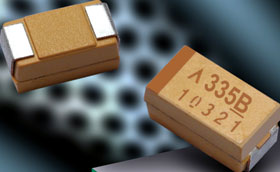
AVX has surpassed previous voltage rating milestones with the introduction of the new TCJ 100 V and 125 V tantalum polymer capacitors. As the highest-voltage tantalum capacitors currently on the market, the new surface-mount chip capacitors provide excellent capacitance and ultra-low ESR in a compact case size.
By maintaining 20% recommended voltage derating, TCJ series capacitors significantly extend the usable voltage range and can be used for a wide array of high-voltage applications, including telecommunications equipment, base stations, switching hubs, router and line filters, DC-DC converters in LED TVs and notebook computer power supplies, and a host of industrial applications.
The new parts exhibit a benign failure mode, which eliminates the ignition failures that can occur in standard MnO2 tantalum technology, increases robustness and mitigates any tendency to overload or burn. Subjected to strict ageing and screening processes to ensure that all parts demonstrate the highest reliability, TCJ series capacitors maintain high reliability exceeding 1% per 1000 hours at 85°C and full-rated voltage.
Rated for use from -55°C to +105°C, the capacitors come in the 2924 case size for the 100 V and 2917 for the 125 V, and are compatible with high-speed pick and place manufacturing processes.
For more information contact Yolandi de Beer, Avnet Kopp, +27 (0)11 319 8600, yolandi.debeer@avnet.co.za, www.avnet.co.za
Further reading:
Harnessing Leakage Inductance
Würth Electronics South Africa
Passive Components
Würth Electronics has expanded its WE-MCRI product series with the new 1090HL variant (HL = High Leakage), a coupled inductor specifically designed to improve the performance of SEPIC, ZETA and Cuk converters.
Read more...
Ultra-slim 30 W DIN Rail AC/DC
Brabek
Passive Components
RECOM is extending its REFIN family with the new REFIN2U-S30.
Read more...
Panasonic thick film current sense resistors
Avnet Abacus
Passive Components
Panasonic thick film current sense resistors enable potential cost savings up to 50% as an alternative to metal shunts
Read more...
Space saving SMD common-mode chokes
Electrocomp
Passive Components
TDK Corporation presents the EP21 series of flat-wire double chokes designed for common-mode EMI filtering and available in an SMD format with dimensions of only 23,8 x 17,7 mm and heights ranging from 21,6 to 22,3 mm
Read more...
Highly rugged GAPS and HAPS proximity sensors
IOT Electronics
Passive Components
Now available through Powell Electronics are the GAPS (General Aerospace Proximity Sensors) and HAPS (Harsh Application Proximity Sensors) proximity sensors from Honeywell.
Read more...
Understanding EMI Filters and their applications
Vepac Electronics
Passive Components
Electromagnetic Interference (EMI) Filters are essential for maintaining electromagnetic compatibility (EMC), allowing multiple devices to function together without interference.
Read more...
SMT flat-wire inductor
Passive Components
Würth Elektronik introduces its new WE-SFIA series of flat-wire inductors in 2010, 2013, and 2016 packages.
Read more...
Compact SSI family for industrial automation
Altron Arrow
Passive Components
Infineon Technologies has introduced the ISSI20BxxF Solid State Isolator (SSI) family, bringing solid-state isolation technology into high-volume applications traditionally served by photovoltaic isolators (PVIs), photovoltaic relays (PVRs), and electromechanical relays (EMRs).
Read more...
SGMICRO expands analogue IC portfolio
iCorp Technologies
Passive Components Telecoms, Datacoms, Wireless, IoT
SGMICRO continues to add to its analogue IC portfolio at a steady pace, with new devices released across power protection, power conversion, current sensing and RF signal-chain categories.
Read more...
SMT flat-wire inductor for automotive electronics
Würth Electronics South Africa
Passive Components
Würth Elektronik introduces its new WE-SFIA series of flat-wire inductors in 2010, 2013, and 2016 packages.
Read more...









 printer friendly version