Reference board jumpstarts LED streetlight design
2 April 2014
Design Automation
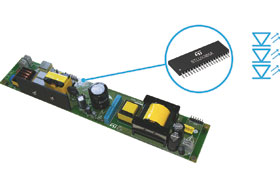
STMicroelectronics has introduced a complete and configurable solution to develop and efficiently control a dimmable, high-brightness LED string (up to 100 W) for street lighting applications.
Based on the award-winning STLUX385A digital power controller, the plug-and-play design highlights the device’s ability to optimise LED efficiency at any dimming level and minimise power in idle conditions.
Replacing incandescent, low-pressure sodium and high-intensity discharge streetlights with LEDs is widely seen as the most promising way to reduce the huge amount of energy that the world uses to light the streets of its cities, towns and villages.
LEDs are inherently more efficient than earlier lamp technologies and, more importantly, they are dimmable. This means that, in conjunction with a smart power supply, their light output can be rapidly adjusted to scenarios ranging from ambient daylight to bright moonlight. In addition, they can also implement civic policies such as dimming selected lamps at a chosen time.
Many cities around the world have started to convert their existing streetlamps to use LED technology and even more are drawing up plans to do so. In the USA, for example, Boston, Massachusetts had converted 40% of its 64 000 electric streetlamps to LEDs by the end of 2012 and was already realising $2,8 million (or 35%) savings annually in electricity cost.
ST’s reference design includes full schematics, bill of materials and firmware, enabling customers to rapidly develop digital power controllers for 100 W LED lamps using the STLUX385A. In this solution, the chip handles a primary-side regulated power conversion stage, as well as all the supported communication links. The power conversion stage consists of a PFC regulator followed by a ZVS LC-resonant stage. High-precision dimming is controlled using a primary-side regulation control technique.
The demonstration board provides all the key physical communication interfaces such as DALI, insulated 0 – 10 and UART, with all the communication managed by the STLUX385A. The flexibility of the IC also allows the board to be easily connected to other interfaces such as Wi-Fi, power-line modems, Bluetooth and ZigBee.
For more information contact Erich Nast, Avnet Kopp, +27 (0)11 319 8600, [email protected], www.avnet.co.za
Further reading:
Advanced STM32 debugging in VS Code
Design Automation
Once an STM32 project is running in VS Code, the IAR C-SPY Debug extension adds a professional-grade analysis layer that scales with project complexity.
Read more...
Accelerate development of AI-enabled embedded systems
Design Automation
ADI’s CodeFusion Studio (CFS) is a modern embedded software development platform aimed at accelerating the creation of AI-enabled embedded systems.
Read more...
Introducing STM32CubeMX2
Altron Arrow
Design Automation
STMicroelectronics has launched STM32CubeMX2, a new evolution of its popular configuration and code generation tool for STM32 microcontrollers.
Read more...
AI assistant for STM32 developers
Design Automation
The STMicroelectronics STM32 Sidekick is an AI-driven assistant fully integrated into the STM32 ecosystem designed to streamline embedded development using STM32 microcontrollers.
Read more...
Connected without limits: An engineering perspective on Altron Arrow’s wireless ecosystem
Altron Arrow
Editor's Choice Design Automation
Wireless connectivity is no longer a supporting technology, but rather, a core design consideration that underpins modern electronic systems across industries.
Read more...
Next-gen robotic systems initiative
EBV Electrolink
Design Automation
EBV Elektronik recently introduced MOVE – Driving Robotics Forward, a new initiative designed by EBV Elektronik‘s Embedded Solutions team to support the development of next-generation robotic systems.
Read more...
Reference design for NB-IoT plus GNSS
Altron Arrow
Design Automation
ST Microelectronics’ STDES-ST87M01IGN is a reference design for the ST87M01 NB-IoT + GNSS module, implemented on a 2-layer FR4 PCB (90 x 60 x 1,6 mm).
Read more...
ST welcomes STM32Cube AI Studio
Design Automation
STMicroelectronics has introduced STM32Cube AI Studio, a new desktop software environment designed to simplify the deployment of artificial intelligence on STM32 microcontrollers.
Read more...
NeoCortec introduces new NeoGW software
Design Automation
This is a powerful multiplatform open-source solution designed to streamline integration between the NeoMesh network and upper-level systems, whether deployed in the cloud or on-premise environments.
Read more...
Keil Studio now in VSCode
Design Automation
Keil Studio, Arm’s latest IDE, now integrates embedded development tools directly into Visual Studio Code providing features like seamless industry tool integration, version control, and a CLI for CI workflows.
Read more...









 printer friendly version