New silicon capacitors out-perform MLCCs
8 April 2015
Test & Measurement
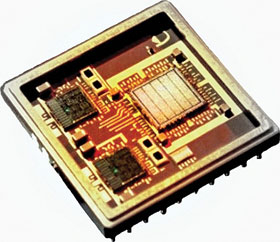
In modern high-temperature electronics, where equipment is becoming extremely expensive and where cost of operation is a key driver, a capacitor that cannot fail is desirable, offering high reliability and a long operating lifetime, even at 250°C. To cope with these demands, MLCC technologies involve very high deratings, leaving no room for miniaturisation. Furthermore, these large devices are prone to failures due to ceramic cracks during assembly.
Compared with MLCC, IPDiA MOS technology offers a fully modellised reliability model, which makes its reliability predictable over the lifetime of the application. For example, when a best-in-class MLCC offers a maximum operating lifetime of 1000 hours at 250°C, IPDiA says its Xtreme capacitor range can last up to 84 000 hours under the same conditions. Furthermore, electrical tests after production have proved no susceptibility to early failures.
With its latest technological breakthrough, the company is now able to offer silicon capacitors in values from10 pF to 4,7 μF, with breakdown voltages from 11 V to 450 V, that exceed the overall electrical performance of NPOs or X7Rs thanks to capacitance stability over temperature (60 ppm/°C), voltage and time.
For more information visit www.ipdia.com
Further reading:
AI Experts provide product-specific intelligence
Measuretest
Test & Measurement
VIAVI Solutions has announced AI Experts, the first addition to its NITRO AI portfolio of AI-driven capabilities with each Expert providing product-specific intelligence.
Read more...
Rugged spectrum analyser
Vepac Electronics
Test & Measurement
The HAROGIC PXR Series is designed for maximum durability and performance in the most demanding environments.
Read more...
Setting a new benchmark for high-power DC load testing
Conical Technologies
Test & Measurement Power Electronics / Power Management
The new ITECH IT8900G/L high-speed, high-power DC electronic load offers a powerful combination of speed, scalability, precision and high-power density.
Read more...
Locate underground cable faults faster with the Fluke AF2082 A-Frame
Comtest
Editor's Choice Test & Measurement
Underground cable faults can lead to costly downtime, service disruptions, and extensive excavation if the fault location is uncertain. The AF2082 simplifies this process by guiding operators directly to the fault point.
Read more...
Precision power for electronics testing
Vepac Electronics
Test & Measurement
The PeakTech 6168 switching power supply is a versatile and reliable solution designed for professional applications in laboratories, development environments, service centres, and training facilities.
Read more...
12-bit 1-wire temperature sensing
RS South Africa
Test & Measurement
The DS18B20 digital thermometer from Analog Devices provides 9-bit to 12-bit Celsius temperature measurements in the range -55°C to 125°C.
Read more...
Ultra-fast wideband RF insight
Vepac Electronics
Test & Measurement
The Harogix PXE-200 is a high-performance real-time spectrum analyser designed for demanding RF environments up to 20 GHz.
Read more...
Field calibration made easy
Instrotech
Test & Measurement
Built around modern component technology, an intuitive interface, and a rugged IP54-rated housing, Instrotech’s Calog series is engineered for the demands of real industrial field calibration work.
Read more...
Rugged two-pole voltage tester
Vepac Electronics
Test & Measurement
A key advantage of the PeakTech 1094 is its battery-free operation, ensuring the tester is always ready for use whenever required by professional electricians or maintenance personnel.
Read more...
Rapid IoT prototyping simplified
Future Electronics
Test & Measurement
The STEVAL-MKBOXPRO from STMicroelectronics is a compact, ready-to-use wireless development kit designed to accelerate the creation of intelligent IoT and wearable applications.
Read more...









 printer friendly version