29 April 2015Manufacturing / Production Technology, Hardware & Services
RS Components has augmented its range of rapid prototyping products for use by electronics and mechanical engineers involved in design, prototyping and research and development, in addition to enthusiasts and those in education.
The company is now supplying four MakerBot 3D printing machines, three of which are based upon the same core fused deposition modelling (FDM) technology, including the easy-to-use Mini 3D, and the Z18 which offers a particularly large build volume.
The first of the products is the fifth-generation design of the MakerBot Replicator desktop 3D printer. Key specifications include a 100 micron layer resolution and a build volume of 252 x 199 x 150 mm. Other features include an onboard camera and diagnostics, and assisted build-plate levelling, as well as a swappable smart extruder. The printer also offers a build platform made from glass, and USB, Wi-Fi and Ethernet connectivity. Material filament for this model is MakerBot PLA.
The second model in the range is the MakerBot Replicator Mini, an easy-to-use and compact desktop machine that is ideal for use in the home or classroom. Like the Replicator, this printer also has a swappable smart extruder, but offers a build volume of 100 x 100 x 125 mm, layer resolution of 200 microns, and Wi-Fi and USB connectivity.
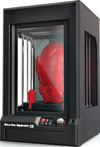
The next printer – MakerBot Replicator Z18 – offers a build volume of 305 x 305 x 457 mm. It integrates an enclosed and heated build chamber designed for printing large models with minimal curling. Like the Replicator, the Z18 includes a swappable smart extruder, onboard camera, diagnostics and assisted build-plate levelling, a 100 micron layer resolution, and Wi-Fi, USB and Ethernet connectivity.
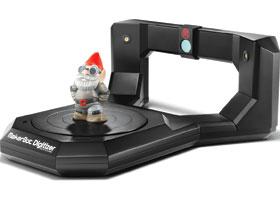
The final product is the MakerBot Digitiser desktop 3D scanner, which provides users with a fast and easy way to create 3D models. MakerBot’s MultiScan technology allows users to scan objects from multiple angles and merge the resulting scans together to create the best possible 3D model. Outputting standard 3D file formats, users can further shape or transform objects in a third-party 3D modelling program.
The scanner offers a scan volume of up to 203 x 203 mm with dimensional accuracy of ±2,0 mm and resolution of 0,5 mm. With an approximate scan time of 12 minutes for each 3D model, the scan will create approximately 200 000 triangles, the number and size of which will generally determine the accuracy of the curved surfaces of an object.
Weller limited Black Edition soldering station Testerion
Manufacturing / Production Technology, Hardware & Services
Weller’s WE1010 Black Edition Soldering Station is a premium limited-edition soldering station.
Read more...Large-format table top enclosures RS South Africa
Enclosures, Racks, Cabinets & Panel Products
The COMMUNITEC enclosure range from OKW is ideal for housing large-format electronic assemblies in an elegant, modern, design-oriented package. A key feature is the recessed handle concealed behind the operating panel, which allows the units to be carried comfortably and provides greater flexibility in use.
Read more...Quick and easy shielding Würth Electronics South Africa
Electronics Technology Manufacturing / Production Technology, Hardware & Services
Würth Elektronik expands its EMC product portfolio with nanocrystalline WE-FNCS sheets.
Read more...Smarter local buying could reboot South Africa’s manufacturing sector
Manufacturing / Production Technology, Hardware & Services
With smarter localisation, clearer procurement rules and a more deliberate industrial strategy, public spending could again become a powerful engine for rebuilding factories, expanding supply chains and restoring confidence in South Africa as a place that makes things.
Read more...The effect of seasonal changes on ESD performance in South Africa Actum
Editor's Choice Circuit & System Protection Manufacturing / Production Technology, Hardware & Services
Electrostatic discharge performance is influenced by several environmental factors, with relative humidity being one of the most important. This is particularly relevant in South Africa, where seasonal changes can result in significant differences in humidity levels.
Read more...Procurement is becoming a competitive advantage RS South Africa
News
As mining, manufacturing and industrial businesses continue to navigate rising costs, supply chain disruption and increasing pressure to improve operational performance, procurement and inventory management have become strategic business priorities rather than simply administrative functions.
Read more...High precision in-line conformal coating inspection system MyKay Tronics
Manufacturing / Production Technology, Hardware & Services
Conformal coating is widely used to protect electronics from moisture or other environmental hazards. It is critical to know if coatings are properly applied; covering what is meant to be covered and not covering what should be exposed.
Read more...Soldering day highlights
Manufacturing / Production Technology, Hardware & Services
JAPAN UNIX has published a new event report and highlight video from their UNIX SOLDERING DAY 2026 in Hungary. This event reflects on their commitment to supporting manufacturers not only through soldering automation systems, but also through technical education, live demonstrations, hands-on training, and practical engineering know-how.
Read more...Clearing the Static: Electrostatic Discharge Actum
Manufacturing / Production Technology, Hardware & Services
A cordless ESD (Electrostatic Discharge) wrist strap does not work by grounding the person in the same way as a traditional wired wrist strap. Instead, it works by reducing or balancing the static charge on your body so that you are less likely to discharge electricity into sensitive electronic components.
Read more...Engineering trust in South Africa’s SMT sector ZETECH ONE
Manufacturing / Production Technology, Hardware & Services
From a small Johannesburg start-up to a trusted SMT technology partner, Zetech One has spent four decades helping South African electronics manufacturers improve production quality, efficiency and reliability.
While every effort has been made to ensure the accuracy of the information contained herein, the publisher and its agents cannot be held responsible for any errors contained, or any loss incurred as a result. Articles published do not necessarily reflect the views of the publishers. The editor reserves the right to alter or cut copy. Articles submitted are deemed to have been cleared for publication. Advertisements and company contact details are published as provided by the advertiser. Technews Publishing (Pty) Ltd cannot be held responsible for the accuracy or veracity of supplied material.











 printer friendly version