Gen3 upgrades SIR and CAF systems
12 August 2015
Test & Measurement
Manufacturing / Production Technology, Hardware & Services
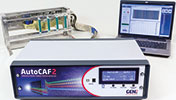
Gen3 Systems has redesigned its line of surface installation resistance testers (AutoSIR) and conductive anodic filament monitoring testing system (AutoCAF).
Key new features of both the AutoSIR 2 and AutoCAF 2 include a measurement time for 256 channels of less than 8 seconds; applied voltage in the range of 1 V to 1000 V; measurement range of 106 Ω to 1014 Ω; continuous measurement on all selected tests; measurement test intervals fully selectable from a minimum of 1 minute; and the capability of testing to all existing test specifications IPC – IEC – JNC and other user specifications.
Unlike the original instruments, the use of switch relays is eliminated so that, when the test and measurement voltages are the same, truly continuous monitoring and measurements can be made. Each channel is current limited (1 M), ensuring that electro-chemical reactions (dendrites) are preserved for subsequent failure analysis. The frequent monitoring capability provides a full picture of the electro-chemical reactions taking place on a circuit assembly, and provides early trend analysis enabling tests to be curtailed.
Both the AutoSIR 2 and AutoCAF 2 systems are available with 64, 128 or 256 channel configurations.
For more information contact Igmar Grewar, Quamba Technologies, +27 (0)83 417 4294, [email protected], www.quamba.co.za
Further reading:
AI Experts provide product-specific intelligence
Measuretest
Test & Measurement
VIAVI Solutions has announced AI Experts, the first addition to its NITRO AI portfolio of AI-driven capabilities with each Expert providing product-specific intelligence.
Read more...
Rugged spectrum analyser
Vepac Electronics
Test & Measurement
The HAROGIC PXR Series is designed for maximum durability and performance in the most demanding environments.
Read more...
Setting a new benchmark for high-power DC load testing
Conical Technologies
Test & Measurement Power Electronics / Power Management
The new ITECH IT8900G/L high-speed, high-power DC electronic load offers a powerful combination of speed, scalability, precision and high-power density.
Read more...
Locate underground cable faults faster with the Fluke AF2082 A-Frame
Comtest
Editor's Choice Test & Measurement
Underground cable faults can lead to costly downtime, service disruptions, and extensive excavation if the fault location is uncertain. The AF2082 simplifies this process by guiding operators directly to the fault point.
Read more...
The new reality of PCB material supply
Jemstech
Editor's Choice Manufacturing / Production Technology, Hardware & Services
How resilient manufacturing strategies are helping OEMs navigate a changing global supply chain.
Read more...
Strengthening local electronics manufacturing through investment and innovation
Microtronix Manufacturing
Editor's Choice Manufacturing / Production Technology, Hardware & Services
Microtronix South Africa cements its commitment to local manufacturing with ongoing investments in production capacity, skills development, and job creation.
Read more...
Precision power for electronics testing
Vepac Electronics
Test & Measurement
The PeakTech 6168 switching power supply is a versatile and reliable solution designed for professional applications in laboratories, development environments, service centres, and training facilities.
Read more...
12-bit 1-wire temperature sensing
RS South Africa
Test & Measurement
The DS18B20 digital thermometer from Analog Devices provides 9-bit to 12-bit Celsius temperature measurements in the range -55°C to 125°C.
Read more...
Ultra-fast wideband RF insight
Vepac Electronics
Test & Measurement
The Harogix PXE-200 is a high-performance real-time spectrum analyser designed for demanding RF environments up to 20 GHz.
Read more...
Field calibration made easy
Instrotech
Test & Measurement
Built around modern component technology, an intuitive interface, and a rugged IP54-rated housing, Instrotech’s Calog series is engineered for the demands of real industrial field calibration work.
Read more...









 printer friendly version