

Power Electronics / Power Management


AC-DC front-end modules

27 January 2016 Power Electronics / Power Management

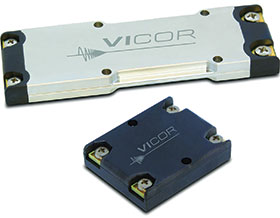
Vicor announced an addition to its new family of high-density PFM AC-DC front-end modules in the rugged VIA package that offers superior cooling performance and versatility in converter mounting.

Featuring a universal AC input range (85–264 V), power factor correction, and a fully isolated 24 V or 48 V d.c output, and delivering 400 W of isolated, regulated, DC output power at efficiencies up to 93%, these new modules provide power density of 8 W/cm³ in a 9 mm thin package. The new units are ideally suited for use in a broad range of industrial, process control, telecommunications, office equipment, test and measurement, LED lighting and other ‘off-line’ applications.

Every electronic product or system that operates off an AC utility line must incorporate an AC-DC front end to convert the AC utility voltage into the smooth DC voltage required by electronic circuitry. These new units integrate a full range of front-end functions required by contemporary AC line-operated power systems – transient and inrush current protection; input power factor correction; input to output isolation, and a regulated SELV (Safety Extra Low Voltage) DC output – and meet international safety and regulatory agency standards for isolation, conducted emissions, power factor correction, and susceptibility to AC line transients, flicker, interruptions and surges.

VIA package configurations are available for both on-board mounting and chassis mounting, and units are available in two operating temperature ranges.

In many applications, a user can instantly implement a complete AC-DC front end by simply combining a PFM with an AIM (Universal AC Input Module), which integrates all required primary-side rectification, filtering and transient protection circuitry), both in VIA packages and suitable secondary-side storage capacitance. Alternatively, a designer can combine a PFM front-end module with rectification, filtering and secondary-side output capacitance that is optimised for a specific application.

Whereas many alternative front-end systems are configured with capacitive energy storage at the high-voltage input, the PFM offers enhanced system safety by storing energy in low-voltage capacitors at the isolated SELV output. At one-fifth the thickness of traditional 1U front-end solutions, the mechanically robust, thermally adept VIA package simplifies mounting to an equipment side panel, chassis or other external heatsinking device, and provides improved thermal performance in any application. Moving the AC-DC conversion function to a chassis or side panel can reduce system size and cost, or free up valuable system real estate for other uses, and can provide improved thermal performance while eliminating the need for, and cost of, external heatsinks.

The new modules are compatible with a wide variety of available downstream power conversion components. By using Vicor’s online suite of PowerBench design tools to combine PFM AC-DC front-end modules with downstream modules selected from Vicor’s portfolio of high-density, high-efficiency, modular power converters, power architects can rapidly design and deploy complete off-line power systems.

For more information contact ECS, +27 (0)12 345 6132, [email protected], www.ecssa.co.za


Share this article:
Share via emailShare via LinkedInPrint this page

Further reading:

Finding value for money with your IoT battery
Uniross Batteries Power Electronics / Power Management
Designing an IoT application involves a lot of choices. Designers are looking for performance and quality, but need to balance those alongside a low Total Cost of Ownership.

Read more...
Powering the IoT
Uniross Batteries Power Electronics / Power Management
Choosing the right battery is not simply a technical detail, but a defining factor in the longevity and cost-effectiveness of any IoT deployment.

Read more...
The move to DC infrastructure
IOT Electronics Power Electronics / Power Management
The shift toward direct current infrastructure in data centres is accelerating as operators pursue higher efficiency, improved reliability, and stronger alignment with renewable energy goals.

Read more...
Power inductor for automotive applications
Würth Elektronik eiSos Power Electronics / Power Management
The WE-MXGA inductor features RDC values up to 25% lower and a saturation current up to 47% higher compared to other components currently available on the market.

Read more...
High-performance DC-DC converter
Conical Technologies Power Electronics / Power Management
With a wide 9 - 40 V DC input range, the Claf Power DWHB400-F24xxN series is a high-performance DC-DC converter family ideally suited for 12 V and 24 V battery-based systems including vehicles, off-grid installations, and distributed power architectures.

Read more...
DC-DC converters for next-generation IoT
iCorp Technologies Power Electronics / Power Management
AIPUPOWER’s K78XXJT-500R3 and K78XXJT-500R3-LB give designers a compact, high-efficiency power option for battery-powered and space-constrained systems, combining up to 96% efficiency with no-load input current as low as 0,2 mA.

Read more...
240 W in compact form factor
Brabek Power Electronics / Power Management
The cost-effective and reliable RECOM RACPRO1-S240E DIN-rail mount AC-DC series is only 125 x 139 mm and 39 mm wide, yet provides 240 W output.

Read more...
You cannot manage what you cannot measure
Power Electronics / Power Management
South African sites are generating solar energy. Most still have no idea what is consuming it… or when, or why. Intelligent load management hardware is changing that.

Read more...
Scalable and intelligent power solution
Power Electronics / Power Management
Designed for Africa’s rapidly evolving energy landscape, Bluetti’s ES125 offers a scalable, intelligent power solution that delivers reliable and cost-efficient electricity for uninterrupted operations.

Read more...
Simulating grid abnormalities
Conical Technologies Power Electronics / Power Management
Simulating grid abnormalities has become an essential part of validating systems such as inverters, UPS units, photovoltaic inverters, and EV charging infrastructure.

Read more...


While every effort has been made to ensure the accuracy of the information contained herein, the publisher and its agents cannot be held responsible for any errors contained, or any loss incurred as a result. Articles published do not necessarily reflect the views of the publishers. The editor reserves the right to alter or cut copy. Articles submitted are deemed to have been cleared for publication. Advertisements and company contact details are published as provided by the advertiser. Technews Publishing (Pty) Ltd cannot be held responsible for the accuracy or veracity of supplied material.


© Technews Publishing (Pty) Ltd | All Rights Reserved

