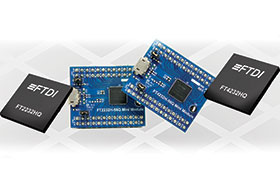
To provide engineers with a greater breadth of I/O options and also address demands to conserve board real estate, FTDI has announced new versions of its highly popular FT2232H and FT4232H devices.
These configurable USB 2.0 Hi-Speed (supporting 480 Mbps operation) ICs are now available in 56-pin VQFN packages, which complement the 64-pin LQFP package format. As a result they are now easier to place and route on to PCBs, as well as being better suited to space-constrained electronic designs.
The FT2232H and FT4232H incorporate 2 and 4 UARTs respectively. To maximise application flexibility, both channels on the FT2232H and 2 of the 4 channels on the FT4232H can be independently configured in a wide variety of different industry-standard serial interfaces. This is accomplished via a multi-protocol synchronous serial engine (MPSSE), which allows emulation of JTAG, SPI, I²C, bit-bang or other synchronous serial modes. Both the FT2232H-56Q and FT4232H-56Q are also offered in mini modules. These small dual-inline PCBs have attached micro-USB connectors to ease interfacing with external infrastructure.
Key applications for these ICs/modules are upgrading legacy peripheral designs to accept USB and field updating of equipment. Other items where they will be utilised include USB instrumentation, smart card readers, industrial control systems, bar code readers, USB Flash drive reader/writers and interfaces for portable electronic goods (MP3 players, digital cameras, etc.)
The highly integrated nature of the FT2232H/FT4232H offering enables more streamlined implementations to be undertaken. Among the functionality packed into each IC is a 1,8 V LDO voltage regulator, integrated POR and clock multiplier PLL (covering frequencies from 12 MHz to 480 MHz). The baud rate generator allows data transfer at non-standard as well as standard speeds.
Since the USB protocol is taken care of on-chip, there is no need for USB specific firmware to be created. These ICs are supported by a broad array of USB drivers for Windows, Mac and Linux operating systems. The -40°C to 85°C operating temperature range means they are suited to industrial deployment.
Simplifying system design iCorp Technologies
Telecoms, Datacoms, Wireless, IoT
The FGMC63N tri-band MCU Wi-Fi 6E module from Quectel addresses offers integrated connectivity across 2,4 GHz, 5 GHz, and 6 GHz bands in a compact, highly optimised design.
Read more...Dragino’s connectivity catalogue Otto Wireless Solutions
Telecoms, Datacoms, Wireless, IoT
Where Wi-Fi demands frequent charging and covers tens of meters, and traditional cellular consumes too much power for battery-operated nodes, LoRaWAN threads the needle.
Read more...RF filters explained RFiber Solutions
Telecoms, Datacoms, Wireless, IoT
As RF environments become increasingly crowded, RF filters play a critical role in maintaining signal quality, improving system performance, and ensuring reliable operation.
Read more...Practical design strategies for 5G RF Design
Telecoms, Datacoms, Wireless, IoT
The Cavli CQM211 aims to provide a platform that combines strong 5G connectivity with onboard compute capability, as well as interface flexibility that suits both new designs and rapid migrations from earlier products.
Read more...An industry-first Android 16 smart module solution RF Design
Computer/Embedded Technology Telecoms, Datacoms, Wireless, IoT
The MeiG Smart SLM580 4G Smart Module features native support for Android 16 and covers core frequency bands in major countries and regions worldwide.
Read more...High performance RF signal conditioning RFiber Solutions
Telecoms, Datacoms, Wireless, IoT
The AM3269 from Mercury Systems is a high-performance RF preselector module designed to improve receiver sensitivity and signal integrity in demanding electronic warfare, signals intelligence, test, and communications applications.
Read more...RF filters explained RFiber Solutions
Telecoms, Datacoms, Wireless, IoT
As RF environments become increasingly crowded, RF filters play a critical role in maintaining signal quality, improving system performance, and ensuring reliable operation.
Read more...Industrial connectivity without compromise
Telecoms, Datacoms, Wireless, IoT
The IR315 combines 4G LTE, Wi-Fi, Ethernet, and VPN technologies into a rugged, industrial-grade platform that enables seamless connectivity across a wide range of applications.
While every effort has been made to ensure the accuracy of the information contained herein, the publisher and its agents cannot be held responsible for any errors contained, or any loss incurred as a result. Articles published do not necessarily reflect the views of the publishers. The editor reserves the right to alter or cut copy. Articles submitted are deemed to have been cleared for publication. Advertisements and company contact details are published as provided by the advertiser. Technews Publishing (Pty) Ltd cannot be held responsible for the accuracy or veracity of supplied material.









 printer friendly version