1000-core processor developed
13 July 2016
DSP, Micros & Memory
Computer/Embedded Technology
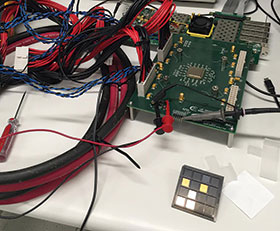
A microchip containing 1000 independent programmable processors has been designed by a team at the University of California, Davis’ department of electrical and computer engineering. The energy-efficient ‘KiloCore’ chip has a maximum computation rate of 1,78 trillion instructions per second and contains 621 million transistors.
“To the best of our knowledge, it is the world’s first 1000-processor chip and it is the highest clock-rate processor ever designed in a university,” said Bevan Baas, professor of electrical and computer engineering, who led the team that designed the chip architecture. While other multiple-processor chips have been created, none exceed about 300 processors, according to an analysis by Baas’ team. Most were created for research purposes and few are sold commercially. The KiloCore chip was fabricated by IBM using its 32 nm CMOS technology.
Each processor core can run its own small program independently of the others, which is a fundamentally more flexible approach than so-called ‘single-instruction-multiple-data’ approaches utilised by processors such as GPUs (graphics processing units). The idea is to break an application up into many small pieces, each of which can run in parallel on different processors, enabling high throughput with lower energy use, Baas said.
Because each processor is independently clocked, it can shut itself down to further save energy when not needed, said graduate student Brent Bohnenstiehl, who developed the principal architecture. Cores operate at an average maximum clock frequency of 1,78 GHz, and they transfer data directly to each other rather than using a pooled memory area that can become a bottleneck for data.
The chip is the most energy-efficient ‘many-core’ processor ever reported, Baas said. For example, the 1000 processors can execute 115 billion instructions per second while dissipating only 0,7 Watts, low enough to be powered by a single AA battery. The KiloCore chip executes instructions more than 100 times more efficiently than a modern laptop processor.
Applications already developed for the chip include wireless coding/decoding, video processing, encryption, and others involving large amounts of parallel data such as scientific data applications and data centre record processing. The team has completed a compiler and automatic program mapping tools for use in programming the chip.
Further reading:
Accelerate development of physical AI deployments
Altron Arrow
DSP, Micros & Memory
With Avocado OS now available on the HummingBoard RZ-V2N-
AIoT and SolidSense AIoT V2N from SolidRun, teams can move from prototype to deployed fleet in weeks.
Read more...
AI-ready edge MPU for HMIs
Future Electronics
DSP, Micros & Memory
The Renesas RZ/G3E MPU is a high-performance microprocessor designed to enable advanced HMI systems with integrated artificial intelligence capabilities at the edge.
Read more...
Industrial-grade ESP32-S3 controller
DSP, Micros & Memory
Erqos Technologies has introduced the EQSP32CE, a CE-certified, industrial-grade ESP32-S3 controller designed for developers who want the flexibility of the ESP32 ecosystem in hardware that can be deployed directly into real-world automation.
Read more...
Universal NFC device
Altron Arrow
DSP, Micros & Memory
Delivering high-end performance in a compact 4 x 4 mm package, the multipurpose NFC reader from ST Microelectronics, enables the convenience of contactless interaction and features for various end applications.
Read more...
Compact low-power 32-bit platform
EBV Electrolink
DSP, Micros & Memory
Microchip’s PIC32CM PL10 microcontroller family expands the company’s Arm Cortex-M0+ portfolio, delivering a compact, low-power 32-bit platform designed for cost-sensitive embedded applications.
Read more...
Bridging the gap between prototype and production
DSP, Micros & Memory
Choosing between the FRDM i.MX 93, FRDM i.MX 91 and FRDM i.MX 91S development platforms can be intimidating, but once designers understand how each platform aligns with their application’s requirements, the decision becomes straightforward.
Read more...
Low-power memory born for edge AI
iCorp Technologies
DSP, Micros & Memory
As intelligence moves from the cloud to the device, memory become one of the most important design decisions in modern electronics. Edge-AI products – from smart speakers and surveillance cameras to ADAS modules and wearables – need to move data fast, but they also need to sip power. Winbond’s low-density LPDDR4/LPDDR4X SDRAM range is built to strike that balance.
Read more...
Compact direct Time-of-Flight 3D LiDAR module
Altron Arrow
AI & ML DSP, Micros & Memory
The VL53L9 from STMicroelectronics is the first direct Time-of-Flight (dToF) 3D LiDAR all-in-one module in ST’s portfolio, offering a resolution of 2,3K zones, wide field of view, on-chip processing, 100 frames per second, and sensing range from 5 centimeters to 9 meters.
Read more...
Next-gen smart module powers intelligence at the edge
iCorp Technologies
DSP, Micros & Memory
Quectel Wireless Solutions has expanded its smart module portfolio with the SH803FD, a new-generation, high-performance smart module.
Read more...
Programmable logic redefined
DSP, Micros & Memory
Microchip’s CLB-based PIC MCUs combine programmable logic and embedded control in a single device to help reduce latency, cost, and design complexity.
Read more...









 printer friendly version