1 January 2017
Manufacturing / Production Technology, Hardware & Services
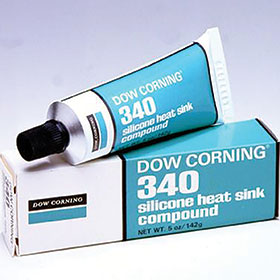
DC 340 heatsink compound from Dow Corning features a high thermal conductivity and provides low bleed benefits. The fluid is thickened with a heat conductive metal oxide filler that gives the compound its high thermal conductivity, low bleed benefits and high temperature stability. The compound can resist consistency changes at temperatures up to 177°C, resulting in a positive seal of the heatsink. This enables the compound to provide increased efficiency by improving the heat transport from the electronic device.
DC 340 is ideal for aircraft engines, LED applications, mounting studs of transistors, diodes and silicon-controlled rectifiers. Additionally, the compound serves as a thermal coupler for heatsink devices and is stable at high temperatures.
The compound is available in multiple packaging sizes from small tubes for individual use to drums for large scale operations and production lines.
Advanced X-ray inspection systems MyKay Tronics
Manufacturing / Production Technology, Hardware & Services
The Scienscope AXl-6100 series comprises specialised X-ray inspection systems explicitly engineered for the examination of long circuit boards.
Read more...Compact all-in-one placement machines Testerion
Manufacturing / Production Technology, Hardware & Services
Introducing the CLT-FG, a new series of compact all-in-one SMT placement machines
Read more...200 W of power in a space-saving design Vepac Electronics
Manufacturing / Production Technology, Hardware & Services
The Hakko FX-972 Soldering Station delivers high-performance soldering in a compact package, making it suitable for a wide range of soldering applications.
Read more...FineX: Makes shielding clear Avnet Abacus
Manufacturing / Production Technology, Hardware & Services
Panasonic Industry launches high-transparency, low-resistance, flexible transparent conductive film for electromagnetic wave shield with pre-applied OCA.
Read more...Collaboration is now critical RS South Africa
Manufacturing / Production Technology, Hardware & Services
The message emerging from RS Connect is clear: Organisations can no longer rely on internal optimisation alone to secure performance. Competitive advantage is increasingly being determined by the strength of external relationships, shared capability and coordinated action across value chains.
Read more...Disruption is the new normal. Effortless is the new competitive advantage. Seven Labs Technology
Manufacturing / Production Technology, Hardware & Services
Global supply chains have been under pressure for years. The manufacturers still standing are the ones who stopped waiting for normal to return, and started building something better.
Read more...World-first 016008 mm component placement
Manufacturing / Production Technology, Hardware & Services
Fuji has achieved the world’s first placement of 016008 mm (0,16 x 0,08 mm or 006 x 003 inches) size components on printed circuit boards with its SMT pick and place machine, NXTR.
Read more...Lifecycle and obsolescence: Protecting electronics through process Production Logix
Manufacturing / Production Technology, Hardware & Services
At Production Logix, we believe longevity is not accidental. It is engineered through early visibility, structured response, and disciplined execution, in partnership with our OEM customers.
Read more...Maximising squeegee quality and durability Testerion
Manufacturing / Production Technology, Hardware & Services
Transition Automation has announced two new product advancements designed to improve SMT printing performance and extend squeegee life: laser-enhanced Permalex bonding and integrated edge protectors.
Read more...NeoDen ND2 PCB screen printer ZETECH ONE
Manufacturing / Production Technology, Hardware & Services
The NeoDen ND2 PCB screen printing machine is a fully automatic stencil printer designed to deliver precise and consistent solder paste application in modern SMT production environments.
While every effort has been made to ensure the accuracy of the information contained herein, the publisher and its agents cannot be held responsible for any errors contained, or any loss incurred as a result. Articles published do not necessarily reflect the views of the publishers. The editor reserves the right to alter or cut copy. Articles submitted are deemed to have been cleared for publication. Advertisements and company contact details are published as provided by the advertiser. Technews Publishing (Pty) Ltd cannot be held responsible for the accuracy or veracity of supplied material.









 printer friendly version