


Siemens industrial PCs (IPC) have been leading trends for over 30 years. As early as 1983, Siemens started combining standard PC technology with characteristics that fulfilled demanding industrial requirements, and with its Simatic IPCs it has since continued to set new milestones.
With 4500 employees, the company’s site in Karlsruhe is the fifth largest location of Siemens AG in Germany. It includes the Process Industries and Drives division, with process industry and process automation being the focus of the site.
Innovation strength, quality based on fully optimised production steps, and real flexibility for the customer are the pillars of success for Siemens Manufacturing Karlsruhe (MF-K). Siemens manufactures about 24 000 different products at this site, including flat components for other sites. In addition to products for industrial communication, such as network and identification components, the Karlsruhe plant focuses on developing and manufacturing the trendsetting systems in the Simatic product range.
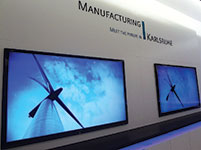
‘Meet the Future in Karlsruhe’ are the words that welcome visitors at the entrance area of the manufacturing complex, and visitors will indeed see state-of-the-art manufacturing which focuses on maximum flexibility and short production times. “We manufacture on a build-to-order basis,” explains Josef Kühn, a planner and designer in the technology department who looks after selective soldering processes. He has been with Siemens since 1981, and thanks to his work at various sites he can rely on a wealth of experience.
“A configurator supports the customer in selecting a processor, memory size or extension cards, and lets the customer order IPC products in any quantity – as low as one piece,” says Kühn. “Our standard delivery time of just 15 days means that our manufacturing process must be absolutely flexible and able to absorb daily fluctuations.”
Flexible production concept for fast implementation
The production concept behind the fulfilment of individual customer requirements is based on modern manufacturing islands. In addition to the ability to cost-effectively produce small lot sizes, the standalone ‘island’ production approach largely eliminates process-related waiting times and supports the manufacture of the highest-quality products – to name but a few of the advantages.
The basic prerequisite for flexible manufacturing islands is of course the flexibility of the individual production plants within an island. “We ensure this flexibility by using selective soldering units from Seho,” adds Kü’hn. “A number of the manufacturing islands employ multiple GoSelective, PowerSelective and SelectLine systems from Seho. We produce 232 different types of flat components for IPCs, 136 of which with Seho soldering systems.”
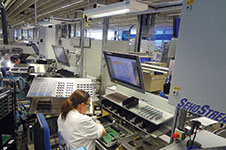
The most recently installed manufacturing island for IPCs combines a SelectLine with a PowerSelective system, plus assembly workstations and automatic handling systems from the Seho Streamline range. This arrangement allowed the system to be optimised for Siemens’ requirements. A total of four assembly workstations include manual component assembly. The intelligent design starts with component storage. “While the assembly takes place at the workstation, the rear of the unit allows us to prepare for the next product version,” explains Kü’hn. “We then simply turn the component storage around and get started on the next job. This saves a lot of time.”
The finished components are then moved on to soldering in a SelectLine system which is also designed to be highly flexible. The system is equipped with two electromagnetic solder units with different soldering nozzle sizes to accommodate a wide range of different soldering geometries without re-tooling.
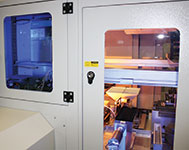
PCBs which are soldered exclusively on SelectLine systems are passed through a separating station and are automatically returned to the assembly workstations. All the other PCBs are automatically passed to a PowerSelective system for further processing.
PowerSelective systems are also equipped with a mini-wave soldering unit and they have a conventional soldering wave as a special feature. “This enables us to cover a highly varied product range with just one soldering system. The flexibly programmable gripper system, which can be freely rotated and tilted, gives us an excellent solder outline and high-quality soldering results,” says Kü’hn. “Any production system is only as good as the components that have been installed in it,” he adds with a smile.
Indeed, the exact type of IPC that is produced using this manufacturing island is the one that ensures process reliability for the PowerSelective system. Kühn explains: “Process safety is obviously our top priority. The Simatic IPCs are designed to provide maximum performance and durability. This would hardly be possible without a reproducible manufacturing process.” To support this need, the selective soldering systems from Seho all offer 100% automated process control.
Maximum nozzle service life for maximum process safety
Especially in selective soldering processes, where the smallest structures need to be processed with high accuracy, residues in the soldering nozzle can have a major impact on the reproducibility and the quality of the results. “Depending on the type of solder alloy and the number of soldering cycles, the soldering nozzle may show signs of flux deposits and oxide residue which would negatively affect the soldering result,” explains Alexander Blum, product manager with Seho Systems GmbH.
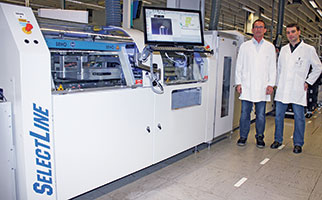
A sound process depends on a robust solder wave height and wetting surface. An evenly wetted and oxide-free soldering nozzle is of utmost importance. Soldering nozzles must therefore be cleaned and rewetted regularly. This is a process that typically requires system downtime and the use of aggressive chemicals.
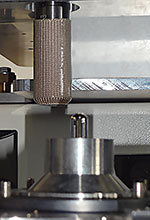
The IPC manufacturing island at Siemens in Karlsruhe is used in a 2/3 shift operation scenario; production stoppage to allow the nozzles to be cleaned manually was not an option. Instead, the SelectLine was fitted with patented Seho ultrasonic cleaning technology. In freely programmable cleaning cycles the liquid solder is oscillated, which gently cleans the nozzle surfaces and re-wets them under exclusion of atmospheric oxygen. “Our experience has shown that cyclical ultrasonic cleaning significantly improves the service life. With SelectLine nozzles, we have an average service life of approximately 2 months – typically we would get just a few days with other comparable systems,” says Kü’hn. “The extended service life obviously has a positive impact on process reliability, and the automated nature of the ultrasonic cleaning process reduces the workload for the system operator.”
Another benefit, in addition to higher availability and lower material wear, is the system’s low environmental impact, as no chemicals are used during the cleaning process. “This, in combination with other automated control mechanisms that are integrated in the system, ensures a fully monitored process,” says Blum.
Successful together
‘Made by Siemens’ is a globally recognised trademark that stands for quality, performance and efficiency. “The same stringent requirements that our IPCs satisfy, we also place on our production processes. And in Seho we have a partner on our side who takes the same approach,” explains Kühn.
The electronics industry is one of the most dynamic sectors worldwide and constantly presents new challenges to manufacturers. This is especially true for trendsetting companies such as Siemens. “At times, our attempts to optimise production processes may seem unorthodox,” Kühn sums up. “But with Seho as our supplier we always have a competent partner with whom we can discuss new tasks.”
A collaborative partnership can ensure that new ideas turn into innovative technical solutions which go into series operation after a joint optimisation phase.






© Technews Publishing (Pty) Ltd | All Rights Reserved
 printer friendly version