21 March 2018Manufacturing / Production Technology, Hardware & Services
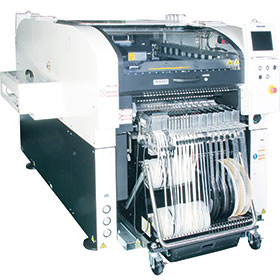
The machine is the latest stage in the evolution of the NPM series and is geared for manufacturers who value setup and changeover time over speed.
“The NPM-W2S was designed to solve manufacturer’s need to tighten control of their work in process, minimise changeover, and expand feeder capacity while accommodating smaller lot sizes in a cost-effective manner,” said Shawn Robinson, senior product marketing manager, Panasonic Factory Solutions Company of America. “The solution addresses these challenges as well as expanding standard component range from 03015 mm microchips to massive 100 x 90 mm components and connectors nearly 150 mm long and up to 30 mm tall.”
The machine delivers 100 N insertion force for greater odd-form capability and increases pin-through-hole device imaging capability via optional pin-in-paste illumination. Equipped with a multi-recognition camera, it enables component alignment, defect inspection, chip thickness and 3D co-planarity inspection in a single pass to promote high productivity and quality. Optical character recognition (OCR) and pre-pickup inspection features allow unique recognition of tray-fed parts from barcodes, lines and polarity marks to determine proper pickup angles, even if parts are fed incorrectly.
Single- and dual-lane mode functionality promotes the capability to process extremely long LED panels nearly 1200 mm in length. It can automatically convert modes to dual-lane ‘shared’ or ultra-productive ‘hybrid’ mode. The NPM-W2S offers features to enhance efficiency such as automated board support pin placement, self-aligning feeder cart changeover, intelligent feeder anywhere, and 2D-coded nozzle anywhere. It further enhances production quality with thermal expansion compensation, board warp mapping, a 20- or 40-position direct pick tray tower, and closed-loop component monitoring with material verification, control and trace.
Manufacturers can scale production lines from low- to high-volume depending on production needs, while conserving investments until production or technology requirements mandate. OEMs and EMS providers can reconfigure the machine heads in minutes. The NPM-W2S also incorporates existing CM series Panasonic feeders and nozzles to minimise capital investment and reduce inventory expense.
Soldering day highlights
Manufacturing / Production Technology, Hardware & Services
JAPAN UNIX has published a new event report and highlight video from their UNIX SOLDERING DAY 2026 in Hungary. This event reflects on their commitment to supporting manufacturers not only through soldering automation systems, but also through technical education, live demonstrations, hands-on training, and practical engineering know-how.
Read more...Clearing the Static: Electrostatic Discharge Actum
Manufacturing / Production Technology, Hardware & Services
A cordless ESD (Electrostatic Discharge) wrist strap does not work by grounding the person in the same way as a traditional wired wrist strap. Instead, it works by reducing or balancing the static charge on your body so that you are less likely to discharge electricity into sensitive electronic components.
Read more...Engineering trust in South Africa’s SMT sector ZETECH ONE
Manufacturing / Production Technology, Hardware & Services
From a small Johannesburg start-up to a trusted SMT technology partner, Zetech One has spent four decades helping South African electronics manufacturers improve production quality, efficiency and reliability.
Read more...The new reality of PCB material supply Jemstech
Editor's Choice Manufacturing / Production Technology, Hardware & Services
How resilient manufacturing strategies are helping OEMs navigate a changing global supply chain.
Read more...Streamlining Device Programming with the AutoBee-D1 Vepac Electronics
Manufacturing / Production Technology, Hardware & Services
The AutoBee-D1 desktop automated programmer is designed to simplify the programming of devices, while delivering consistent accuracy, high throughput and reduced manual intervention.
Read more...Zero PFAS die attach paste Testerion
Manufacturing / Production Technology, Hardware & Services
With silver price volatility increasing and sustainability requirements accelerating across semiconductor assembly, MacDermid Alpha Electronics Solutions introduces ATROX CD 560-1, a zero per- and polyfluoroalkyl substance (PFAS) alternate silver filler die attach paste.
Read more...Precision jet printing for advanced PCB designs MyKay Tronics
Manufacturing / Production Technology, Hardware & Services
Mycronic’s BA 01 small dot ejector delivers unmatched precision in solder paste jet printing for advanced PCB designs.
Read more...Polypropylene pole-top boxes support smarter, more secure electricity networks
Manufacturing / Production Technology, Hardware & Services Enclosures, Racks, Cabinets & Panel Products
As South Africa accelerates the rollout of smart prepaid electricity metering, innovative enclosure technology from Power Process Systems (PPS) is helping utilities improve network security, reduce electricity theft and protect critical electrical infrastructure.
Read more...200 W of power in a space-saving design Vepac Electronics
Manufacturing / Production Technology, Hardware & Services
The Hakko FX-972 Soldering Station delivers high-performance soldering in a compact package, making it suitable for a wide range of soldering applications.
While every effort has been made to ensure the accuracy of the information contained herein, the publisher and its agents cannot be held responsible for any errors contained, or any loss incurred as a result. Articles published do not necessarily reflect the views of the publishers. The editor reserves the right to alter or cut copy. Articles submitted are deemed to have been cleared for publication. Advertisements and company contact details are published as provided by the advertiser. Technews Publishing (Pty) Ltd cannot be held responsible for the accuracy or veracity of supplied material.









 printer friendly version