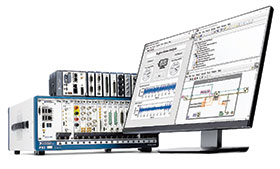
A new release of National Instruments’ LabVIEW software has been built with the aim of giving engineers new tools that simplify system integration and grant more control through hardware accessibility.
Users can integrate more third-party IP from tools like Python to make the most of the strengths of each package or existing IP from their stakeholders. Test engineers can use new functionality in LabVIEW 2018 to strengthen code reliability by automating the building and execution of software through integration with open interface tools like Jenkins for continuous delivery.
Capabilities like this empower test engineers to focus on system integration and development where they can offer unique differentiation, rather than get bogged down in the semantics of how to use software tools or move IP from one to another. For test engineers using FPGAs for high-performance processing, new deep learning functions and improved floating-point operations can reduce time to market.
To meet demands like testing higher complexity DUTs (devices under test) and shorter timeframes, engineers need tools tailored to their needs that they can efficiently use through their workflow, helping them to meet their exact application requirements. LabVIEW 2018 features products tailored to needs within distinct stages of their workflow – products that have been adopted in whole or in part by more than 300 000 active users.
With InstrumentStudio software providing an interactive multi-instrument experience, TestStand test management software handling overall execution and reporting, and SystemLink software managing assets and software deployments, this workflow improves the productivity of test and validation labs across many industries. Each piece of the workflow is also interoperable with third-party software to maximise code and IP reuse and draws on the LabVIEW Tools Network ecosystem of add-ons and tools for more application-specific requirements.
For more information contact Test Dynamics, +27 62 217 0063.
AI Experts provide product-specific intelligence Measuretest
Test & Measurement
VIAVI Solutions has announced AI Experts, the first addition to its NITRO AI portfolio of AI-driven capabilities with each Expert providing product-specific intelligence.
Read more...Rugged spectrum analyser Vepac Electronics
Test & Measurement
The HAROGIC PXR Series is designed for maximum durability and performance in the most demanding environments.
Read more...Setting a new benchmark for high-power DC load testing Conical Technologies
Test & Measurement Power Electronics / Power Management
The new ITECH IT8900G/L high-speed, high-power DC electronic load offers a powerful combination of speed, scalability, precision and high-power density.
Read more...Locate underground cable faults faster with the Fluke AF2082 A-Frame Comtest
Editor's Choice Test & Measurement
Underground cable faults can lead to costly downtime, service disruptions, and extensive excavation if the fault location is uncertain. The AF2082 simplifies this process by guiding operators directly to the fault point.
Read more...Precision power for electronics testing Vepac Electronics
Test & Measurement
The PeakTech 6168 switching power supply is a versatile and reliable solution designed for professional applications in laboratories, development environments, service centres, and training facilities.
Read more...12-bit 1-wire temperature sensing RS South Africa
Test & Measurement
The DS18B20 digital thermometer from Analog Devices provides 9-bit to 12-bit Celsius temperature measurements in the range -55°C to 125°C.
Read more...Ultra-fast wideband RF insight Vepac Electronics
Test & Measurement
The Harogix PXE-200 is a high-performance real-time spectrum analyser designed for demanding RF environments up to 20 GHz.
Read more...Field calibration made easy Instrotech
Test & Measurement
Built around modern component technology, an intuitive interface, and a rugged IP54-rated housing, Instrotech’s Calog series is engineered for the demands of real industrial field calibration work.
Read more...Rugged two-pole voltage tester Vepac Electronics
Test & Measurement
A key advantage of the PeakTech 1094 is its battery-free operation, ensuring the tester is always ready for use whenever required by professional electricians or maintenance personnel.
Read more...Rapid IoT prototyping simplified Future Electronics
Test & Measurement
The STEVAL-MKBOXPRO from STMicroelectronics is a compact, ready-to-use wireless development kit designed to accelerate the creation of intelligent IoT and wearable applications.
While every effort has been made to ensure the accuracy of the information contained herein, the publisher and its agents cannot be held responsible for any errors contained, or any loss incurred as a result. Articles published do not necessarily reflect the views of the publishers. The editor reserves the right to alter or cut copy. Articles submitted are deemed to have been cleared for publication. Advertisements and company contact details are published as provided by the advertiser. Technews Publishing (Pty) Ltd cannot be held responsible for the accuracy or veracity of supplied material.









 printer friendly version