AC/DC converters for cost sensitive applications
14 November 2018
Power Electronics / Power Management
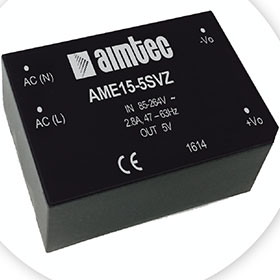
Aimtec's new AC/DC series offer greater cost effectiveness following new production automation, leading to improved reliability and performance. Offering a commercial input voltage range of 85-264 V a.c. and an output voltage range from 3,3-24 V, the range includes the AMEL3-VZ (available wire terminal), AMEL5-VZ (available wire terminal), AMEL6-VZ, AME5-VZ, AME10-VZ, AME15-VZ, AME20-VZ and AME25-VZ.
With operating temperatures from -40°C to 85°C or -40°C to 70°C (AMEL3/5/6-VZ) with full power up to 55°C, they also feature isolation of 4000 V a.c. coupled with an efficiency of up to 87% for improved reliability and system safety. Furthermore, a high mean time before failure of 300 000 hours, output short circuit protection (OSCP), output over-current protection (OCP) and output over-voltage protection (OVP) come standard with the new series.
Aimtec's new cost-effective AC/DC converters are suitable for street lighting controls, power grid, instrumentation, industrial controls, communication and other commercial applications.
For more information contact Ferash Latchman, Avnet South Africa, +27 11 319 8600, ferash.latchman@avnet.eu, www.avnet.co.za
Further reading:
High-precision current transducer
Power Electronics / Power Management
Danisense announces its new high-precision DP12IP current transducer designed for isolated DC and AC current measurement in demanding PCB-mounted power electronics applications.
Read more...
Secure holder for protected 18650 batteries
Power Electronics / Power Management
Designed for protected 18650 batteries up to 70 mm long, the holder offers secure retention for portable, industrial, and embedded applications.
Read more...
More room to scale
Altron Arrow
Power Electronics / Power Management
With the latest STM32H5 lines from STMicroelectronics, you can now scale within the same platform, from a compact 1 Mbyte device to higher-memory MCUs for graphics-rich and feature-heavy designs.
Read more...
Surface mount power amplifier for high-power applications
RF Design
Power Electronics / Power Management
The GNA-63-5W+, from Mini-Circuits, is a GaN MMIC Power Amplifier (PA) designed for demanding RF applications requiring high efficiency, excellent linearity, and a compact footprint.
Read more...
1200 V QSiC modules
Power Electronics / Power Management
SemiQ Inc has launched the QSiC Dual3, a family of 1200 V half-bridge MOSFET modules for motor drives in data centre cooling systems, grid converters in energy storage systems, and industrial drivers.
Read more...
MCOTS transient filter for military applications
RFiber Solutions
Power Electronics / Power Management
SynQor has announced the new MCOTS-F-28-T-HE transient half-brick filter, the latest addition to its MCOTS product family.
Read more...
Expanded range of high-thermal-performance QSiC modules
Power Electronics / Power Management
SemiQ’s half-bridge series for data centre power converters and industrial motor drives features low RDSON SiC MOSFETs and parallel SBD diodes for best-in-class power density and conversion efficiency.
Read more...
Transporting lithium batteries and IoT devices
Power Electronics / Power Management
With billions of rechargeable and non-rechargeable lithium cells and batteries powering most of the world’s consumer and industrial electronic devices, shipping them to customers through vast global logistics chains is often an overlooked topic.
Read more...
Setting a new benchmark for high-power DC load testing
Conical Technologies
Test & Measurement Power Electronics / Power Management
The new ITECH IT8900G/L high-speed, high-power DC electronic load offers a powerful combination of speed, scalability, precision and high-power density.
Read more...
Quality batteries are critical for IIoT
Uniross Batteries
Power Electronics / Power Management
Batteries intended for use in industrial operations must indeed offer complete reliability under extreme environmental conditions, resistance to vibration and harsh environments.
Read more...









 printer friendly version