

Power Electronics / Power Management


USB Type-C power controllers

23 October 2019 Power Electronics / Power Management

Microchip announced two new solutions that simplify USB Type-C PD (Powered Device) designs to remove the traditional complexity and high costs associated with implementing USB Type-C in a range of applications.

As one of the industry’s first USB-IF-certified USB 3.1 SmartHub devices with integrated support for Power Delivery (TID1212), the USB705x family enables fast device charging and introduces unique PD implementations called HostFlexing and PDBalancing.

HostFlexing simplifies the user’s docking station experience by allowing all USB Type-C ports to function as the ‘notebook’ port, eliminating the need for cryptic labels that try and explain overall functionality of each USB Type-C port. PDBalancing provides a methodology for manufacturers to manage overall system power through centralised control, ultimately saving money for consumers by being able to charge a number of PD-enabled devices with less overall power.

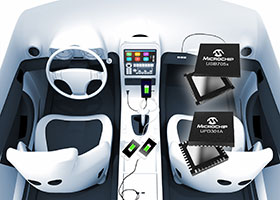
The UPD301A is a standalone USB Type-C PD controller that significantly simplifies the implementation of basic USB Type-C PD charging functionality, making it ideal for applications from rear seat charging in vehicles to portable equipment to public charging stations.

To meet consumer demand for faster mobile device charging and data streaming, the USB705x family combines native support for USB Type-C PD with the 5 Gbps SuperSpeed data rates of USB 3.1. Ideal for docks, PC monitors and automotive infotainment, the family, which consists of the USB7050, USB7051, USB7052 and USB7056, provides a range of USB configurations to meet varying PD and USB Type-C design needs. For example, the USB7050 supports three PD-enabled upstream and downstream USB Type-C ports, while the USB7056 provides only one upstream port alongside five traditional Type-A downstream ports.

The new hubs also support driver assistance applications that are available on all mobile handsets, allowing the graphical user interface of a phone to be displayed on a vehicle’s screen while simultaneously charging the mobile device.

With smartphones increasingly requiring more than standard BC 1.2 power, designers of electronic systems need to be able to easily implement basic high-powered charging in systems. The UPD301A provides a simple, standalone solution for implementing USB Type-C PD charging in a variety of applications.

The device supports both single- and dual-port operation and uses a pin-configurable implementation that focuses on ease of use. The UPD301 complements Microchip’s expansive family of USB hubs and enables solutions from charge-only to full data, video and power management.

The USB705x and UPD301 come with a complete solution including the MPLAB Connect Configurator hub configuration tool, evaluation boards with schematics and Gerber files to reduce development time.




Share this article:
Share via emailShare via LinkedInPrint this page

Further reading:

Quality batteries are critical for IIoT
Uniross Batteries Power Electronics / Power Management
Batteries intended for use in industrial operations must indeed offer complete reliability under extreme environmental conditions, resistance to vibration and harsh environments.

Read more...
12 kW hybrid inverter
Power Electronics / Power Management
Sungrow recently unveiled its next-generation residential energy storage solution, expanding its power range from 5 kW to 12 kW with the introduction of the new MG12RL hybrid inverter.

Read more...
40 W and 75 W railway DC/DC converter
Brabek Power Electronics / Power Management
RECOM has announced two new cost-efficient DC/DC converters for the rail market with an ultra-wide 11:1 input range to cover all nominal input voltages from 24 to 110 V DC.

Read more...
Power modules for solid-state transformers
RS South Africa Power Electronics / Power Management
Microchip’s new 3,3 kV silicon carbide modules deliver the required thermal performance and efficiency for SSTs to increase power available for token generation.

Read more...
Solving South African power problems with locally built intelligence
Editor's Choice Power Electronics / Power Management
Smart metering infrastructure in South Africa remains patchy. The rollout has been slow, coverage is inconsistent, and for the most part, granular per-unit measurement simply does not exist.

Read more...
Wide range power module
Power Electronics / Power Management
The latest DC-DC modules from Würth Elektronik are characterised by high resilience to voltage transients on the 24 V bus and an extremely wide input-voltage range from 3,5 V to 38 V.

Read more...
Selecting primary batteries for maximum service life
Uniross Batteries Power Electronics / Power Management
Primary batteries play an important role in IoT applications. Designed for longevity, they have a high-energy capacity and are often used in standalone applications where charging is impractical or impossible.

Read more...
4 kW e-mobility DC-DC converter
Brabek Power Electronics / Power Management
The RECOM RMOD4000 series of compact, plug-and-play DC-DC converters is a cost-effective solution to provide isolated 14 V, 28 V, or 56 V DC network rails from a high input voltage between 180 and 950 V DC.

Read more...
Aluminium case upgrade boosts performance
Vepac Electronics Power Electronics / Power Management
The SQBF Quarter Brick 300 W DC to DC Converter is now available in a newly upgraded metal case designed to deliver improved durability and superior electrical performance across demanding applications.

Read more...
Extending the range of power converters
RS South Africa Power Electronics / Power Management
Power Integrations recently announced a breakthrough in flyback topology extending the power range of flyback converters to 440 W - well beyond the limits that traditionally required more complex resonant and LLC topologies.

Read more...


While every effort has been made to ensure the accuracy of the information contained herein, the publisher and its agents cannot be held responsible for any errors contained, or any loss incurred as a result. Articles published do not necessarily reflect the views of the publishers. The editor reserves the right to alter or cut copy. Articles submitted are deemed to have been cleared for publication. Advertisements and company contact details are published as provided by the advertiser. Technews Publishing (Pty) Ltd cannot be held responsible for the accuracy or veracity of supplied material.


© Technews Publishing (Pty) Ltd | All Rights Reserved