

Circuit & System Protection


Single-ended capacitors designed for tough applications

24 April 2002 Circuit & System Protection

Although aluminium electrolytic capacitors historically rank among the oldest electronic components, they are being constantly developed to open up new applications and satisfy tougher requirements.

Electronics has become a key link in the value chain of the automobile industry. Depending on model and equipment options, electrical and electronic systems now account for 10 to 20% of vehicle costs. Whereas electronic components were restricted to a minimum of safety and convenience applications only a few years ago, today they are experiencing a veritable boom throughout the automobile industry. Safety, environmentally-friendly engine management, convenience and infotainment are the buzzwords that sum up this fast-moving trend.

However, these useful features and functions not only consume more and more power, but have also become so numerous and varied that it is hard to predict in which combinations and sequences they are likely to be switched on or off. Dramatic current fluctuations of dozens of amperes within a few milliseconds are the result. Combined with generator ripple, these fluctuations can destabilise voltage in the automotive electrical system. For sophisticated controller and processor-based electronics in particular, such a fuzzy voltage is unacceptable because it can trigger off malfunctions such as inadvertent inflation of airbags with disastrous consequences.

Aluminium electrolytic capacitors are the components of choice for protection against short voltage fades and severe ripple. Focusing on the special needs of the automobile industry, Epcos has developed single-ended types in good time and substantially improved existing series to meet tough requirements.

In series B41888, for example, equivalent series resistance (ESR) has been reduced by as much as 30% to obtain better blocking with fewer capacitors. As more and more electronic circuitry is installed in the immediate vicinity of the engine, a wider temperature range is needed for the components used. This presents automotive electronics with one of its toughest challenges. Epcos has specially developed the B41866, B41867 and B41868 series for extreme ambient temperatures. They are designed for continuous operation in a range from -55 to +150°C.
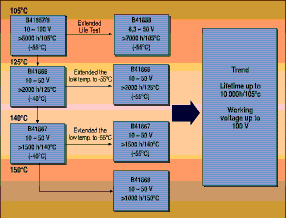
Road map for single-ended aluminium electrolytic capacitors at Epcos

Aluminium electrolytic capacitors have long been regarded as the lowest common denominator in the service life of electronic equipment. Epcos has done much to change their image. The service life of the types mentioned above is specified as 7000 hours at 105°C - long enough for the average useful life expected for most cars and trucks. Special design measures have also improved their shock and vibrational strength. But development of aluminium electrolytic capacitors is far from exhausted, and Epcos continues to improve the critical parameters of these heavy-duty components.


Credit(s)


Share this article:
Share via emailShare via LinkedInPrint this page

Further reading:

Clearing the Static: The importance of ESD audits
Actum Circuit & System Protection
An ESD audit is the first step in establishing an effective static control programme in the workplace, and will help identify vulnerable areas and potentially hazardous static zones that require improvement.

Read more...
EMI shielding materials application guide
Circuit & System Protection
TE Connectivity’s shielding solutions include electrically conductive elastomers, gaskets, knitted wire mesh, oriented wire, EMI shielding ventilation panels, shielded window, cable shielding and shielding components.

Read more...
Clearing the Static: ESD containers and packaging
Actum Circuit & System Protection
         Vacuum forming ESD Electronic components can be damaged by electrostatic discharges. To protect against such damage, electronic assembly parts are often transported or stored in vacuum formed component ...

Read more...
Electrostatic discharge chairs
Actum Circuit & System Protection
An ESD chair forms an integral part of grounding within the electrostatic discharge protected area to prevent potential damage to products.

Read more...
Conductive ESD footwear
Actum Circuit & System Protection
Conductive ESD footwear is used in conjunction with other grounding devices, such as a wrist strap, cord, and ESD surface mats, to provide a continuous path to ground.

Read more...
Clearing the Static: The importance of cleaning in ESD control
Actum Circuit & System Protection
To prevent Electrostatic Discharge (ESD) damage to sensitive electronic assemblies and components, all production, handling, packaging, and storage must take place in an ESD-protected environment.

Read more...
Precision in next-gen asset tracking
Electrocomp Telecoms, Datacoms, Wireless, IoT
KYOCERA AVX’s advanced antenna technologies have been engineered specifically for compact, high-performance tracking devices.

Read more...
Miniaturised RFID Tags
Electrocomp Telecoms, Datacoms, Wireless, IoT
In the rapidly evolving landscape of Industry 4.0, where precision, resilience, and compact design are more than buzzwords, Neosid is revolutionising identification through its NeoTAG line of RFID transponders.

Read more...
Clearing the Static: Staying grounded
Actum Circuit & System Protection
To maintain reliable electrostatic discharge control, regular testing and accurate measurement are essential, with grounding products and ESD testing equipment being vital.

Read more...
Smarter protection without disruption
NewElec Pretoria Circuit & System Protection
Designed for operations still running without integrated automation, NewElec’s retrofit-friendly systems let you upgrade performance and safety without overhauling your entire network.

Read more...


While every effort has been made to ensure the accuracy of the information contained herein, the publisher and its agents cannot be held responsible for any errors contained, or any loss incurred as a result. Articles published do not necessarily reflect the views of the publishers. The editor reserves the right to alter or cut copy. Articles submitted are deemed to have been cleared for publication. Advertisements and company contact details are published as provided by the advertiser. Technews Publishing (Pty) Ltd cannot be held responsible for the accuracy or veracity of supplied material.


© Technews Publishing (Pty) Ltd | All Rights Reserved

