Signal conditioning modules
8 May 2002
Test & Measurement
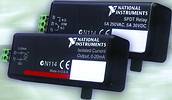
National Instruments offers two new signal conditioning modules allowing engineers and scientists to add control capabilities to their portable or low channel-count data acquisition (DAQ) systems. The modules are ideal for design validation and research applications says NI.
The SCC-CO20 is a single-channel isolated current output module that delivers up to 20 mA and features a safety working isolation of 300 V per module. The module controls devices that provide a 0 to 20 mA current interface, such as valves or actuators. The SCC-RLY01 is a single-channel relay module that connects one input to one output for switching external devices. The module delivers one SPDT relay capable of switching 5 A at 30 V d.c or 250 V a.c. The SCC-RLY01 module is ideal for switching power supplies and other high-voltage, high-current signals.
The SCC-CO20 and SCC-RLY01 modules expand the NI SCC signal conditioning family. The SCC signal conditioning front-end offers the flexibility and advanced features required for a low channel-count or portable data acquisition system. The SCC series is an easy-to-use signal conditioning option for applications that require multiple signal/sensor types and connectivity options. The measurement type and connectivity options can be selected on a per-channel basis.
National Instruments
011 805 8197
Further reading:
AI Experts provide product-specific intelligence
Measuretest
Test & Measurement
VIAVI Solutions has announced AI Experts, the first addition to its NITRO AI portfolio of AI-driven capabilities with each Expert providing product-specific intelligence.
Read more...
Rugged spectrum analyser
Vepac Electronics
Test & Measurement
The HAROGIC PXR Series is designed for maximum durability and performance in the most demanding environments.
Read more...
Setting a new benchmark for high-power DC load testing
Conical Technologies
Test & Measurement Power Electronics / Power Management
The new ITECH IT8900G/L high-speed, high-power DC electronic load offers a powerful combination of speed, scalability, precision and high-power density.
Read more...
Locate underground cable faults faster with the Fluke AF2082 A-Frame
Comtest
Editor's Choice Test & Measurement
Underground cable faults can lead to costly downtime, service disruptions, and extensive excavation if the fault location is uncertain. The AF2082 simplifies this process by guiding operators directly to the fault point.
Read more...
Precision power for electronics testing
Vepac Electronics
Test & Measurement
The PeakTech 6168 switching power supply is a versatile and reliable solution designed for professional applications in laboratories, development environments, service centres, and training facilities.
Read more...
12-bit 1-wire temperature sensing
RS South Africa
Test & Measurement
The DS18B20 digital thermometer from Analog Devices provides 9-bit to 12-bit Celsius temperature measurements in the range -55°C to 125°C.
Read more...
Ultra-fast wideband RF insight
Vepac Electronics
Test & Measurement
The Harogix PXE-200 is a high-performance real-time spectrum analyser designed for demanding RF environments up to 20 GHz.
Read more...
Field calibration made easy
Instrotech
Test & Measurement
Built around modern component technology, an intuitive interface, and a rugged IP54-rated housing, Instrotech’s Calog series is engineered for the demands of real industrial field calibration work.
Read more...
Rugged two-pole voltage tester
Vepac Electronics
Test & Measurement
A key advantage of the PeakTech 1094 is its battery-free operation, ensuring the tester is always ready for use whenever required by professional electricians or maintenance personnel.
Read more...
Rapid IoT prototyping simplified
Future Electronics
Test & Measurement
The STEVAL-MKBOXPRO from STMicroelectronics is a compact, ready-to-use wireless development kit designed to accelerate the creation of intelligent IoT and wearable applications.
Read more...









 printer friendly version