


Transport layer protocols
Ethernet is termed a data link and physical layer technology and, therefore, occupies layers two and one of the OSI reference model. The original designers never intended the technology to guarantee end-to-end message delivery. This responsibility is given to the transport layer (layer four) of the OSI model in Figure 1.
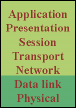
Responsibility for internetworking (communication between two networks) is given to layer three - the network layer. The transport and internetworking layer functionality becomes part of the protocol stack and two protocols have found much use with Ethernet - TCP/IP and SPX/IPX. These two protocols will not directly interoperate so it is important that all Ethernet nodes on the network utilise compatible protocols. Since TCP/IP powers the Internet, this is the protocol that has won out and the one recommended for industrial Ethernet.
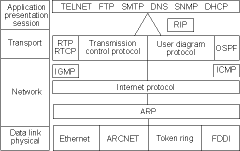
Actually, TCP/IP is a set of protocols defined by a series of RFCs (request for comments) that have evolved over the years. In Figure 2, one will notice how the TCP/IP stack of protocols relates to the OSI model. TCP/IP will work with other data link technologies besides Ethernet so it resides above the data link/physical layer. At the transport layer there are two important protocols. The transmission control protocol (TCP) acknowledges receipt of messages while the user datagram protocol (UDP) does not. Both are useful. At the very top of the protocol stack there are several useful application layer protocols that find use in industrial Ethernet. TCP/IP is a complex subject and it will not be addressed here. To the installer, the most important issue is the addressing of nodes, which is a network layer issue.
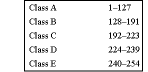
The Internet Protocol (IP) handles the routing of packets between stations that may reside on different networks. Each station must have a unique 32-bit address that not only identifies the host (station) but the network as well. Addresses are best shown as four bytes in a decimal-dot-decimal notation. A valid address would be 128.8.120.5 but it is difficult to determine what part of the address is the host address and what part is the network address. Addresses are defined as residing in either one of five classes - A, B, C, D or E. Table 1 defines the classes by observing the value of the first byte of the address. It is the class that determines the <host><netid> split.
Assigning IP addresses is not simple and they are usually assigned by the network administrator. Once assigned they must be applied to each station in the network. Depending upon the system installed, IP addresses may be dynamically assigned or statically assigned. Dynamically assigned addresses come from a server, while statically assigned addresses must be entered for each station as part of the configuration. IP addresses are either public or private. A public address can usually be seen on the Internet. The following addresses are private and cannot be assessed through a router and, therefore, will not be seen on the Internet:
10.0.0.0 to 10.255.255.255
172.16.0.0 to 172.31.255.255
192.168.0.0 to 192.168.255.255
IP addressing should not be confused with Ethernet MAC addresses. An Ethernet MAC address is assigned by the equipment vendor so as to be unique worldwide. IP addresses are assigned during installation and can be reassigned as necessary.
Application layer protocols
Now that we have determined our connector and cable needs, selected either hubs or switches and assigned the required IP addresses, we should be able to communicate between stations. This is not necessarily true. We still need compliance at the highest level of the OSI reference model. There are several industrial automation protocols that are being proposed such as EtherNet/IP, iDA, PROFInet and MODBUS/TCP. This does not include the traditional Internet applications such as FTP, SNMP, SMTP and TELNET. Your equipment may not support all these application protocols, so you must understand the capabilities of your system. It is also possible that your equipment can handle all these applications. This is another advantage for using a TCP/IP stack.
This is where our discussion stops. Industrial Ethernet offers many possibilities; however, because of this flexibility, the subject is somewhat complex. You may not have all the answers but you should have a better feeling about some of the questions that need to be asked.
Finally
We hope this series has been helpful. For a more in-depth analysis of industrial Ethernet, several articles can be downloaded from www.ctrlink.com
For more information contact our representative in South Africa, Electronic Products Design, 012 665 9700.
| Tel: | +27 12 493 0852 |
| Email: | jaapwillemse@gmail.com |
| www: | www.epd.co.za |
| Articles: | More information and articles about Electronic Products Design |






© Technews Publishing (Pty) Ltd | All Rights Reserved
 printer friendly version