


Pressure is mounting to reduce energy waste globally as consumers use more appliances requiring power or recharging. Energy agencies worldwide have created regulations to reduce the costly waste but the absence of technology has limited their ability to make the regulations stringent.
In the US, President George Bush issued an executive order which dictated that "Each agency, when it purchases ... shall purchase products that use no more than one watt in their standby power consuming mode." This meant that US government organisations had to make every effort to meet this demand and if products were not available they had to buy devices with the lowest standby power.
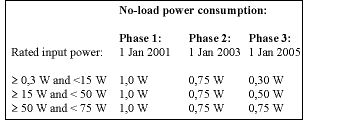
In Europe there is an ongoing programme for no-load external power supply requirements (Table 1), while Japan has its Top Runner programme. Many other standards and programmes have been introduced around the world including Blue Angel and the China Sustainable Energy Programme (see 'Green room for energy efficiency regulations' at the end of this article).
Energy vampires
One major source of wasted power is 'energy vampires' - the large and heavy transformer-based power adapters and battery chargers in homes and businesses that continuously drain energy, even when the electronic devices they power are not operating. Unknown to most US consumers, more than $4 bn - or nearly 10% - of the electricity they pay for every year is wasted powering products at home thought to be 'off'.
According to studies for the Energy Department by the Berkeley National Laboratories, standby wastes the equivalent of the power generated by 26 average-size power plants in the USA alone. This does not include the standby power wasted in businesses worldwide. All of this waste contributes to carbon dioxide emissions with no benefit to energy users.
Energy vampires include the bulky and heavy transformer adapters and chargers partnered with PDAs, cellphones, CD players, cordless phones, digital cameras, MP3 players, electric razors and many other household electronic devices. Replacing the vampires saves energy dollars and cuts the environmental impact of generating power that is wasted as heat.
Energy-smart semiconductor
In response to the global need to cut energy waste, Power Integrations has developed the LinkSwitch, an energy-smart semiconductor that enables electronics manufacturers to eliminate up to 90% of the power wasted by energy vampires in standby and no-load conditions and to shrink the size and weight of these adapters by up to 80%.
Power Integrations' switching power supply IC for the first time, cost-effectively replaces inefficient linear transformer designs in adapters and battery chargers rated at 3 W and below.
The LinkSwitch is a highly integrated high-voltage power conversion IC designed specifically to displace low power linear transformers by delivering switcher benefits - smaller size, lighter weight, superior performance and energy efficiency - at equal or lower system cost. With as few as 14 components, the LNK501 enables a fault protected, universal input (85 V a.c. to 265 V a.c.), constant voltage, constant current (CV/CC) output switching power supply that meets worldwide energy efficiency standards. The LNK501 is available in both through-hole and surface mount DIP packages.
The LinkSwitch family is based on the same technology as the company's widely-used TOPSwitch product lines of which approximately one billion devices have shipped since 1994. The LinkSwitch combines a 700 V power MOSFET, PWM controller, high voltage start-up, current limit, and thermal shutdown circuitry onto a single CMOS chip.
It uses a primary-based CV/CC solution that combines the primary clamp, feedback, IC supply and loop compensation functions, eliminating up to 20 external components typically found in alternative switcher designs. This primary-controlled, constant current power supply output characteristic is suitable for many low-cost battery chargers, providing overload protection under output short circuit conditions.
Requiring only three terminals, LinkSwitch includes thermal and current limit protection, auto-restart for short circuit and open loop fault protection, and the company's EcoSmart technology. EcoSmart reduces the energy consumption of the power supply during standby and no-load conditions.
The LinkSwitch family, combined with the TinySwitch-II and TOPSwitch-GX product families, allows Power Integrations to address power supplies from 0 to 250 W, offering improvements in size, weight and energy efficiency. The company believes its technology can now address over 90% of all AC to DC power supplies made today.
Design support
LinkSwitch is supported by a number of design tools including a 20-page datasheet, a design guide application note (AN-35), a Design Accelerator Kit (DAK-16) containing two operational 2,75 W universal input AC-DC adapters and product samples, and the company's power supply design software program, PI Expert.
For more information contact Memec SA, 021 674 4103.
Green room for energy efficiency regulations
Power Integrations has set up the 'Green Room' the first consolidated online resource for information on energy efficiency regulations and initiatives worldwide. This website ( www.powerint.com/greenroom/</a>) should help manufacturers, regulators, and consumers access details and deadlines for all current and planned energy efficiency standards worldwide.
The site also links visitors via an icon character named 'LINK the Energy Vampire Slayer' to the specific Power Integrations design solution currently available to meet a given standard. The company wanted to consolidate information gathering, and at the same time showcase its EcoSmart solutions, which allow its customers to meet all current and proposed energy standards worldwide.
Visitors can search regulations by the type of product being manufactured, the name of the standard, or by the region of the world. For the most part, energy efficiency standards remain specific to a given country or region through organisations like Energy Star in the USA or Blue Angel in Germany. The 'Green Room' also contains a question and answer section and facts and figures on the significant energy savings attributable to using Power Integrations' solutions.






© Technews Publishing (Pty) Ltd | All Rights Reserved
 printer friendly version