

Test & Measurement


Forced discharge test of lithium batteries for aviation applications

26 April 2023 Test & Measurement

Effective from 1 January 2009, the latest version of the Technical Instructions for the Safe Transport of Dangerous Goods by Air issued by the International Civil Aviation Organization (ICAO) added UN serial numbers for dangerous goods, and lithium batteries are classified as lithium-ion batteries (UN 3090 and UN 3091) and lithium metal batteries (UN 3480 and UN 3481). The regulation states that lithium batteries cannot be transported by air if they are not accompanied by a test report or certificate of approval based on UN38.3.

UN 38.3 refers to Part 3, paragraph 38.3 of the United Nations Manual of Tests and Criteria for the Transport of Dangerous Goods, which requires lithium batteries to pass height simulation, high and low temperature cycling, vibration test, shock test, external short circuit at 55°C, impact test, overcharge test, and forced discharge test, before transportation to ensure the safety of lithium batteries.

Forced discharge means that the battery discharges the internal stored power. When the voltage reaches a certain value, continued discharge will cause over-discharge. It will destroy the crystalline structure of the positive and negative electrodes of the battery, degrading the thermal stability of the two electrodes. The negative electrode produces a large amount of hydrogen gas, which catalyses the decomposition of the organic electrolyte. When the temperature is high enough, the positive electrode will decompose and produce a large quantity of hydrocarbons, which will eventually lead to the rupture of the battery, resulting in fire.

Real case scenario

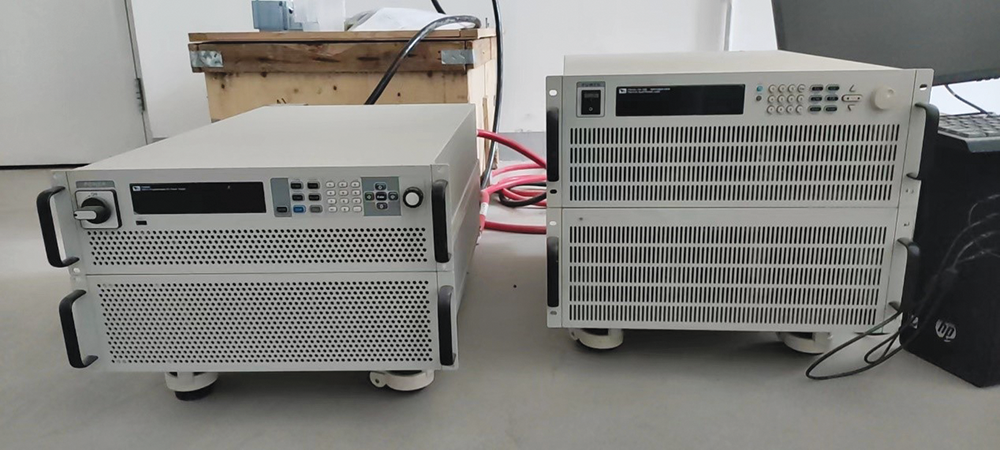
A test required a 3,7 V battery cell to undergo a forced discharge at 500 A. An ITECH T6030D-80-900 high-power DC power supply was used. The PSU was set to 12 V/510 A and connected in series with the battery cell. An IT8912A-150-1200 high-performance DC electronic load, with constant current set to 500 A, was used to discharge the cell.

The sense function of the load was switched on, and through the remote measurement terminal, the voltage of the battery cell could be read back in real time. The voltage and current data used for this experiment was then recorded through the supporting software. The data was then analysed, and conclusions drawn, once the experiment was complete.

ITECH DC power supplies and loads can be used to test all types of battery chemistries. Besides the models mentioned above, there are also bi-directional DC power supplies and the ITS5300 battery testing system for different battery testing options.


Credit(s)


Share this article:
Share via emailShare via LinkedInPrint this page

Further reading:

Compact high precision magnetometer
Future Electronics Test & Measurement
Bosch Sensortec has introduced the BMM350, a compact 16-bit, 3-axis magnetometer engineered to deliver high accuracy, low noise, and exceptional energy efficiency in space constrained designs.

Read more...
Ultra compact NTC thermistors
RS South Africa Test & Measurement
Murata Manufacturing Co. has expanded its compact NCU03 series of NTC thermistors with two ultra-small 0603M devices tailored for consumer and automotive designs.

Read more...
Omniflex uses LoRaWAN to track water usage
Omniflex Remote Monitoring Specialists Test & Measurement
Omniflex has helped New South Wales Ports improve its ability to track water usage by installing remote monitoring to 38 water meters at its Port Kembla site, sending the data to the NSWPorts web portal.

Read more...
Surviving the extremes: Understanding shock and vibration in MEMS sensors
Altron Arrow Editor's Choice Test & Measurement
By considering factors such as mechanical headroom, damping, and system-level robustness, designers can ensure that the chosen sensor not only survives, but performs reliably over time.

Read more...
Advanced pressure monitoring sensor
EBV Electrolink Test & Measurement
The Infineon KP497 is an advanced, highly integrated digital pressure sensor designed for demanding automotive and industrial applications, with a particular focus on battery management systems.

Read more...
Four-quadrant regenerative grid simulator
Conical Technologies Power Electronics / Power Management
The IT7900EP series high-performance regenerative grid simulator from ITECH is a full four-quadrant AC grid simulator capable of both sourcing and sinking power.

Read more...
Slimline 150 W bench PSU
Vepac Electronics Test & Measurement
The PeakTech P 6222 is the company’s new, slim laboratory power supply that offers precisely adjustable output values of 30 V and 5 A with a continuous power output of 150W.

Read more...
Redefining edge intelligence in RF analysis
Vepac Electronics Test & Measurement
The HAROGIC PXR Series bridges the gap between benchtop-grade RF performance and high-performance edge computing.

Read more...
Otto Wireless appointed as sole agent for Dragino Technology
Otto Wireless Solutions Test & Measurement
Dragino is a globally recognised leader in LoRaWAN and Internet of Things products and solutions, and is known for delivering reliable, cost-effective hardware.

Read more...
AI-ready rugged spectrum analysis for the field
Vepac Electronics Test & Measurement
The HAROGIC PXR Series is a rugged, benchtop-grade spectrum analyser and an AI-ready open platform in a single portable instrument.

Read more...


While every effort has been made to ensure the accuracy of the information contained herein, the publisher and its agents cannot be held responsible for any errors contained, or any loss incurred as a result. Articles published do not necessarily reflect the views of the publishers. The editor reserves the right to alter or cut copy. Articles submitted are deemed to have been cleared for publication. Advertisements and company contact details are published as provided by the advertiser. Technews Publishing (Pty) Ltd cannot be held responsible for the accuracy or veracity of supplied material.


© Technews Publishing (Pty) Ltd | All Rights Reserved

