28 June 2023Manufacturing / Production Technology, Hardware & Services
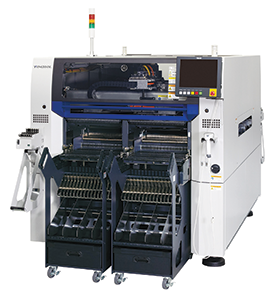
Yamaha Motor Europe Robotics SMT Section has announced a new YRM20DL surface mounter.The YRM20DL is a premium high-efficiency modular design that achieves improved actual and per-unit-area productivity, with a newly developed high-rigidity dual-lane conveyor, further reducing transport losses. The YRM20DL is built on the basic performance of the company’s flagship high-speed, high-accuracy, high-versatility, universal mounter YRM20.
The YRM20DL supports a maximum PCB width of up to 330 mm, where the same width PCB is being conveyed at the front and rear while in dual-lane production mode. In the case of parallel mounting, the front and rear heads can operate without any interference up to a maximum PCB length of 380 mm, enabling high-efficiency mounting without loss.
The basic performance of the unit has been further enhanced to achieve a productivity of up to 120 000 CPH, along with a higher-accuracy placement of ±15 µm (Cpk ≥ 1,0) through the revision of the layout such as bringing the mounted components pick-up area and the mounting area closer together, optimising the main spindle motion control, and improving the rigidity of the conveyor. The RM head/HM head supports 0201 (0,25 x 0,125 mm) sized ultra-small chip component mounting and narrow adjacent mounting.
The newly developed high-rigidity dual-lane conveyor supports a maximum PCB width of up to 330 mm where the same width PCB is being conveyed at the front and rear while in dual-lane production mode. An ultra-high-speed rotary RM head that employs overdrive motion (mutual head insertion) allows the front and rear heads to operate without any interference up to a maximum PCB length of 380 mm, enabling highly efficient mounting without head standby loss.
In single-lane production, which uses only one of the two lanes, it is possible to transport PCBs up to a maximum length of 810 mm, a maximum width of 610 mm, a transportable weight of 3 kg, and a maximum PCB thickness of up to 6,5 mm. This new model is also compatible with a wide range of extra-large-sized PCBs, including for automotive products, industrial, medical, power devices, and LED lighting.
Soldering day highlights
Manufacturing / Production Technology, Hardware & Services
JAPAN UNIX has published a new event report and highlight video from their UNIX SOLDERING DAY 2026 in Hungary. This event reflects on their commitment to supporting manufacturers not only through soldering automation systems, but also through technical education, live demonstrations, hands-on training, and practical engineering know-how.
Read more...Clearing the Static: Electrostatic Discharge Actum
Manufacturing / Production Technology, Hardware & Services
A cordless ESD (Electrostatic Discharge) wrist strap does not work by grounding the person in the same way as a traditional wired wrist strap. Instead, it works by reducing or balancing the static charge on your body so that you are less likely to discharge electricity into sensitive electronic components.
Read more...Engineering trust in South Africa’s SMT sector ZETECH ONE
Manufacturing / Production Technology, Hardware & Services
From a small Johannesburg start-up to a trusted SMT technology partner, Zetech One has spent four decades helping South African electronics manufacturers improve production quality, efficiency and reliability.
Read more...The new reality of PCB material supply Jemstech
Editor's Choice Manufacturing / Production Technology, Hardware & Services
How resilient manufacturing strategies are helping OEMs navigate a changing global supply chain.
Read more...Streamlining Device Programming with the AutoBee-D1 Vepac Electronics
Manufacturing / Production Technology, Hardware & Services
The AutoBee-D1 desktop automated programmer is designed to simplify the programming of devices, while delivering consistent accuracy, high throughput and reduced manual intervention.
Read more...Zero PFAS die attach paste Testerion
Manufacturing / Production Technology, Hardware & Services
With silver price volatility increasing and sustainability requirements accelerating across semiconductor assembly, MacDermid Alpha Electronics Solutions introduces ATROX CD 560-1, a zero per- and polyfluoroalkyl substance (PFAS) alternate silver filler die attach paste.
Read more...Precision jet printing for advanced PCB designs MyKay Tronics
Manufacturing / Production Technology, Hardware & Services
Mycronic’s BA 01 small dot ejector delivers unmatched precision in solder paste jet printing for advanced PCB designs.
Read more...Polypropylene pole-top boxes support smarter, more secure electricity networks
Manufacturing / Production Technology, Hardware & Services Enclosures, Racks, Cabinets & Panel Products
As South Africa accelerates the rollout of smart prepaid electricity metering, innovative enclosure technology from Power Process Systems (PPS) is helping utilities improve network security, reduce electricity theft and protect critical electrical infrastructure.
Read more...200 W of power in a space-saving design Vepac Electronics
Manufacturing / Production Technology, Hardware & Services
The Hakko FX-972 Soldering Station delivers high-performance soldering in a compact package, making it suitable for a wide range of soldering applications.
While every effort has been made to ensure the accuracy of the information contained herein, the publisher and its agents cannot be held responsible for any errors contained, or any loss incurred as a result. Articles published do not necessarily reflect the views of the publishers. The editor reserves the right to alter or cut copy. Articles submitted are deemed to have been cleared for publication. Advertisements and company contact details are published as provided by the advertiser. Technews Publishing (Pty) Ltd cannot be held responsible for the accuracy or veracity of supplied material.









 printer friendly version