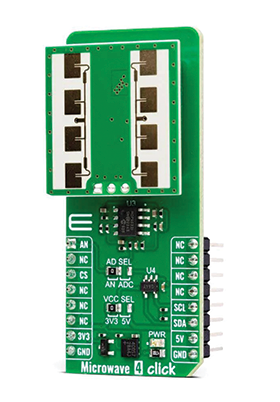
MikroElektronika (MIKROE) has introduced a new motion sensor Click board, to support the development of intrusion alarms, automatic door openers, presence-sensing applications, and more.
The Microwave 4 Click utilises the Doppler Shift phenomenon to sense motion. It is based on the PD-V12, a miniature high-frequency microwave transceiver from Ningbo Pdlux Electronic Technology. This motion sensor is a K-band Bi-Static Doppler transceiver module. It is housed in a metal can and features a built-in resonator oscillator, providing a stable operation as it improves its front signal-receiving ability and reduces its blind area. The Microwave 4 Click detects the frequency shift between a transmitted and a received signal reflected from a moving object within the field of view of the transceiver.
The radiated power (EIRP) emissions of less than 3 mW at maximum meet FCC and CE regulations. The device exhibits very low noise in the 10 to 100 Hz range, and the received signal strength (RSS) is measured at 70 dB. The module uses two antennas for RX and TX with a maximum gain of 0 dBi and is designed to be installed in such a way that allows it to operate at closer than 20 cm to users or nearby persons.
Click boards enable design engineers to change peripherals easily, cutting down development time. The mikroBUS socket standard enables any Click board to be instantly connected to the microcontroller or microprocessor on a main board. Many leading microcontroller companies including Microchip, NXP, Infineon, Dialog, STM, Analog Devices, Renesas and Toshiba, now include the mikroBUS socket on their development boards.
ToF sensor with 6 m range Altron Arrow
Test & Measurement
Specifically designed for long-range, multitarget measurements, the VL53L4CX from ST Microelectronics provides very accurate distance measurements up to 6 m with excellent results over short distances.
Read more...Low power liquid detection for smart systems Future Electronics
Test & Measurement
Microchip Technology’s MTCH9010 Liquid Detection Turnkey Device is a compact, low power sensing solution designed to simplify reliable liquid detection in modern electronic systems.
Read more...AI Experts provide product-specific intelligence Measuretest
Test & Measurement
VIAVI Solutions has announced AI Experts, the first addition to its NITRO AI portfolio of AI-driven capabilities with each Expert providing product-specific intelligence.
Read more...Rugged spectrum analyser Vepac Electronics
Test & Measurement
The HAROGIC PXR Series is designed for maximum durability and performance in the most demanding environments.
Read more...Setting a new benchmark for high-power DC load testing Conical Technologies
Test & Measurement Power Electronics / Power Management
The new ITECH IT8900G/L high-speed, high-power DC electronic load offers a powerful combination of speed, scalability, precision and high-power density.
Read more...Locate underground cable faults faster with the Fluke AF2082 A-Frame Comtest
Editor's Choice Test & Measurement
Underground cable faults can lead to costly downtime, service disruptions, and extensive excavation if the fault location is uncertain. The AF2082 simplifies this process by guiding operators directly to the fault point.
Read more...Precision power for electronics testing Vepac Electronics
Test & Measurement
The PeakTech 6168 switching power supply is a versatile and reliable solution designed for professional applications in laboratories, development environments, service centres, and training facilities.
Read more...Module provides 4G LTE Cat 1 bis connectivity Dizzy Enterprises
Telecoms, Datacoms, Wireless, IoT
Mikroe adds 4G LTE Cat 1 bis connectivity where reliable data transmission and low power consumption are critical with the GC02S1-EU2 module.
Read more...12-bit 1-wire temperature sensing RS South Africa
Test & Measurement
The DS18B20 digital thermometer from Analog Devices provides 9-bit to 12-bit Celsius temperature measurements in the range -55°C to 125°C.
Read more...Ultra-fast wideband RF insight Vepac Electronics
Test & Measurement
The Harogix PXE-200 is a high-performance real-time spectrum analyser designed for demanding RF environments up to 20 GHz.
While every effort has been made to ensure the accuracy of the information contained herein, the publisher and its agents cannot be held responsible for any errors contained, or any loss incurred as a result. Articles published do not necessarily reflect the views of the publishers. The editor reserves the right to alter or cut copy. Articles submitted are deemed to have been cleared for publication. Advertisements and company contact details are published as provided by the advertiser. Technews Publishing (Pty) Ltd cannot be held responsible for the accuracy or veracity of supplied material.









 printer friendly version