

Interconnection


Connectors for AI accelerators

31 July 2024 Interconnection

Developments of the last few years have thrust the subjects of artificial intelligence and machine learning into the limelight.

With the growth of online tools, consumers can now harness the power of AI for a range of tasks. High-performance interconnects provide the link between CPUs and AI accelerators and play a vital role in the scalability and flexibility that these systems demand.

Despite its recent place in the spotlight, AI has been with us for some time. AI powers the algorithms that navigate us through the world. It keeps traffic moving and recommends our next purchase, along with countless other tasks. In essence, these systems are crunching through enormous amount of data, making vast numbers of calculations, and analysing patterns to aid us in decision making.

Coping with larger models is at the heart of the AI revolution, and providing the computing power that is required is a challenge for designers. Fortunately, there is precedent in conventional computer design. The familiar desktop computer handles data-intensive tasks by handing off the processing required for specialist devices. The CPU is responsible for core tasks, but assigns graphics processing or sound emulation to secondary specialist modules. This has led to the structure that is familiar today – a graphics card and sound card, along with other specialist components, mounted to a CPU on a motherboard.

In the world of AI, accelerators perform a similar task. The CPU continues to provide the processing power for the overall system, whilst accelerators, often GPUs, are the specialist hardware, providing the dedicated computational power to crunch through the large models being used by the latest AI systems. The key difference between a conventional computer with its single accelerator or GPU is scalability.

Instead of a one-to-one relationship of CPU to accelerator card, it is possible to equip a single CPU with a potentially large number of accelerators. In such an arrangement, efficient computation depends on the transmission of data between cards with the lowest possible latency and the greatest possible signal integrity. The connections between the cards therefore play a vital role in allowing these computers to process the data they need to.

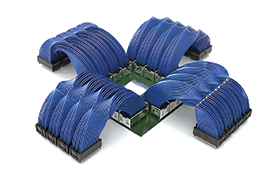
A range of Samtec connectors are playing an enormous role in delivering the connectivity required by AI systems. The range includes conventional board-to-board connector systems that support industry-standard form factors, including PCIe CEM AIC and PECFF. However, faster data rates can be supported over longer distances using ultra-low-skew twinax cable to bypass high-loss printed circuit boards. Samtec’s AcceleRate HP cable assembly is the industry’s highest density 112 Gbps PAM4-rated solution for cable-to-board applications.


Credit(s)


Share this article:
Share via emailShare via LinkedInPrint this page

Further reading:

Omniball through-hole contacts
Spectrum Concepts Interconnection
Mill-Max has introduced an expansion to its Omniball spring-loaded contact range with a new series of through-hole mount Omniball pins designed for robust and versatile interconnect solutions.

Read more...
Phoenix’s Push-X range is growing
Phoenix Contact Interconnection
With the new XT 1,5 terminal blocks, Phoenix Contact is extending the series to include versions for conductor cross-sections from 0,34 to 2.5 mm2.

Read more...
Connector range for demanding environments
Future Electronics Interconnection
TE Connectivity’s DEUTSCH connector range offers high-performance interconnect solutions engineered for demanding environments where reliability and durability are essential.

Read more...
The mechanical side of power
Spectrum Concepts Interconnection
[Sponsored] Power delivery has always been a key requirement of electronic systems, but the way power is generated, distributed, and consumed is changing rapidly with renewable energy installations and energy storage systems introducing new power sources.

Read more...
Magnetic connectors with 2,54 mm pitch
Spectrum Concepts Interconnection
This expansion of the company’s Maxnetic product line delivers next-generation high reliability magnetic connectors designed for use in ever shrinking electronic devices and their applications.

Read more...
Reliable connectivity in harsh environments
Future Electronics Interconnection
The ecomate family of circular, multiway connectors from Amphenol delivers exceptional durability, safety, and versatility for power and signal applications.

Read more...
Cylindrical interconnects with multiple configurations
Startech Industrial Interconnection
Part of the renowned 5015 family of cylindrical interconnects, 97 Series connectors from Amphenol offer an exceptional range of customisation options to meet diverse connectivity needs across multiple industries.

Read more...
Trunk line fusion splicer
Interconnection
The JILONG 280T All-Rounder Middle Trunk Line fusion splicer is a rugged, high-performance fibre optic fusion tool engineered for core networks, FTTx, and access infrastructure.

Read more...
Understanding and controlling impedance in high-speed interconnects
Spectrum Concepts Interconnection
[Sponsored] As data rates move well into the hundreds of gigabits per second, success increasingly depends on an invisible but critical factor: impedance.

Read more...
Low profile spring-loaded connectors
Spectrum Concepts Interconnection
Mill-Max has announced the introduction of low-profile, surface mount additions to its 2 mm pitch spring-loaded connector range.

Read more...


While every effort has been made to ensure the accuracy of the information contained herein, the publisher and its agents cannot be held responsible for any errors contained, or any loss incurred as a result. Articles published do not necessarily reflect the views of the publishers. The editor reserves the right to alter or cut copy. Articles submitted are deemed to have been cleared for publication. Advertisements and company contact details are published as provided by the advertiser. Technews Publishing (Pty) Ltd cannot be held responsible for the accuracy or veracity of supplied material.


© Technews Publishing (Pty) Ltd | All Rights Reserved

