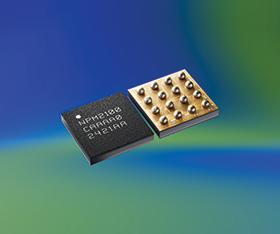
Nordic Semiconductor has announced an addition to its nPM family of Power Management ICs (PMICs). The nPM2100 PMIC prolongs the operating time per battery for primary (non-rechargeable) battery applications by managing energy resources using an ultra-efficient boost regulator and a wide range of energy-saving features. Application examples for the nPM2100 include wireless mice and keyboards, consumer asset tracking, remote controls, and body-worn medical devices.
Examples of supported batteries are one or two AA/AAA/LRxx batteries (in series), or one 3 V LiMnO2 cell. Single- or dual-cell silver oxide and zinc-air coin-cell batteries are also supported, plus any other primary battery that operates within the nPM2100’s input voltage range.
The nPM2100 features a boost regulator with an output range of 1,8 to 3,3 V, powered from an input range of 0,7 to 3,4 V. The regulator can deliver up to 150 mA maximum current. The regulator also powers a Load Switch/LDO supplying up to 50 mA across an output range of 0,8 to 3,0 V. It features a quiescent current (IQ) of 150 nA and delivers up to 95% power conversion efficiency at 50 mA and 90,5% efficiency at 10 µA, making it one of the most efficient contemporary boost regulators on the market.
Quality batteries are critical for IIoT Uniross Batteries
Power Electronics / Power Management
Batteries intended for use in industrial operations must indeed offer complete reliability under extreme environmental conditions, resistance to vibration and harsh environments.
Read more...12 kW hybrid inverter
Power Electronics / Power Management
Sungrow recently unveiled its next-generation residential energy storage solution, expanding its power range from 5 kW to 12 kW with the introduction of the new MG12RL hybrid inverter.
Read more...40 W and 75 W railway DC/DC converter Brabek
Power Electronics / Power Management
RECOM has announced two new cost-efficient DC/DC converters for the rail market with an ultra-wide 11:1 input range to cover all nominal input voltages from 24 to 110 V DC.
Read more...Power modules for solid-state transformers RS South Africa
Power Electronics / Power Management
Microchip’s new 3,3 kV silicon carbide modules deliver the required thermal performance and efficiency for SSTs to increase power available for token generation.
Read more...Solving South African power problems with locally built intelligence
Editor's Choice Power Electronics / Power Management
Smart metering infrastructure in South Africa remains patchy. The rollout has been slow, coverage is inconsistent, and for the most part, granular per-unit measurement simply does not exist.
Read more...Wide range power module
Power Electronics / Power Management
The latest DC-DC modules from Würth Elektronik are characterised by high resilience to voltage transients on the 24 V bus and an extremely wide input-voltage range from 3,5 V to 38 V.
Read more...Selecting primary batteries for maximum service life Uniross Batteries
Power Electronics / Power Management
Primary batteries play an important role in IoT applications. Designed for longevity, they have a high-energy capacity and are often used in standalone applications where charging is impractical or impossible.
Read more...4 kW e-mobility DC-DC converter Brabek
Power Electronics / Power Management
The RECOM RMOD4000 series of compact, plug-and-play DC-DC converters is a cost-effective solution to provide isolated 14 V, 28 V, or 56 V DC network rails from a high input voltage between 180 and 950 V DC.
Read more...High-precision thick-film resistors Avnet Silica
Passive Components
The new Panasonic ERJPC high precision thick-film resistors series deliver accuracy levels previously only achievable with thin film technology, offering customers higher power density and cost-effective performance.
Read more...Aluminium case upgrade boosts performance Vepac Electronics
Power Electronics / Power Management
The SQBF Quarter Brick 300 W DC to DC Converter is now available in a newly upgraded metal case designed to deliver improved durability and superior electrical performance across demanding applications.
While every effort has been made to ensure the accuracy of the information contained herein, the publisher and its agents cannot be held responsible for any errors contained, or any loss incurred as a result. Articles published do not necessarily reflect the views of the publishers. The editor reserves the right to alter or cut copy. Articles submitted are deemed to have been cleared for publication. Advertisements and company contact details are published as provided by the advertiser. Technews Publishing (Pty) Ltd cannot be held responsible for the accuracy or veracity of supplied material.









 printer friendly version