


The vision AI platform PerCV.ai (pronounced Perceive AI), could be the secret weapon that enables a company to deploy an AI application when so many others fail. The solution from Irida Labs, a member of the ST Partner Program, is an end-to-end platform that works with STM32N6 devices. It provides all the required infrastructure to build a new application by capturing and managing data, training models, and optimising algorithms to run on STM32 devices. In a nutshell, it streamlines the creation of vision AI-powered applications at the edge.
The challenges behind computer vision at the edge are that the inherent constraints of microcontrollers are opposite to what video capture and processing requires. On one hand, IoT and other embedded systems constantly reduce power consumption, shrink their footprint, and lower their memory requirements. On the other hand, capturing a video, extracting its images, and processing the information require a ton of memory, massive computational throughput, and significantly increased power consumption.
To solve the problem of designing a computer vision application, PerCV.ai starts by creating a ‘vision twin’. Just like a regular digital twin, the digital vision twin simulates how the application will run. It examines requirements for optimising training and inference, including camera placements, field of view, and areas of focus. Too often, developers assemble something and attempt to test it in a lab, which does not accurately reflect real-world use cases. Others conduct a sort of Monte Carlo experiment, which can be outrageously costly and yield poor results. By adopting a vision twin, PerCV.ai uniquely guides engineers, making the rest of the process a lot more intuitive and predictable.
The STM32N6 optimisation
Irida Labs’ PerCV.ai is a true end-to-end solution, meaning it helps capture training data, label it, and generate a machine learning algorithm that developers can use in their applications. To solve the computational and efficiency challenges, the company worked closely with ST, using STM32Cube.AI within PerCV.ai to enable the conversion of a neural network with STM32-optimised inference operations, and run end solutions on the STM32N6. By utilising the NPU of our microcontroller, Irida Labs was able to process more frames per second than on any other MCU and detect significantly more objects simultaneously.
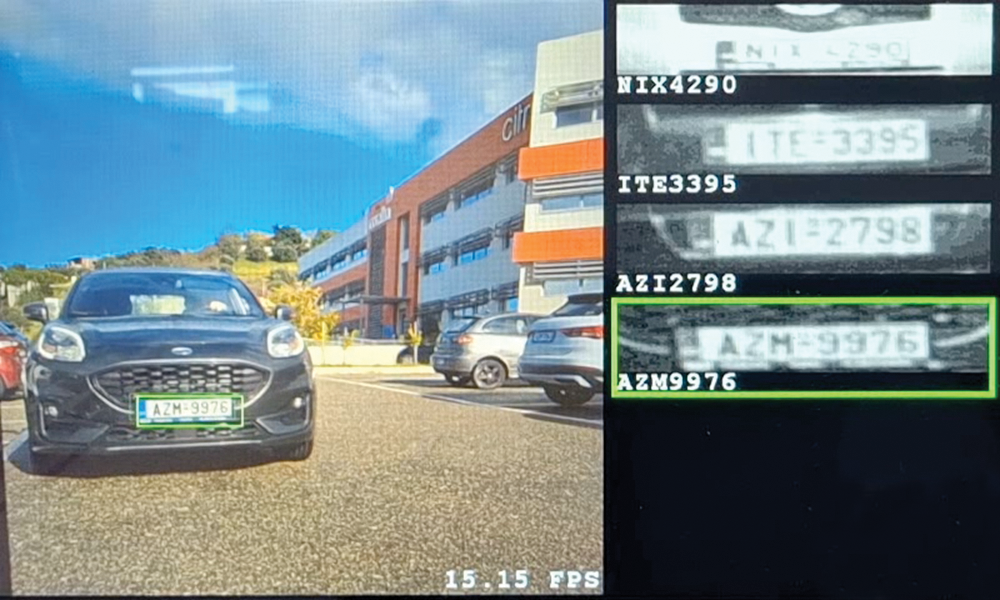
To demonstrate, an application running on the STM32N6570-DK used a MIPI CSI image sensor to track up to five license plates simultaneously. Users observed how the software on the STM32N6 behaved through a live view on the display of the Discovery Kit. Thanks to PerCV.ai, the STM32N6 was able to capture a video feed, detect where the license plates were located, and then ran an optical character recognition algorithm. All this was done on the microcontroller, meaning that at no point is cloud computing involved.
Developers are able to use the STM32N6 and PerCV.ai to run many more types of applications, such as QR code reading, people monitoring, warehouse surveillance, vehicle tracking, and more.
| Tel: | +27 11 923 9600 |
| Email: | info@arrow.altech.co.za |
| www: | www.altronarrow.com |
| Articles: | More information and articles about Altron Arrow |






© Technews Publishing (Pty) Ltd | All Rights Reserved
 printer friendly version