


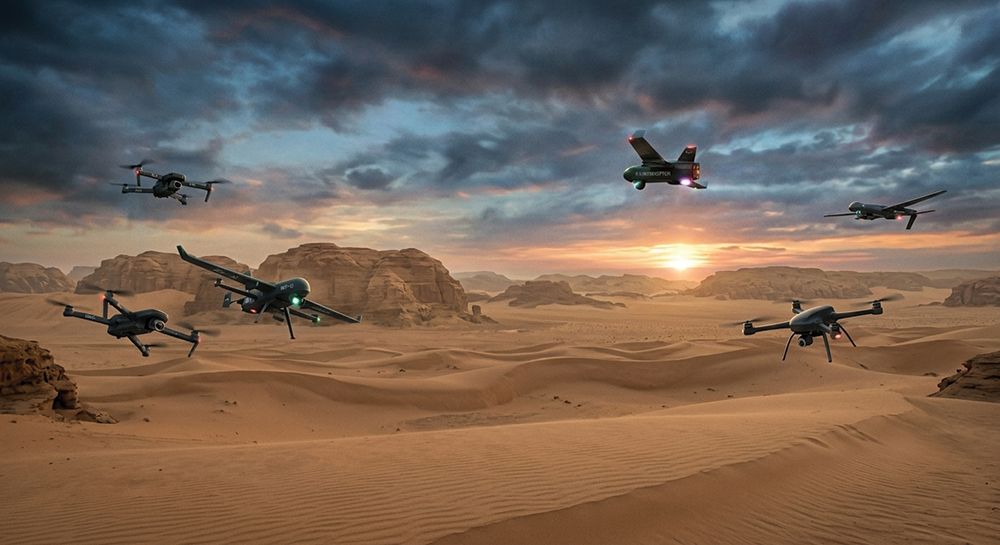
The rapid proliferation of Unmanned Aerial Systems (UAS), ranging from hobbyist quadcopters to sophisticated munitions-carrying military drones, has fundamentally altered the security landscape and come to the fore with the current war in the Middle East.
As of 2026, the global counter-UAV (C-UAS) market has surged to an estimated value of over $8,5 billion, driven by the need to protect critical infrastructure, airports, and battlefield assets from aerial threats.
Effective counter-drone strategy relies on a multi-layered approach. Detection, tracking, and neutralisation is now being guided and implemented using AI.
AI and swarm defence
The current frontier of C-UAS is the integration of artificial intelligence. Modern C-UAS platforms now use AI to autonomously classify threats and coordinate ‘system-of-systems’ responses. As drone swarms comprising up to dozens, if not hundreds, of coordinated UAVs become a reality, the conflict in the Middle East has shown that the future of defence lies in automated systems capable of neutralising multiple targets simultaneously without human fatigue.
The challenge of drone swarms has shifted counter-UAV technology from a manual, one-to-one defensive posture to an automated, many-to-many battle of algorithms. In 2026, the human operator has moved from controlling the action to now overseeing the AI’s decisions.
Modern C-UAS platforms, such as the IDDEA MEGA-APP and Fortem’s SkyDome, use AI to solve the data saturation problem. A swarm of 50 drones can generate thousands of sensor pings per second. AI models can now process this data instantly to:
• Prioritise threats – The AI identifies which drones are carrying payloads versus those acting as decoys or surveillance nodes.
• Predict flight paths – Machine Learning algorithms can analyse erratic flight patterns to predict a drone’s target.
• Coordinate a response – The system can automatically assign the most appropriate countermeasure.
To fight a swarm, defenders are increasingly deploying their own defensive swarms. Systems like the DroneHunter 5.0 are purpose-built to hunt in packs. These interceptors communicate with one another via a mesh network to ensure they do not target the same intruder twice.
A second option is the new AI-guided interceptor range (like the P-1 Interceptor) which can be mass-produced for around $5000 (much cheaper than a traditional missile costing upwards of $100 000).
The move to Agentic AI and Edge Computing
The latest shift in 2026 is the move toward Agentic AI where individual interceptors possess enough onboard intelligence through edge computing to make decisions even if their connection to the base is jammed. If the central command centre is disabled, the defensive drones use peer-to-peer ‘hand-off’ protocols to continue the mission autonomously.
Because these drones use onboard computer vision and AI-based reasoning rather than relying on a constant GPS or radio link, they are significantly harder to remove as a threat using traditional jamming techniques.
The growth in density of these AI-controlled swarms has led to the deployment of a new type of weapon, the High-Power Microwave (HPM) system. Unlike a traditional laser that targets one drone at a time, HPM emits a cone of energy that can instantly disable onboard electronics of a swarm, effectively dropping multiple drones simultaneously. Presently, this is the most powerful method of countering AI-controlled swarms.
Conclusion
The convergence of AI and drone swarms represents a paradigm shift from traditional, human-centric warfare to a high-speed battle of algorithms. In 2026, the strategic advantage no longer belongs solely to the side with the most firepower, but to the one with the most resilient and autonomous software.
| Tel: | +27 11 543 5800 |
| Email: | malckey@technews.co.za |
| www: | www.technews.co.za |
| Articles: | More information and articles about Technews Publishing |






© Technews Publishing (Pty) Ltd | All Rights Reserved
 printer friendly version