


Many workplaces are classed as having explosive (or potentially explosive) atmospheres. Some are obvious – petrol stations and chemical processing plants, for example – but others are less so. Industries like surface coating, wood and grain storage, sugar refining, and even sewage treatment can all present a high risk for an explosive atmosphere under the right conditions.
An explosive atmosphere is defined as a combination of dangerous substances with air, under atmospheric conditions, in the form of gases, vapours, mist, or dust, creating a risk of combustion and explosion.
To prevent serious injuries as well as significant damage, different organisations have taken steps to regulate the use of equipment (and components including batteries) in potentially explosive atmospheres through directives that describe the minimum safety requirements. Choosing compliant batteries not only helps mitigate risk in hazardous areas, but it can also help developers decrease the certification phase and time-to-market.
These exact directives differ by region.
Here the focus will be on ATEX, but if a device is being designed for use in countries covered by other directives, you can contact SAFT’s expert application engineers on <a href=”mailto:energizeiot@saft’>energizeiot@saft</a>.com to help navigate what you need to know and identify the right battery solution for the task.
An introduction to ATEX
The term ATEX is a French acronym for ATmosphères EXplosive and is often misused - people sometimes use it as shorthand for anything hazardous. In reality, ATEX refers specifically to the EU directive covering electrical and non-electrical equipment intended for use in explosive atmospheres. This sets out the essential health and safety requirements, along with the checks manufacturers must carry out before a product can be placed on the EU market.
There are two ATEX directives:
• The ATEX 114 ‘equipment’ Directive 2014/34/EU relates to equipment and protective systems intended for use in potentially explosive atmospheres.
• The ATEX 137 ‘workplace’ Directive 1999/92/EC states the minimum requirements for improving the safety and health protection of workers potentially at risk from explosive atmospheres.
These directives are applicable only to the EU, but there are many similar national schemes all over the world.
The US has an equivalent system, covered mostly by the National Electrical Code (NEC) which is administered by the National Fire Protection Association (NFPA). Other US Government entities and national associations also have input to standards dealing with Hazardous Locations (HazLoc) such as OSHA, MSHA, ANSI and UL. Even with the regulatory diversity in the United States, the requirements are somewhat comparable with the EU ATEX directive.
At the heart of all these regulatory frameworks is the IEC and the IECEx Certification System. The IECEx offers a global framework for equipment, repair facilities, or personal competence, in hazardous areas. It sets international standards and facilitates the operation of Conformity Assessment Systems for manufacturers, regulators, and users of equipment, a prerequisite to ensure safety.
How to be compliant with ATEX and IECEx
The ATEX Directive 2014/34/EU regulation applies to ‘all equipment intended for use in explosive atmospheres, whether electrical or mechanical, including protective systems.’
That means that any IoT monitoring or telemetry system (such as tank monitoring systems, valve sensors, level sensors, gas detectors, temperature sensors, etc.) and all their components must be IECEx certified or compliant if they are to be installed or used in hazardous locations.
That means each of the components in a device needs to be carefully chosen.
IECEx certified equipment carries the ‘Ex’ mark, while partially-tested components will not – but their Test Reports (ExTR) can be found listed on the IECEx database for reference of equipment designers and manufacturers.
In the battery world, a cell can receive an IECEx Report of Partial Testing (ExTR) issued by a Notified Body Test Laboratory (ExNB) to demonstrate its suitability as a component. This means the cell’s compliance has been tested against the relevant requirements of IEC 60079-0 and IEC 60079-11.
The compliant cell can then be confidently integrated into the overall design of a piece of equipment, generally without further testing, due to the IEC principle of mutual recognition (reciprocal acceptance) of test results between certification bodies and test labs. Hence, choosing pre-tested and compliant batteries can help reduce the time needed for device certification and time-to-market.
Which Saft cells are ATEX ready?
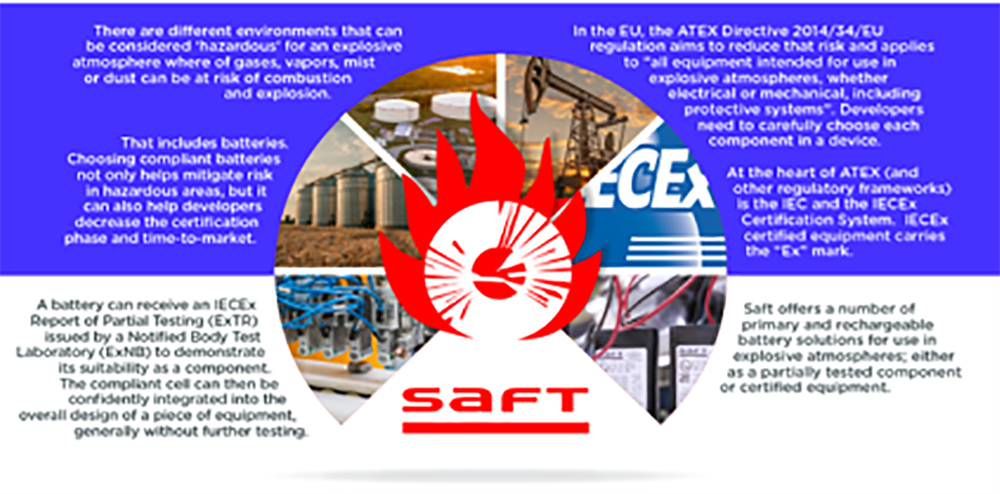
Saft offers a number of solutions for use in explosive atmospheres; either as a partially tested component or certified equipment. The company has clients who use its M 20 Ex SV cells in fuel tanker tracking, and another who uses its LS 17500 cell in smart sensors for storage terminals in ATEX environments.
One further advantage of Saft batteries is the long lifetime, reducing the need for frequent replacement in remote or hard-to-reach locations.
In 2024, Saft also introduced its game-changing ATEX-certified rechargeable batteries. The range, consisting of four medium prismatic (MP) batteries, are of particular interest to those using battery-powered portable tools and devices in the mining, oil and gas, defence, and agricultural industries, and anyone operating in environments that contain specific gases or dusts that can potentially be explosive.

| Tel: | +27 11 466 1156 |
| Email: | info@uniross.co.za |
| www: | www.uniross.co.za |
| Articles: | More information and articles about Uniross Batteries |






© Technews Publishing (Pty) Ltd | All Rights Reserved
 printer friendly version