


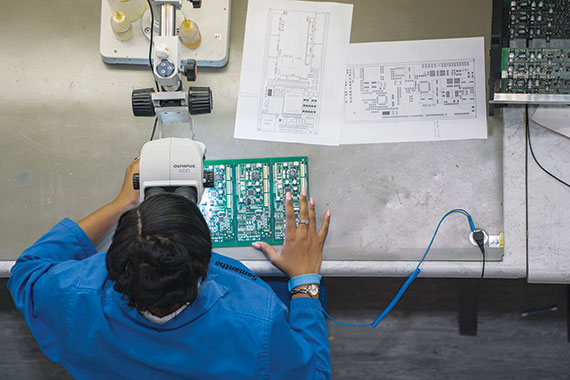
There are several things that can go wrong during the manufacturing process of your design: component shortages, customs delays, and incorrect placement of certain components. These are just to name a few and to quote our technical director, Jacques Klopper, “The devil is in the detail”. You can eliminate these just by tweaking a few main processes from the start. Here are a few pointers to help your Electronics Manufacturing Services (EMS) partner reach your goal and have a smooth experience.
If you’re an OEM (original equipment manufacturer) or an ODM (original design manufacturer), your criteria when choosing EMS partners will probably boil down to three main aspects: price, lead time, and quality.
To obtain a more positive response to those aspects, the three best practices to follow during the quoting (RFQ) stage are:
Know your product forecasts
Always remember that when it comes to manufacturing, the smaller the quantity the bigger the price. If you are able to give your EMS partner a forecast this will be a tremendous help.
Knowing the required quantities, and the timeframe when you need the finished product, will not only assist your EMS partner to get better pricing and lead times from their suppliers, but it will also allow proper planning from the get-go. This will result in an accurate delivery date that can be passed on to the customer.
If you are approaching more consistent, larger volumes for production orders, it will assist the contract manufacturing plan to increase efficiencies whilst reducing supply chain risks.
On the other hand, should the EMS partner be asked to quote multiple quantities with numerous turn times, it could eventually influence the price. Your EMS partner will have to include the extra time just to quote you.
Pay attention to your BOM
If you’re not sure how to prepare a bill of materials (BOM) for a manufacturer, ask your EMS partner for advice. You may already use a software tool that supports some workable options, or your contract manufacturer may also provide you with a template.
One of the major reasons for delays during the RFQ stage is receiving BOMs with errors, incomplete information, obsolete parts, and/or messy formatting. As a result, the manufacturer spends time and resources interpreting, translating and validating BOM data.
This might not seem like a showstopper, but the consequences can be detrimental and this leaves a lot of room for error. It not only delays the RFQ process but can cause a delay in production. Most importantly, the chance of communication breakdown puts your assembly at greater risk of defects.
It will also help to provide more than one approved manufacturer in the BOM. Specifying only one approved manufacturer limits your EMS’s ability to use other equivalent parts for your assembly.
Provide high-quality drawings
Including assembly drawings with your RFQ can make a huge difference. Should the drawing and the eventual BOM not be the same, it could have severe implications such as additional material costs and/or component shortages. Even worse, it could cause a delay in production time.
Any special work instructions you have should also be included with the assembly drawing. The supplier can validate the drawing against the BOM.
Over time, you’ll be able to supply a detailed assembly data pack to reduce defects, costs and production turn time.
In short, if you want a good quality, reasonably priced product in a quick turnaround time, always communicate your assembly requirements more effectively with your EMS partner. The easier the process starts, the smoother it will finish.
At Jemstech we have a value, ‘Team Success’, whereby we consider our customers as part of the team. By following the basic steps above you will help your EMS partner to achieve this fundamental value.
| Tel: | +27 12 349 2492 |
| Email: | [email protected] |
| www: | www.jemstech.co.za |
| Articles: | More information and articles about Jemstech |






© Technews Publishing (Pty) Ltd | All Rights Reserved
 printer friendly version