ESP-DL, recently introduced by Espressif Systems, provides APIs for neural network (NN) inference, image processing, maths operations and deep learning (DL) models. With ESP-DL, developers can use Espressif's SoCs for neural network inference easily and quickly.
Thus far, Espressif’s data show that, in comparison to the company’s ESP32 wireless MCU, when ESP-DL runs on an ESP32-S3 chip the acceleration of a 16-bit detection model is increased by 4,5 times, or 6,25 times in the case of a face recognition model. In addition, the 8-bit face recognition model is 2,5 times faster than the 16-bit model on the ESP32-S3. Furthermore, Espressif offers a tool that can help developers make their own model compatible with the company’s platform.
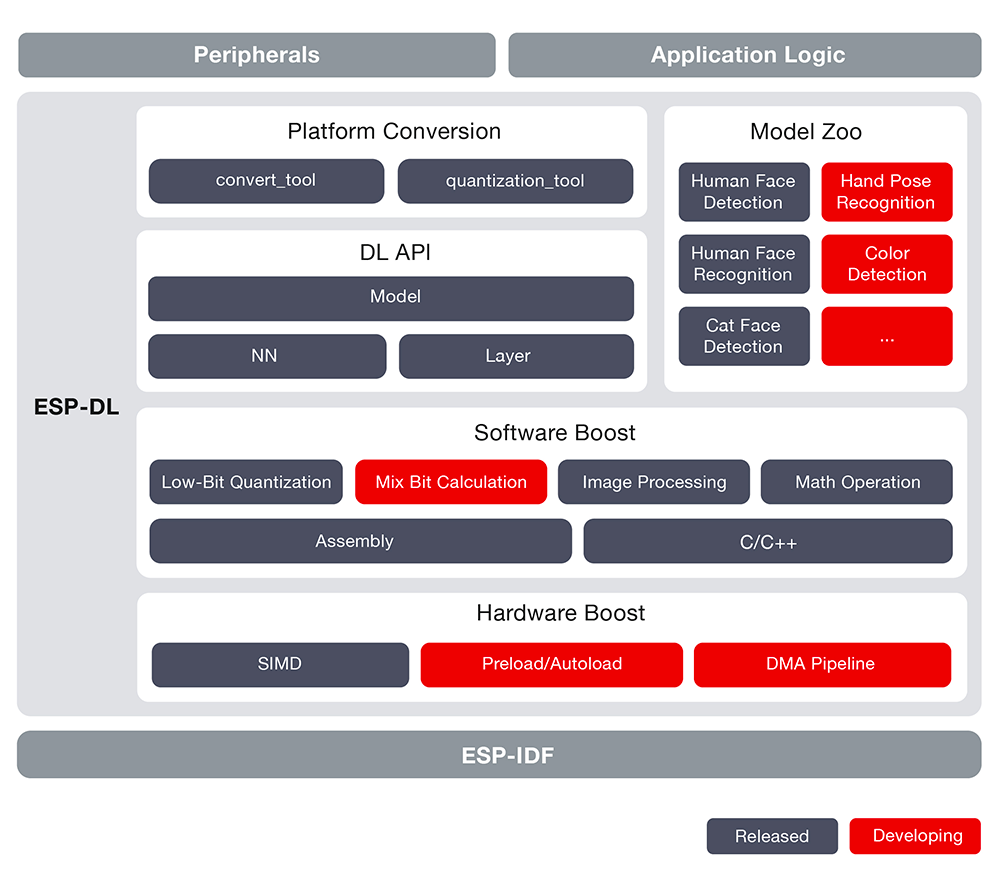
Since ESP-DL does not need any peripherals, it can be used as a project component. For example, if it is added to the esp-who/components/directory, ESP-DL can be used as a submodule of ESP-WHO, which contains several project-level examples of image-based applications. The accompanying figure below shows what ESP-DL consists of and how it is implemented as a project component.
ESP-DL provides tools that can help developers convert their own model (possibly developed with a third-party platform such as TensorFlow, PyTorch, MXNet, etc.) into an 8-bit or 16-bit model and evaluate the performance of the quantised model.
Model Zoo
ESP-DL also provides certain easy-to-use models such as human face detection, human face recognition, cat face detection, etc., in the so-called Model Zoo. These models can be used out-of-the-box. Other models, such as for colour detection and hand-pose recognition, will be released soon.
Customising a model
In the GitHub tutorial entitled ‘How to Customize a Model Step by Step’ you can find all relevant instructions with a runnable example which will help you implement your model quickly and easily.
Variety of APIs
ESP-DL contains sufficient APIs for developers to build their own model, such as neural networks (NN), image processing and matrix operations. Meanwhile, developers can customise layers and provide feedback if they have any special requirements regarding the API utility.
Software and hardware boost
ESP-DL implements quantised computation and brings about a more efficient kind of software by optimising the assembly and architecture of the C/C++ code. It is worth mentioning that the ESP32-S3, with its vector instructions, high-speed SPI interface and configurable cache memory, achieves a much faster acceleration in AI applications.
Wireless connectivity expanded iCorp Technologies
Telecoms, Datacoms, Wireless, IoT
Espressif Systems has introduced two new members of its ESP32 wireless SoC family: the ESP32-E22, the company’s first Wi-Fi 6E connectivity chip, and the ESP32-H21, an ultra-low-power Bluetooth LE microcontroller aimed at coin-cell and battery-powered devices.
Read more...AMD Vivado Design Suite 2026.1
Design Automation
AMD Vivado Design Suite 2026.1 is here and features a new tiered licensing model for greater flexibility, new device support, major NoC and QoR improvements, and ease-of-use enhancements for designing with AMD Versal adaptive SoCs.
Read more...Quectel expands 5G portfolio iCorp Technologies
Telecoms, Datacoms, Wireless, IoT
Quectel expands 5G portfolio with new Qualcomm- and UNISOC-based modules.
Read more...Compact RTK design: More than just the receiver iCorp Technologies
Editor's Choice Telecoms, Datacoms, Wireless, IoT
In practice, engineers building compact RTK products keep discovering the same thing: the hardest component in the system is no longer the receiver. It is the antenna.
Read more...Simplifying RS485 network design iCorp Technologies
Telecoms, Datacoms, Wireless, IoT
Aipu Power has added the RS485-XXXSAV to its transceiver module range, a single-channel isolated RS485 transceiver that bundles power isolation, signal isolation, RS485 interface and bus protection into one drop-in module, aimed at simplifying RS485 network design in industrial equipment.
Read more...SGMICRO expands analogue IC portfolio iCorp Technologies
Passive Components Telecoms, Datacoms, Wireless, IoT
SGMICRO continues to add to its analogue IC portfolio at a steady pace, with new devices released across power protection, power conversion, current sensing and RF signal-chain categories.
Read more...Simplifying system design iCorp Technologies
Telecoms, Datacoms, Wireless, IoT
The FGMC63N tri-band MCU Wi-Fi 6E module from Quectel addresses offers integrated connectivity across 2,4 GHz, 5 GHz, and 6 GHz bands in a compact, highly optimised design.
Read more...Low-power memory born for edge AI iCorp Technologies
DSP, Micros & Memory
As intelligence moves from the cloud to the device, memory become one of the most important design decisions in modern electronics. Edge-AI products – from smart speakers and surveillance cameras to ADAS modules and wearables – need to move data fast, but they also need to sip power. Winbond’s low-density LPDDR4/LPDDR4X SDRAM range is built to strike that balance.
While every effort has been made to ensure the accuracy of the information contained herein, the publisher and its agents cannot be held responsible for any errors contained, or any loss incurred as a result. Articles published do not necessarily reflect the views of the publishers. The editor reserves the right to alter or cut copy. Articles submitted are deemed to have been cleared for publication. Advertisements and company contact details are published as provided by the advertiser. Technews Publishing (Pty) Ltd cannot be held responsible for the accuracy or veracity of supplied material.









 printer friendly version