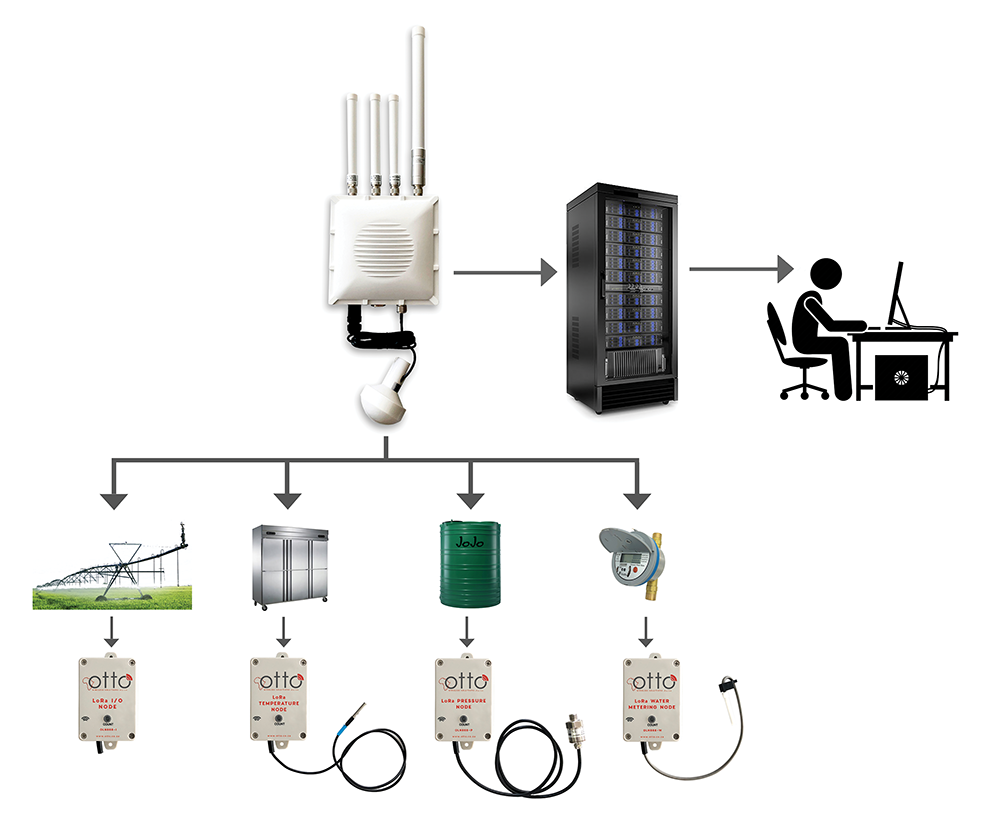
A famous line from a popular book/movie begins, “One ring to rule them all, one ring to find them.” Every engineer knows this is from JRR Tolkien’s ‘Lord of the Rings’. Imagine for a moment that there was one LoRa node capable of finding all the applications out there, going through one gateway to rule them all. The time for imagining is over, because that node now exists.
Introducing the universal LoRa node, OLN868-GP, locally designed and manufactured and ICASA-approved for operation at 868 MHz. This node can be hardware-configured in a variety of ways, with accessories such as a temperature sensor, pressure sensor, water meter probe or simply wires for general I/O – all available once the device has been software-configured accordingly. One piece of hardware, designed logically to cater for a variety of applications.
This, of course, does not resolve the issue of the lack of a LoRa network. This situation is really at the heart of why LoRa has not been adopted in South Africa and why we are lagging behind the rest of the world in this regard. A network requires intimate knowledge of the nodes which will be connected to its server; the protocol needs to be understood in order to enable data to be converted into usable information and the nodes connecting to the network need to be correctly managed so as not to congest the network, or exceed the overall duty cycles in a given area.
In this writer’s opinion, this set of requirements has become a barrier to LoRa adoption in South Africa, because potential service providers have realised they need a means to test and approve hardware devices intended for their networks and need to manage the messaging service in such a way as to ensure an overall quality of service is maintained. But these potential service providers do not supply hardware nodes and are therefore not in control of the configuration of the nodes, which opens their network up to potential abuse.
Through a strategic partnership with a local software services provider, Otto is able to resolve these issues very simply. A sliding-scale setup cost per location, where the setup cost reduces (to zero) as the number of nodes in the area increases, has been introduced and this setup cost and the associated number of nodes covers the initial cost of deploying a gateway, such as the RAK7249-03-142 (pictured), on a high site.
The software services provider then takes over the monthly running costs of the high site and Internet connectivity to the gateway, while providing customers with monthly costing per node, with various messaging packages available. The network is built around customer requirements, should customers wish to engage in such a way. There is no need to pay for the gateway or invest in a backend; your information is presented to you in a simple and usable format.
For customers who prefer to retain full ownership of their entire LoRa network, the same hardware is available for standard purchase and there are no monthly amounts applicable to any local third parties, except, of course, your own hosting and backend server costs. Often, though, these costs are underestimated because most local businesses make use of off-the-shelf third-party solutions which only become economical if one has sufficient economies of scale.
The advantages of LoRa are numerous. The most obvious one is power savings. Provided one is not expecting real-time messaging but is monitoring in real-time and messaging on exception, extremely long battery life can be realised when using low over-the-air baud rates and sending small packets of data. In addition to this, the spread spectrum technology at relatively low frequency lends itself to better ground and wall penetration.
All this makes the technology ideal for applications such as water metering, agriculture, switch control, etc. Consider the sort of setup where multiple individual water meters in a complex are being connected to a backend via a LoRa node and that same type of LoRa node exists elsewhere in the system configured with a pressure sensor that is monitoring and reporting pressure (on exception) at key bulk supply locations. During a water outage the pressure drops and this vacuum sometimes causes the water meter to spin and create a false reading. A spinning meter at the same time as a significant water pressure drop can be correlated and the water meter reading corrected if one’s overall backend has been correctly and intelligently configured.
Utility management on a single hardware and software platform is enabled through the approach we have taken. There is no longer a need for a LoRa gateway to be in the vicinity as a prerequisite. In closing, another application is load-shedding management. And of course, the rest of the opening quote comes to mind: “One ring to bring them all, and in the darkness bind them.” One type of node, configured to monitor the presence of electricity, send a message to a server which is then configured to send a message to the same hardware node elsewhere, which in turn is configured to switch a generator on.
Of course, all of this needs to be done within a low-cost data messaging environment. We believe that the partnerships we have established deliver this, because the nodes going onto the network are known, tested, configured and approved. A simple approach to a complex problem has been implemented. The nodes are low cost as there is one device being manufactured and the server messaging is low-cost because of the economies of scale.
Whether your barrier to making use of LoRa has been availability or the price of nodes and gateways, or the lack of network infrastructure, the solutions to these problems are now available.

The OLN 868-GP universal LoRa telemetry receiver is a base unit used for creating a final LoRa node solution. The base device is non-functional until it is configured and integrated into a final LoRa node via a firmware upload as well as the addition of the applicable sensor. Typical node configurations can cater to applications including, inter alia, water metering, pressure sensing, temperature monitoring and general-purpose I/O.
The base unit has a standard set of technical specs which are common to any configuration:
• Dimensions:
• Mass: 200 g.
• Ingress protection: IP65.
• Operating temperature: -10°C to 50°C.
• Battery: LiOn Li-SOC12 (AA size), non-rechargeable, 2400 mAh, 3,6 V.
• Battery life: >5 years (based on one transmission per day), >3 years for two transmissions per day.
• Operating frequency: LoRaWAN 868 MHz.
• Transmit power: 25 mW (14 dBm).
• Type approval: ICASA TA 2020/5689, ETSI EN300-220 (radio frequency), EN301-489 (EMI/EMC), EN90650 (safety).
• Antenna: Integrated.

The RAK7249-03-142 is an enterprise-grade, DIY outdoor LoRa gateway ideal for commercial loT deployment. It contains the main board, operator-grade waterproof enclosure, backup battery and mounting accessories. The hardware main board completely integrates the Wi-Fi, 4G, GPS and PoE main supply with an integrated back-up battery. The firmware implements a fully featured LoRaWAN-compliant network base station.
The gateway has a range of over 15 km line-of-sight and over 2 km in dense urban environments and is backed by Otto Wireless Solutions’ flexible development support structure which allows for faster development and time to market. The company offers both a ready-to-go firmware image for OpenWrt-based platforms and an open SDK for integration into hardware to support the needs of each customer.
Product features:
• Enterprise-grade network gateway with your own configuration.
• LoRaWAN stack inside and integrated web UI for management.
• Complete hardware specification including LoRa concentrator, cellular, GPS and Wi-Fi.
• Supports power over Ethernet (PoE) IEEE 802.3af/at, Class 4, 48 V.
• Battery backup sustains operation for five hours under typical conditions.
• IP67 waterproof enclosure with cable gland.
| Tel: | +27 11 791 1033 |
| Email: | [email protected] |
| www: | www.otto.co.za |
| Articles: | More information and articles about Otto Wireless Solutions |






© Technews Publishing (Pty) Ltd | All Rights Reserved
 printer friendly version