


As system requirements become more stringent in terms of power and/or signal integrity, designers of electronic systems may need to look at different methods for keeping things cool. Over and above simply selling connectors, Samtec continually generates supporting content to help designers at all levels to create optimal interconnect solutions.
A broad understanding of thermal management – encompassing traditional air cooling, localised spot cooling and full immersion cooling techniques and impacts – is provided by the video at www.dataweek.co.za/*apr22-samtec, parts of which the company presented at SuperComputing 2021 and demonstrated at DesignCon 2022.
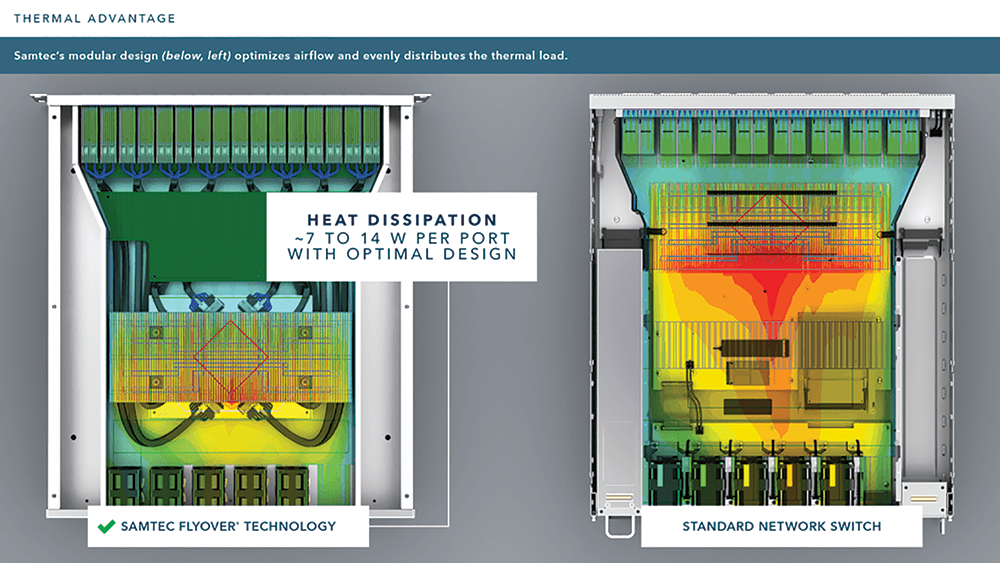 Samtec’s modular Flyover design (left) optimises airflow and evenly distributes the thermal load.
Signal integrity versus power integrity
As part of its immersion cooling considerations, Samtec addresses the current-carrying capacity of many product families. In parallel with this, its test lab and signal integrity teams have been tasked with evaluating customers’ thermal design requests as part of its efforts to ensure that it considers the full signal path and how its connectors play a part in that.
Only focusing on mitigating thermal considerations in one area risks setting customers up for a new challenge farther down the path. When merely seeking to push higher current, some mitigation techniques may be more palatable, however, in applications that move more power there is typically a higher data rate to go with it. Each technique can come at a higher cost to losses in the signal path.
Thermal modelling
There are several factors that Samtec takes into consideration when thermal modelling a product or system. When considering the thermal performance of a system, the company factors in power density, device thermal resistance, total power entering the system, system airflow and system impedance (pressure drop through the box).
It goes without saying that size, weight and cost are also important considerations for the designer at the package and device level, as they will all affect the thermal performance of the system. For example, in heatsinks, aluminium is a natural choice for its ease of manufacturing, cost-effectiveness and heat transfer properties.
Furnished with this information, Samtec can provide a solution for a customer’s system at the package and device level, in the form of customised heatsinks, conductive greases/films and/or heat spreaders. At the system level, the company can assist with the sizing of baffles/plenums, fans and/or fan placement, optimising component location and recommending heat pipes and vapour chambers that will best suit the application. Looking at the component level, thermal models for its connectors under specific conditions can be provided.
Picking the right component
This may be the most basic way to prevent some issues in a system design. Make sure that the connector you are choosing can handle the fully powered system. The cross-sectional area of the contacts, or the wire gauge, may be a limiting factor.
As new chips are introduced or as systems are upgraded, the demands on a current-generation connector may be too much.
Ohm’s Law tells us that increasing the resistance chokes off higher power and creates a hot spot. This is one way that a passive component can contribute to generating heat in the system.
Samtec specifies the current-carrying capacity on all products as part of its standard design verification test. Customers can download the test reports from the product series pages and see very quickly if that connector family will work for them.
Samtec Flyover cables
Moving heat-generating components around in the system is another way to help with thermal management. Increasing airflow helps in general, but strategically aiming that airflow can make it that much more efficient. Moving a component farther away may mean longer trace lengths on the printed circuit board, which can introduce more loss to the system. There is thus a trade-off between a few degrees of temperature and more decibels of loss – that lass can be gained back by using Samtec’s Flyover cable solutions.
The Flyover cable has typically triple the reach of a traditional PCB track, making for a compelling product family that can be placed near the chip, near the front panel or near the backplane. This flexibility may allow a designer to rearrange their system to be more efficient without losing signal integrity.
Full system architecture changes
A much larger leap when it comes to thermal management considerations is to introduce immersion cooling, which Samtec has been studying the effects of on its connectors.
Power integrity has the largest impact, with a fivefold improvement to current-carrying capacity.
This will have adverse effects on some connectors that arise from replacing the air gaps found inside most interconnects with cooling liquid. This change in the dielectric constant – from 1 for air to around 2,1 for cooling liquid – can change some of the losses through the channel. In many cases there are accommodations that can be made, but as speeds increase these effects may become greater and require specialised interconnects and components.
Other types of interconnects will be less affected, like Samtec’s FireFly mid-board fibre-optics. This sealed system and the conversion to fibre-optics create a very appealing immersion cooling option.
| Tel: | +27 11 425 1400 |
| Email: | sales@spectrumconcepts.co.za |
| www: | www.spectrumconcepts.co.za |
| Articles: | More information and articles about Spectrum Concepts |






© Technews Publishing (Pty) Ltd | All Rights Reserved
 printer friendly version