


Industrial revolutions are like buses – you wait for ages and then two arrive, one after the other. We’ve been talking about Industry 4.0 for about 15 years, a concept that uses automation and machine communication to create the smart factory. But now there is a new game in town. Industry 5.0 was first defined by the European Union in January 2022 as a new way of integrating automation and humans into the workplace. The goal is to create a process which benefits both the workforce and the business.
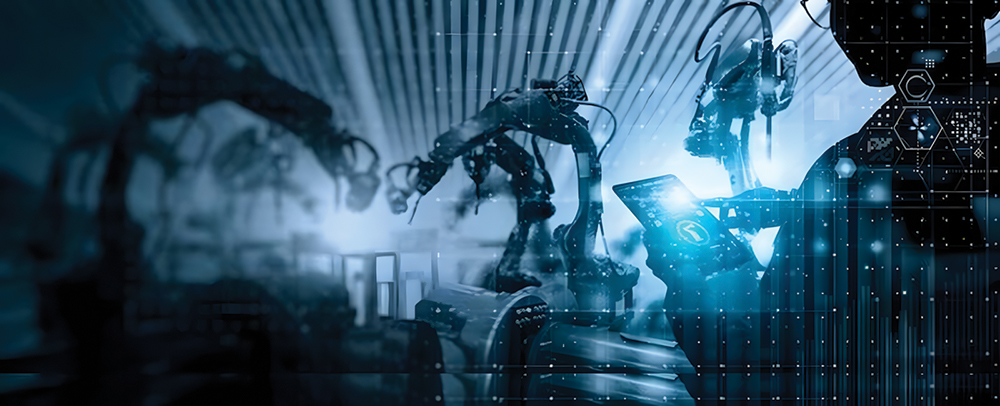
Industry 4.0 earned its label because it has been described as the fourth industrial revolution. The industrial world has employed robots for many years to perform tasks with great precision. Industry 4.0 links robots and all other machines on the production line into a network. The network shares information to create a real-time simulation of the factory. The result is the smart factory, which can respond to new circumstances far more quickly than traditional technologies.
It does not matter how smart the smart factory is, robots are still only as clever as the programming they receive. They are great in a structured environment, but they find it difficult to cope with an unusual situation. Something unexpected can bring production to a halt. In a recent interview, Samtec’s distribution partner Mouser talked to Erik Nieves of Plus One Robotics. Erik explained the situation perfectly: “When a robot stops, it’s not broken – it’s confused.”
Industry 5.0 – The Fifth Industrial Revolution
The next step change in the manufacturing world is Industry 5.0 which places a human operator at the heart of the smart factory. Adding a human worker into the production line is a concept known as supervised autonomy; machines handle routine tasks with greater accuracy than the human operator. But when an unusual situation arises, the human operator can step in, using intuition and lateral thinking to overcome potential stoppages before they become a problem. This ability to adapt, react, and learn creates a resilient working environment.
This focus on the human worker encourages companies to make the most of their people. Industry 5.0 uses automation and AI as tools to enhance workers’ effectiveness, not to replace them. Machine learning can adapt quickly to new situations, but the technology still requires data to provide the lessons. The human brain can find solutions by using lateral thinking and imagination, even in situations it has never encountered before. We cannot yet program machines with the same level of experience.
Industry 5.0 will also emphasise sustainability. The manufacturing industry can play a key role in reducing our dependence on resources. The human in the workplace provides the flexibility to develop new ideas for the efficiency and responsible use of resources that machines cannot replicate.
But in Industry 5.0, sustainability goes beyond the immediate need for efficiency. It is founded on the idea that the wellbeing of human operators has a direct impact on productivity. Making humans central to industry, and allowing them to use their experience, creates a more engaging and rewarding workplace. Automation reduces their workload and creates long-term wellbeing and a more sustainable industry.
Industry 5.0 will share much of the same technology as the current generation of industry automation equipment. However, there are many strategies that will achieve the goal of a resilient and sustainable production line. Industry 5.0 could see humans working alongside robots, people in a supervisory role, or even the use of technology to enhance a worker’s own capabilities.
Edge computing will form an important element in Industry 5.0. Autonomous robots use a range of sensors including LIDAR to navigate around the factory floor, and will need high-speed, low-latency computing power to provide split-second decision making. Samtec is actively developing solutions for edge computing and EdgeAI.






© Technews Publishing (Pty) Ltd | All Rights Reserved
 printer friendly version