

Manufacturing / Production Technology, Hardware & Services


Solar to the rescue amid Eskom tariff hikes

29 November 2024 Manufacturing / Production Technology, Hardware & Services

South Africans are starting to feel the pinch of the 12.7% electricity tariff increase, which came into effect on 1 July, the latest in a raft of double-digit hikes in recent years. In addition, City of Johannesburg residents who use prepaid meters now have to contend with a new R230 (including VAT) fee for network and service charges, irrespective of the number of units purchased.

Although the recent reprieve from loadshedding has given consumers some relief, high electricity prices are likely to continue for some time, with many expecting tariffs to double over the next five years. Localised outages, whether through ordinary faults or cable theft, are still a common occurrence, and until Eskom’s long-term issues are fully resolved, there’s still a possibility that intermittent loadshedding could return.

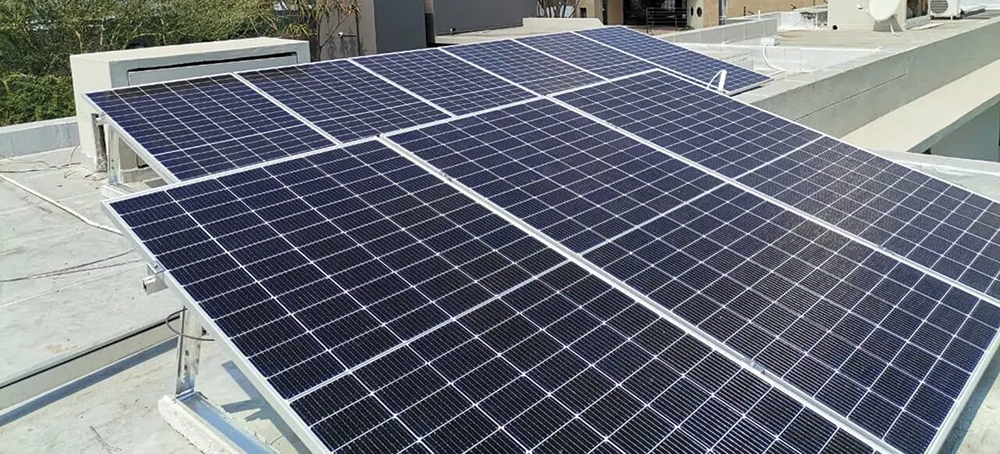
The decision to switch to solar energy is a sensible one to make, now more than ever. A good starting point is understanding how solar technology contributes to overall energy efficiency in residential homes. Foremost in most South African consumers’ minds is the reduction in electricity bills that solar power can provide. According to an economic bulletin published by the South African Reserve Bank, Eskom’s electricity tariffs have increased by around 450% since 2008, a figure that exceeds inflation by a substantial margin. The use of solar energy reduces the need for electricity from the grid, leading to significant savings on energy bills. Solar power also boosts a home’s energy independence by enabling homeowners to produce their own electricity as a safeguard against inevitable future tariff hikes. Residential solar power also supports the much broader goal of decreasing the country’s dependence on fossil fuels, a major contributor of the greenhouse gas emissions associated with climate change.

The news that solar panels will now incur a 10% import tax, in an effort to prioritise supporting the local market demand, may have some worried about the overall affordability of switching to solar. As a homegrown South African business, Versofy SOLAR has long championed local manufacturers. However, until local companies can compete with international manufacturers on a cost, quantity and quality perspective, it may be some time before the 10% import tariff achieves the desired effect. Versofy SOLAR remains committed to using the most trusted components and verified installers. The good news is that, in general, the cost of solar PV panels decreases more than 10% each year. In contrast, Eskom increases prices at a similar rate.

Of course, one of the major challenges to the mass adoption of rooftop solar power is the initial capital costs required to buy a solar system outright, which excludes many South African households from benefitting from solar power and the associated cost savings. This is where rent-to-own and Solar as a Service can help as it allows households to avoid the high upfront costs of solar equipment. Instead of purchasing a solar system outright, consumers have the option to pay a fixed monthly amount for the solar energy system to operate on their property, where everything, from installation to support, is covered in a monthly fee – making solar energy much more affordable and accessible for more people.

Beyond the immediate cost savings, we are quickly reaching the point where homes equipped with solar solutions are more economically viable than those without. Solar power adds to a property’s resale and rental value. While the exact resale value of a property depends on several factors, enhancing a property’s sustainability credentials not only reduces running costs but also increases its market appeal over the long term.

Forward-thinking solar providers are constantly looking at ways of enhancing and extending their offerings to value-added services that optimise a home’s energy consumption and solar energy utilisation. Installing a solar system is always a significant decision, making it essential to choose a knowledgeable and supportive solar provider who has an established track record and expertise, from recommending the right solar system and installation to post-installation support.

Ultimately, switching to solar energy is the most practical response to escalating electricity tariffs, and it has the added benefit of being an investment in a more sustainable, independent, and cost-effective future.




Share this article:
Share via emailShare via LinkedInPrint this page

Further reading:

The impact of harsh environments and ionic contamination on post-reflow circuit assemblies
MyKay Tronics Manufacturing / Production Technology, Hardware & Services
There is well documented historical proof that post-reflow circuit assemblies, when subjected to harsh environments, are particularly vulnerable to failure mechanisms, but modern electronic assemblies are far more susceptible to this phenomenon.

Read more...
Engineering copper grain structure for high-yield hybrid bonding in 3D packaging
Testerion Editor's Choice Manufacturing / Production Technology, Hardware & Services
The way copper grains are sized and distributed forms the metallurgical foundation of hybrid bonding, enabling lower bonding temperatures, greater reliability, and stable grain structures throughout integration.

Read more...
Understanding solder dross: causes and control strategies
Truth Electronic Manufacturing Editor's Choice Manufacturing / Production Technology, Hardware & Services
Dross formation is an inevitable consequence of wave soldering. It occurs when molten solder comes into contact with oxygen, forming metal oxides that float on the surface of the solder bath. Over time, this oxidation byproduct accumulates and must be removed to maintain solder quality and process consistency.

Read more...
Non-destructive techniques for identifying defects in BGA joints – TDR, 2DX, and cross-section-SEM comparison
MyKay Tronics Manufacturing / Production Technology, Hardware & Services
This whitepaper reports the results of a comparison of the following techniques: TDR, automatic X-ray inspection (AXI), transmission X-ray (2DX), cross-section/SEM, and Dye & Pry.

Read more...
Implications of using Pb-free solders on X-ray inspection of flip chips and BGAs
MyKay Tronics Manufacturing / Production Technology, Hardware & Services
With the move to Pb-free soldering, most of the attention has been paid to reflow temperatures, component compatibility, and reliability concerns, but the implications for inspection, particularly X-ray inspection, are equally important and often underestimated.

Read more...
The causes of solder balls in robotic soldering
Manufacturing / Production Technology, Hardware & Services
Solder balls (also known as solder splatter) are a major concern in many production sites as they may potentially cause shorts, leading to long-term impacts on product reliability.

Read more...
Material challenges for superconducting quantum chips
Manufacturing / Production Technology, Hardware & Services
To achieve the scalable and repeatable production of superconducting circuits for quantum technology products, players in the industry are leveraging semiconductor fabrication techniques.

Read more...
UV curing oven for high-efficiency PCB production
Techmet Manufacturing / Production Technology, Hardware & Services
The jCURE-2UV+ from JTU is a cutting-edge ultraviolet curing oven engineered for fast, reliable curing of UV-sensitive coatings in SMT production environments.

Read more...
Automatic stencil cleaning
ZETECH ONE Manufacturing / Production Technology, Hardware & Services
The MBtech N29 series delivers high-precision stencil cleaning with a focus on efficiency, economy and the environment, and is ideal for SMT adhesive and solder paste stencil maintenance.

Read more...
Versatile wave soldering
MyKay Tronics Manufacturing / Production Technology, Hardware & Services
The EMST Stallion fc - PLC is a highly capable wave soldering machine engineered for precision and productivity in electronics manufacturing.

Read more...


While every effort has been made to ensure the accuracy of the information contained herein, the publisher and its agents cannot be held responsible for any errors contained, or any loss incurred as a result. Articles published do not necessarily reflect the views of the publishers. The editor reserves the right to alter or cut copy. Articles submitted are deemed to have been cleared for publication. Advertisements and company contact details are published as provided by the advertiser. Technews Publishing (Pty) Ltd cannot be held responsible for the accuracy or veracity of supplied material.


© Technews Publishing (Pty) Ltd | All Rights Reserved