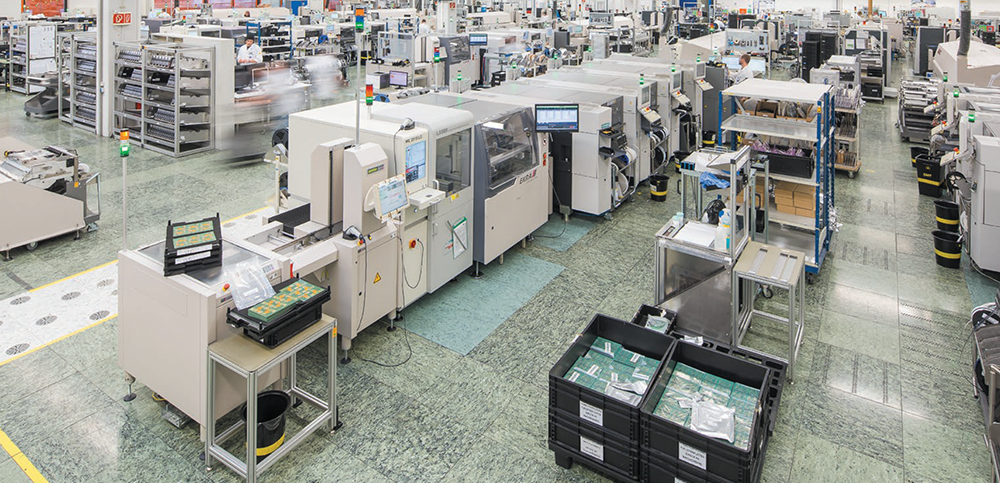
BMK is a leading provider of electronic engineering and manufacturing services (E2MS) for the entire lifecycle of assemblies. The service portfolio includes the development, manufacturing and end-of-life management of electronic assemblies and finished units for customers in the industrial, energy, vehicle, telecom and medical sectors. Headquartered in Augsburg, Germany, BMK’s worldwide operations include facilities in the Czech Republic, Israel and China.
As a pioneer in the field of manufacturing automation, BMK was recently awarded Germany’s Digital Champion Prize by Focus Money Magazine for the industrial sector, based on its commitment to digitally transforming operations, business models and company culture.
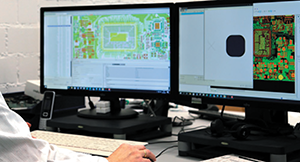
Robert Rudolph, BMK’s head of process enhancement and senior new product introduction (NPI) project leader, explains, “At BMK, we use our experience and enthusiasm to provide our customers with best-in-class design, manufacturing services, and much more; to offer them an extraordinary companion to surpass their expectations. Our emphasis on digitalisation has enabled us to realise this vision.”
Given the industry trend toward high-mix, low-volume production, BMK faces the challenge of fulfilling more frequent NPIs and engineering change orders (ECOs) while attempting to increase efficiency and maintain profitability levels. To accomplish this, BMK expanded its digitisation efforts to include manual manufacturing processes.
BMK, a regular participant in Valor software product user round table meetings, sponsored by Siemens and its regional partner, CircuitByte, was able to consult with other printed circuit board (PCB) assembly specialists on how to improve operational efficiency via automation. During these meetings, Siemens and CircuitByte offered to replace BMK’s legacy Unicam NPI tool with its state-of-the-art Valor Process Preparation software. “Unicam is an outstanding tool, but the decision to adopt the Valor system was a no-brainer because of its extensive NPI feature set and comprehensive parts library,” says Rudolph.
The Valor solution Valor Process Preparation, which is part of the Xcelerator portfolio, the comprehensive and integrated portfolio of software and services from Siemens Digital Industries Software, was integrated by BMK into its process flow to perform the following functions:
• Stencil data generation.
• Creation of surface mount technology (SMT) machine programs.
• Generation of manufacturing documents.
• Validation of components using the Valor Parts Library (VPL).
According to Rudolph, using Valor Process Preparation provides added value as a reverse-engineering tool. “With Valor Process Preparation we can generate the missing CAD data from Gerber files and then import accurate physical models of the electronic components from the VPL database. These are capabilities that we have not had before Valor Process Preparation.”
“Due to our experience, we create the stencil data to reach a higher quality level for the SMT process. With the Valor Stencil session, we improved this data prep process so that we can now generate this data quicker and more automatically. The challenge is to obtain an identical footprint for all instances of a specific component that is to be mounted on the board.”
“Now using the Valor Stencil module, we check a footprint only once and use that same footprint for all instances of the component. The Valor Stencil module lets us create our own footprint database, and the footprints from previous assemblies are re-used in new projects, saving a lot of time,” added Rudolph.
In addition, BMK decided to adopt Valor BOM Connector for improving the bill-of-materials (BOM) preparation process. “BOM Connector is the most complete tool on the market for electronic manufacturing, greatly easing the tasks of loading, preparing, scrubbing, formatting, checking and comparing BOM data,” says Rudolph.
“Another benefit is that you can create more accurate quotes much quicker and provide a powerful database backend to track and re-use your work for future projects.”
Results
Following the introduction of the Valor systems at BMK, the company noted many improvements, including BOM quotes were more accurate and much faster, stencil preparation was 30% quicker, layout errors and incorrect assemblies were increasingly identified before the production stage and the entire SMT process was accelerated by 10%.
Further, the company had the ability to run the increasing number of NPIs in less time. The company grew without adding staff and had the ability to run high-complexity NPIs.
To access the complete case study, visit www.dataweek.co.za/*mar25-cs
| Tel: | +27 11 315 8316 |
| Email: | [email protected] |
| www: | www.asic.co.za |
| Articles: | More information and articles about ASIC Design Services |






© Technews Publishing (Pty) Ltd | All Rights Reserved
 printer friendly version