

Analogue, Mixed Signal, LSI


What is horizontal convection reflow technology?

21 February 2007 Analogue, Mixed Signal, LSI

Leading up to the development of lead-free soldering alloys, Novastar developed ‘horizontal convection’ for the soldering reflow process. Novastar has pioneered innovations such as baffle-free solder pots, high efficiency preheaters, exchangeable heater technology, efficient low cost forced-air systems and now, its horizontal convection reflow oven technology can deal with the precise profiles required by lead-free solders.

Getting the correct temperature profile, with the narrow process window in lead-free applications is now more important than ever. In each chamber or 'zone', air is circulated toward one side of the oven above the PCB and toward the opposite side of the oven below the PCB, forming a 'cyclone' around the board (Figures 1 and 2). This forced air circulation results in a uniform temperature profile along the entire circuit board assembly. This technology is ideal for the precise profiles needed for lead-free soldering.
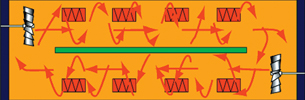
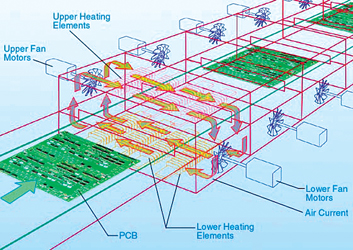
Figure 1. Cross-section of a 1200HC horizontal convection oven. The air is recirculated within the confines of each chamber

Figure 2. By controlling the air flow around the board by having consistent temperature, air pressure, air velocity, volume and direction across the board, temperature uniformity is ensured

Horizontal convection defined

* The main difference between horizontal convection and traditional oven technology:

In traditional reflow ovens, air currents are introduced vertically from above and below on the PCB while in horizontal convection, air is circulated horizontally in one direction across the top of the board and in the opposite direction beneath the board. This is key. This prevents hot spots and because of this parallel 'angle of attack' the air stream's ability to infiltrate the spaces underneath component bodies such as BGAs and J-leaded devices is enhanced. Temperatures across the entire PCB front to back are thus virtually identical (Figure 3).
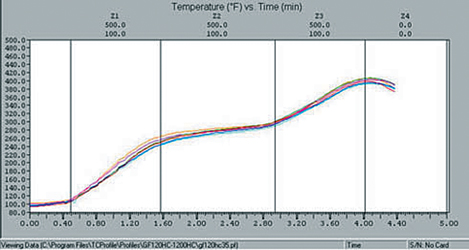
Figure 3. Graph shows the profile taken in a 1200HC 3-Zone oven showing actual board temperatures recorded with 6 thermocouples evenly positioned across the board

* Lower overall equipment cost and operation cost:

Because the horizontal convection system requires neither plenum nor air re-introduction apparatuses, it is (due to its simplicity) more reliable and less costly. There is no need for costly flux management systems as there is no sticky flux residue in the oven. This greatly reduces the need for constant cleaning, maintenance and servicing.

* Eliminates hot spots across the board:

By controlling the air flow around the board by having consistent temperature, air pressure, air velocity, volume and direction across the board, temperature uniformity is ensured. The top and bottom of the board receive the air from the outsides toward the centre, which acts to counter the centre hot-spot/cool-outside condition (Figure 3). This minimises thermal stress to PCB materials and components.

* No flux management system is needed:

There is no flux residue because the air is recirculated within the confines of each chamber. Chambers each contain all the elements needed to be self-sufficient: heating elements, fan blades, inert gas suffusers and exhaust ports. The air never comes into contact with cooler surfaces and thus does not condense anywhere within the oven.

* Uses less nitrogen in inert atmosphere applications:

An advantageous side-effect of the system is an ability to produce low oxygen ppm (parts per million) levels when purging with inert gas, because the volume of space to be affected includes only the confines of each chamber. In traditional oven design, by contrast, the chamber as well as the upper and lower plenums must be purged.

* The best profiles!

There are multiple reasons for this claim. Heated air within each zone is extremely controllable and precise. Temperatures across the board are uniform with no hot spots because air is circulated horizontally in a circular or 'cyclone' motion around the PCB. Temperatures across the entire PCB front to back are virtually identical.


Credit(s)


Share this article:
Share via emailShare via LinkedInPrint this page

Further reading:

Smart IMU for high/low-g acceleration
Altron Arrow Analogue, Mixed Signal, LSI
The ISM6HG256X is a 6-axis intelligent inertial measurement unit that enables smart motion sensing, edge computing, and real-time awareness.

Read more...
Compact Schottky diodes increase efficiency
RS South Africa Analogue, Mixed Signal, LSI
Gen 3 SiC Schottky diodes from Vishay in the compact SlimSMA HV package increase efficiency while enhancing electrical insulation.

Read more...
Silanna launches Plural ADC EVKs
Analogue, Mixed Signal, LSI
Silanna Semiconductor has released its first evaluation kits for the Plural data converter family to offer the fastest, most cost-effective way to evaluate and deploy high-performance ADCs.

Read more...
High speed, low noise 2 A driver
iCorp Technologies Analogue, Mixed Signal, LSI
The SGM8423-2A from SGMICRO is a high efficiency, class AB, low distortion power line driver optimised to accept a signal from a Power Line Carrier modem.

Read more...
Online sensor technology hub
Analogue, Mixed Signal, LSI
Mouser’s sensor content hub offers an extensive collection of articles, blogs, eBooks, and product information from its technical experts and leading manufacturing partners.

Read more...
Ultra-low power MEMS accelerometer
Altron Arrow Analogue, Mixed Signal, LSI
Analog Devices’ ADXL366 is an ultra-low power, 3-axis MEMS accelerometer that consumes only 0,96 µA at a 100 Hz output data rate and 191 nA when in motion-triggered wake-up mode.

Read more...
BT Audio 4 Click board
Dizzy Enterprises Analogue, Mixed Signal, LSI
The BT Audio 4 Click board from MIKROE provides high-quality wireless audio streaming and data comms over Bluetooth.

Read more...
Precision MEMS IMU modules
Altron Arrow Analogue, Mixed Signal, LSI
The ADIS16575/ADIS16576/ADIS16577 from Analog Devices are precision, MEMS IMUs that includes a triaxial gyroscope and a triaxial accelerometer.

Read more...
MEMS with embedded AI processing
Altron Arrow Analogue, Mixed Signal, LSI
STMicroelectronics has announced an inertial measurement unit that combines sensors tuned for activity tracking and high-g impact measurement into a single, space-saving package.

Read more...
High-performance IMU
RS South Africa Analogue, Mixed Signal, LSI
TDK Corporation has announced availability of the new InvenSense SmartMotion ICM-536xx family of high-performance 6-axis IMUs.

Read more...


While every effort has been made to ensure the accuracy of the information contained herein, the publisher and its agents cannot be held responsible for any errors contained, or any loss incurred as a result. Articles published do not necessarily reflect the views of the publishers. The editor reserves the right to alter or cut copy. Articles submitted are deemed to have been cleared for publication. Advertisements and company contact details are published as provided by the advertiser. Technews Publishing (Pty) Ltd cannot be held responsible for the accuracy or veracity of supplied material.


© Technews Publishing (Pty) Ltd | All Rights Reserved

