


Since the early days of serial wired communication in the 1980s, engineers have faced a stubborn challenge: channels that naturally degrade signals. Real-world cables are not perfect; they attenuate high frequency components, introduce distortion, and, over long distances, can significantly slow or corrupt data.
While error correction techniques like CRC can help recover damaged information after the fact, a more powerful approach is to treat the cause rather than the symptom. That is where pre-emphasis and equalisation come in. Though they address the same problem, they operate on opposite ends of the communication link and offer different trade-offs. Understanding how each works, and when to use one over the other, is critical when designing reliable high-speed systems.
Equalisation: Fixing the signal at the receiver
Equalisation is a receiver based strategy that focuses on undoing the distortion caused by the cable. The idea is elegant: if the channel behaves like a low pass filter, then apply a compensating high pass-like filter at the receiver to restore the original waveform. In an ideal case, these two effects would perfectly cancel, leaving behind a clean signal.
In practice, however, the channel’s behaviour must be known or estimated. To accomplish this, systems often send a known preamble before the data. By observing how this preamble becomes distorted, the receiver can approximate the channel response and set the equalisation filter accordingly. Although this method significantly improves bit error performance, it depends heavily on knowing channel characteristics (cable length, data rate, and network topology) and recalibration may be required if any of these values change.
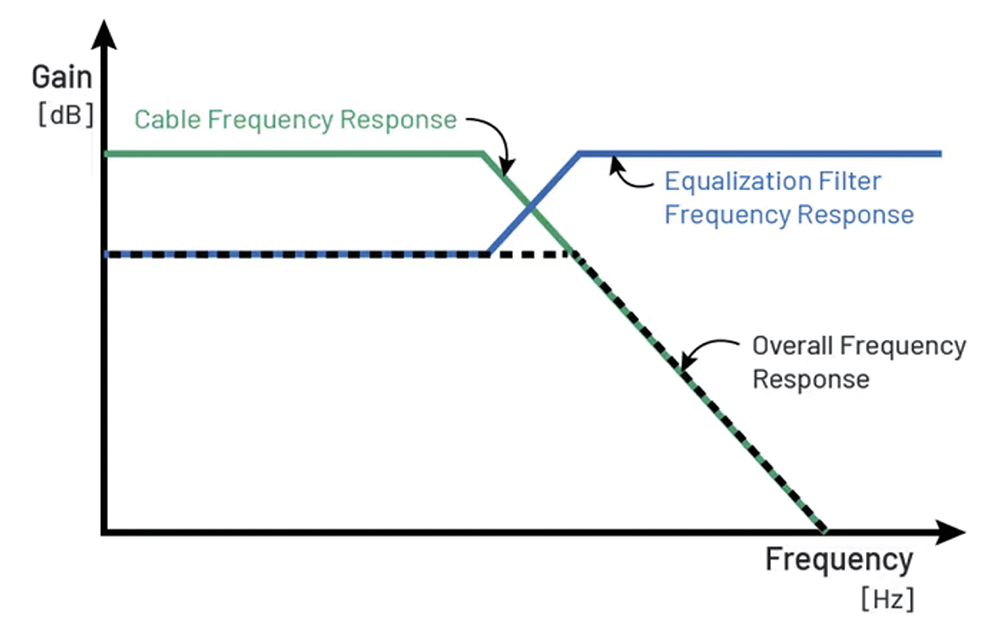 Figure 1. Example of equalisation in the frequency domain [Analog Devices].
Pre-emphasis: Preparing the signal before sending
Pre-emphasis tackles the same underlying challenge, but from the opposite direction; the transmitter. Since cables attenuate high frequency components the most, pre-emphasis intentionally boosts those frequencies before the signal even enters the wire. As the signal travels, the channel naturally attenuates these boosted components, bringing them back down toward their nominal levels by the time they reach the receiver.
This technique effectively pre-corrects the data, making it much more resistant to the low-pass behaviour of real-world cabling.
Unlike equalisation, pre‑emphasis requires no digital processing and adapts easily to varying data rates and network types.
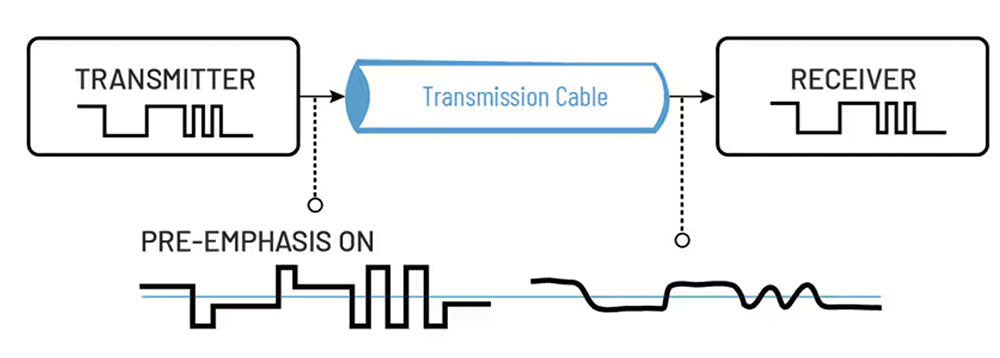 Figure 2. Pre-emphasis filtering in the time domain [Analog Devices].
Which method should be used?
In an ideal world, the best system uses both, complementing each other to maximise robustness: pre-emphasis preserves signal integrity over the channel, while equalisation cleans up any remaining distortion at the end.
In cost-sensitive systems such as RS-485 networks (especially multidrop topologies or installations where cable lengths and data rates vary) you often need to choose one. Here is how they compare:
• Data rate flexibility
Pre-emphasis: Works across any data rate with the same transceiver requiring no changes to the pre-emphasis driver.
Equalisation: Must be designed for a specific data rate. The same filter cannot be used for two different data rates.
• Network topology
Pre-emphasis: Works in both point-to-point and multidrop networks.
Equalisation: Works well on point-to-point networks; difficult to calibrate on multidrop networks where the distances between nodes can vary.
• Cable length variability
Pre-emphasis: Cable length can be anything within a certain range. Longer cable lengths can be dealt with by lowering the data rate.
Equalisation: Needs to be known beforehand, or the filter needs to be calibrated. If the cable changes, the filter needs to be recalibrated.
• Processing requirements
Pre-emphasis: Pre-emphasis is achieved with the transceiver’s
analogue driver, not via digital processing.
Equalisation: While equalisation with analogue circuitry is possible,
it is usually implemented with a digital filter, which means the receiver requires a high-speed ADC, and in more complicated systems, an adaptive digital filter.
• Cost
Pre-emphasis: Lower cost.
Equalisation: Higher cost due to digital processing.
If your system’s cable characteristics, data rate, and topology are fixed, equalisation can be a powerful and cost-efficient enhancement, but if the system needs to remain flexible or operate across varying conditions, pre-emphasis is the more robust and cost-effective choice.
For industrial interfaces like RS-485, cost sensitivity and topology flexibility often make pre-emphasis the more practical solution. Analog Devices offers high-speed RS-485 transceivers with built-in pre-emphasis, including the MAX22500E, capable of achieving data rates up to 100 Mbps, making it ideal for modern, high performance industrial networks.
| Tel: | +27 11 923 9600 |
| Email: | info@arrow.altech.co.za |
| www: | www.altronarrow.com |
| Articles: | More information and articles about Altron Arrow |






© Technews Publishing (Pty) Ltd | All Rights Reserved
 printer friendly version